Review
. 2022 Jun 6;82(11):2057-2065.
doi: 10.1158/0008-5472.CAN-21-3371.

Forkhead Box Transcription Factors: Double-Edged Swords in Cancer

Affiliations
Review

Forkhead Box Transcription Factors: Double-Edged Swords in Cancer

Maria Castaneda et al. Cancer Res. .

Abstract

A plethora of treatment options exist for cancer therapeutics, but many are limited by side effects and either intrinsic or acquired resistance. The need for more effective targeted cancer treatment has led to the focus on forkhead box (FOX) transcription factors as possible drug targets. Forkhead factors such as FOXA1 and FOXM1 are involved in hormone regulation, immune system modulation, and disease progression through their regulation of the epithelial-mesenchymal transition. Forkhead factors can influence cancer development, progression, metastasis, and drug resistance. In this review, we discuss the various roles of forkhead factors in biological processes that support cancer as well as their function as pioneering factors and their potential as targetable transcription factors in the fight against cancer.


Figures

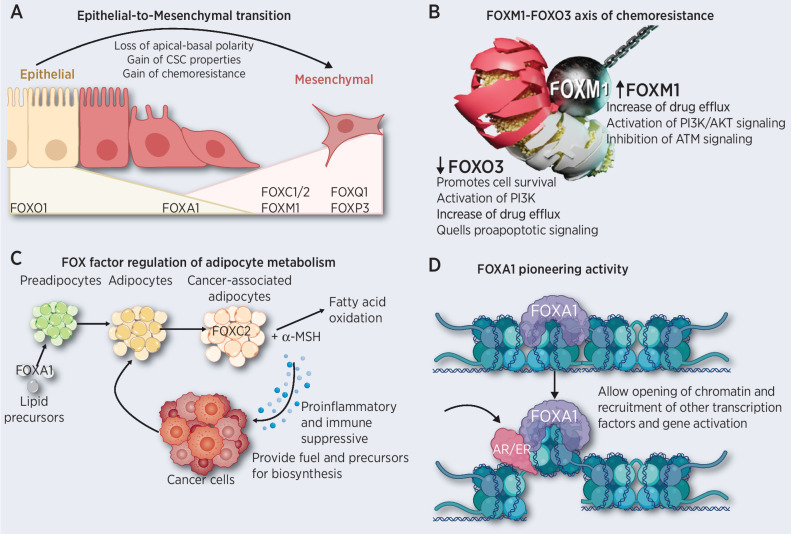
Figure 1. Role of FOX factors in cancer. A, Depiction of the two extreme phenotypes of EMT with the associated physiologic changes and the FOX factors that elicit each phenotype. FOXA1 can induce and inhibit EMT, depending on the cancer subtype. B, Summary of the functions of the FOXO3–FOXM1 axis in drug resistance. A drug-resistant state occurs upon inhibition of FOXO3 or upregulation of FOXM1, often in combination, leading to an increase in prosurvival mechanisms and drug efflux transporter activation. C, Schematic of how FOX factors regulate adipocyte metabolism, creating an immunosuppressive environment. FOXA1 mediates the acquisition of lipid precursors to fuel tumor proliferation. These precursors can become cancer-associated adipocytes expressing FOXC2. The cooperation between FOXC2 and α-MSH to promote fatty-acid oxidation creates an energy source for cancer cells. This creates a feedback loop in which cancer cells signal adipocytes to become cancer-associated adipocytes, and the cycle continues. D, Pioneering activity of FOXA1, a potential mechanism of action of other transcription factors. FOXA1 is capable of binding condensed chromatin to create an opening for easier accessibility of other transcription factors. In this case, FOXA1 allows for the binding of ER or AR to condensed chromatin, thereby activating an altered hormone response in cancer cells.
Figure 1.
Role of FOX factors in cancer. A, Depiction of the two extreme phenotypes of EMT with the associated physiologic changes and the FOX factors that elicit each phenotype. FOXA1 can induce and inhibit EMT, depending on the cancer subtype. B, Summary of the functions of the FOXO3–FOXM1 axis in drug resistance. A drug-resistant state occurs upon inhibition of FOXO3 or upregulation of FOXM1, often in combination, leading to an increase in prosurvival mechanisms and drug efflux transporter activation. C, Schematic of how FOX factors regulate adipocyte metabolism, creating an immunosuppressive environment. FOXA1 mediates the acquisition of lipid precursors to fuel tumor proliferation. These precursors can become cancer-associated adipocytes expressing FOXC2. The cooperation between FOXC2 and α-MSH to promote fatty-acid oxidation creates an energy source for cancer cells. This creates a feedback loop in which cancer cells signal adipocytes to become cancer-associated adipocytes, and the cycle continues. D, Pioneering activity of FOXA1, a potential mechanism of action of other transcription factors. FOXA1 is capable of binding condensed chromatin to create an opening for easier accessibility of other transcription factors. In this case, FOXA1 allows for the binding of ER or AR to condensed chromatin, thereby activating an altered hormone response in cancer cells.

References

    1. Wahba HA, El-Hadaad HA. Current approaches in treatment of triple-negative breast cancer. Cancer Biol Med 12:106–16. - PMC - PubMed
    1. Pan ST, Li ZL, He ZX, Qiu JX, Zhou SF. Molecular mechanisms for tumour resistance to chemotherapy. Clin Exp Pharmacol Physiol 43:723–37. - PubMed
    1. Schnipper LE. American society of clinical oncology statement: a conceptual framework to assess the value of cancer treatment options. J Clin Oncol 33:2563–77,. - PMC - PubMed
    1. Wu S-G, Li H, Tang L-Y, Sun J-Y, Zhang W-W, Li F-Y, et al. The effect of distant metastases sites on survival in de novo stage-IV breast cancer: A SEER database analysis. Tumour Biol 2017;39:1010428317705082. - PubMed
    1. Jackson BC, Carpenter C, Nebert DW, Vasiliou V. Update of human and mouse forkhead box (Fox) gene families. Hum Genomics 2010;4:345–52. - PMC - PubMed

Publication types

MeSH terms

Substances