


Leveraging the potential of machine learning for assessing vascular ageing: state-of-the-art and future research
- PMID: 35316972
- PMCID: PMC7612526
- DOI: 10.1093/ehjdh/ztab089
Leveraging the potential of machine learning for assessing vascular ageing: state-of-the-art and future research
Abstract
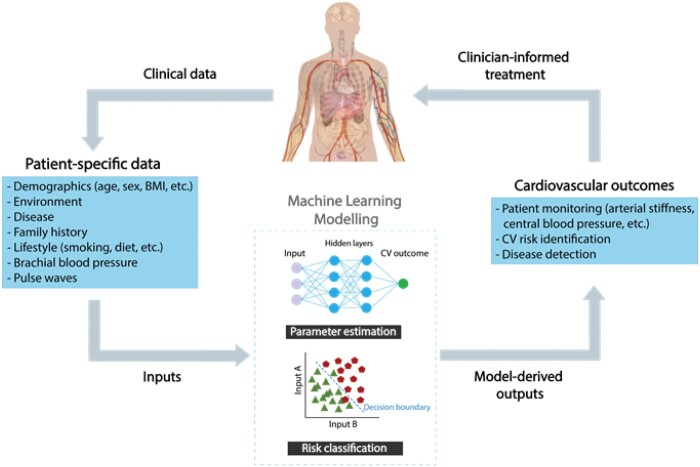
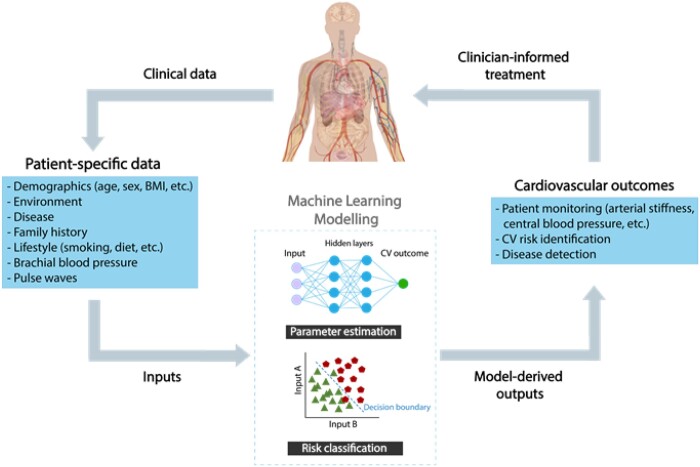
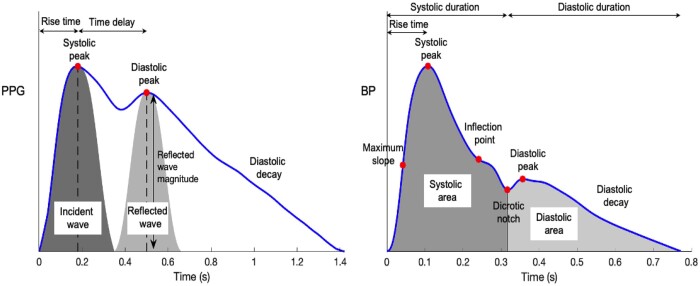
Vascular ageing biomarkers have been found to be predictive of cardiovascular risk independently of classical risk factors, yet are not widely used in clinical practice. In this review, we present two basic approaches for using machine learning (ML) to assess vascular age: parameter estimation and risk classification. We then summarize their role in developing new techniques to assess vascular ageing quickly and accurately. We discuss the methods used to validate ML-based markers, the evidence for their clinical utility, and key directions for future research. The review is complemented by case studies of the use of ML in vascular age assessment which can be replicated using freely available data and code.
Keywords: Arterial stiffness; Blood pressure; Cardiovascular; Central blood pressure; Machine learning; Pulse wave velocity.
Conflict of interest statement
Conflict of interest: none declared.
Figures
 , presence of CV event;
  , absence of CV event. Adapted from: ‘
References
-
- McEniery CM, Yasmin Hall IR, Qasem A, Wilkinson IB, Cockcroft JR. Normal vascular aging: differential effects on wave reflection and aortic pulse wave velocity: the Anglo-Cardiff Collaborative Trial (ACCT). J Am Coll Cardiol 2005;46:1753–1760. - PubMed
-
- Laurent S. Defining vascular aging and cardiovascular risk. J Hypertens 2012;30:S3–S8. - PubMed
-
- Climie RE, Mayer CC, Bruno RM, Hametner B. Addressing the unmet needs of measuring vascular ageing in clinical practice-European cooperation in science and technology action VascAgeNet. Artery Res 2020;26:71–75.
Grants and funding
LinkOut - more resources
Full Text Sources