


Adrenocortical carcinoma: Pediatric aspects (Review)
- PMID: 35317446
- PMCID: PMC8908472
- DOI: 10.3892/etm.2022.11216
Adrenocortical carcinoma: Pediatric aspects (Review)
Abstract
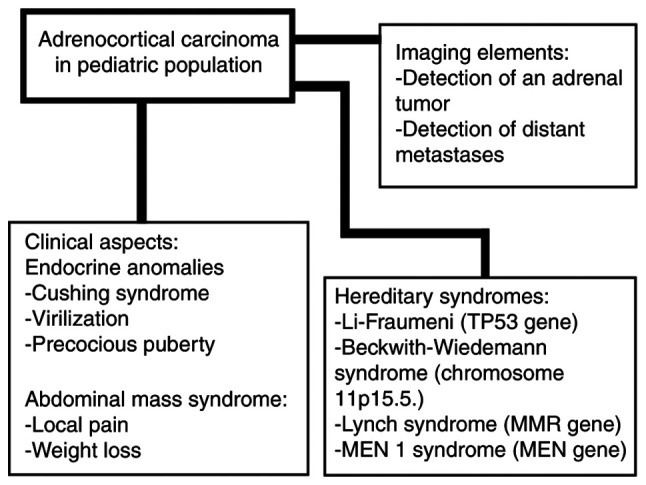
Adrenocortical carcinoma (adrenal cortex-derived cancer), an orphan malignancy, is a very aggressive disease that affects both adults and children with an annual incidence of 1-2 adult and 0.2-0.38 pediatric cases/million (in the pediatric population it represents 0.2% of all cancers), with a female predominance. A total of 80-90% of cases have hormonal imbalances such as Cushing syndrome, virilization, and puberty anomalies. Precocious puberty (PP) of iso- or hetero-sexual pattern is independent of gonadotropin-releasing hormone (GnRH) (high testosterone/estrogens and low FSH/LH) but post-operative activation of GnRH may be expected (central PP). PP is accompanied by accelerated growth while Cushing syndrome by reduced growth velocity. Pure androgen-secreting tumors have been exceptionally described. A total of 50-80% of children have different genetic/epigenetic anomalies involving tumor protein p53 (most often, almost half of the cases; with a population cluster in Southern Brazilian children), insulin-like growth factor, multiple endocrine neoplasia type 1 (MEN1), PRKAR1A, dysfunctional alternative lengthening of telomeres. Hereditary syndromes associated to adrenocortical carcinoma include Li-Fraumeni, Beckwith-Wiedemann, MEN1, and Lynch. Recently, mutations in epidermal growth factor receptor have been reported in teenagers, suggesting the future use of tyrosine kinase inhibitors. Adrenalectomy is the first line therapy offering the best prognosis if complete tumor removal is achieved; genetic testing is recommended before surgery. Adjuvant therapies are less standardized in children (mitotane is a key adjuvant drug in addition with different regimes of chemotherapy such as etoposide, Adriamycin and cisplatin). A Ki-67 value of at least 15% is a predictor of poor outcome. Weiss score also serves as a prognostic factor, as well as the tumor size at diagnosis. The prognosis of adrenocortical carcinoma is poor with an overall 5-year survival rate of 55%; a Weiss score of at least 6 is associated with a 2-year survival rate of 35%. At present, pediatric adrenocortical carcinoma still represents a severe condition that requires prompt intervention and a multidisciplinary team. Further development of molecular markers is required for an improved understanding of the disease thus improving the protocols of approach and the prognostic.
Keywords: Li-Fraumeni syndrome; Weiss score; adrenal cortex; adrenal tumor; adrenalectomy; adrenocortical carcinoma; cortisol; mitotane; pediatric; virilization.
Copyright © 2020, Spandidos Publications.
Conflict of interest statement
The authors declare that they have no competing interests.
Figures
References
-
- Ribeiro TC, Jorge AA, Almeida MQ, Mariani BM, Nishi MY, Mendonca BB, Fragoso MC, Latronico AC. Amplification of the insulin-like growth factor 1 receptor gene is a rare event in adrenocortical adenocarcinomas: Searching for potential mechanisms of overexpression. Biomed Res Int. 2014;2014(936031) doi: 10.1155/2014/936031. - DOI - PMC - PubMed
Publication types
LinkOut - more resources
Full Text Sources
Research Materials
Miscellaneous