Review
. 2022 Jun 21:91:1-32.
doi: 10.1146/annurev-biochem-032620-110705. Epub 2022 Mar 23.

Better, Faster, Cheaper: Recent Advances in Cryo-Electron Microscopy

Affiliations
Review

Better, Faster, Cheaper: Recent Advances in Cryo-Electron Microscopy

Eugene Y D Chua et al. Annu Rev Biochem. .

Abstract

Cryo-electron microscopy (cryo-EM) continues its remarkable growth as a method for visualizing biological objects, which has been driven by advances across the entire pipeline. Developments in both single-particle analysis and in situ tomography have enabled more structures to be imaged and determined to better resolutions, at faster speeds, and with more scientists having improved access. This review highlights recent advances at each stageof the cryo-EM pipeline and provides examples of how these techniques have been used to investigate real-world problems, including antibody development against the SARS-CoV-2 spike during the recent COVID-19 pandemic.

Keywords: SARS-CoV-2; automation; cryo-EM; democratization; in situ tomography; machine learning.


Figures

Figure 1
Figure 1
Electron microscopy (EM) entries in data archives have been growing rapidly. In orange are released EM map entries in the Electron Microscopy Data Bank, in blue are released EM model coordinates in the Protein Data Bank, and in green are raw data sets contributed to the Electron Microscopy Public Image Archive (EMPIAR).
Figure 2
Figure 2
Advances in membrane protein preparation for cryo–electron microscopy (cryo-EM) include the use of various membrane mimetics, such as nanodiscs (green), to prepare membrane proteins, for example, the sugar transferase AftD (red), for cryo-EM imaging (19).
Figure 3
Figure 3
The development of all-gold HexAuFoil grids with small (<0.3 μm) holes dramatically reduced beam-induced motion during imaging. The gold foil and gold mesh reduce foil movement, while the small holes minimize ice movement during electron irradiation.
Figure 4
Figure 4
Advances in cryo–electron microscopy instrumentation and processing recently produced an atomic-resolution map of apoferritin (3), shown here in blue, volume-rendered using PyMOL. The hydrogen difference map (green) shows ordered hydrogens, even on a water molecule (center). Modeled atoms are shown as spheres with bonds as sticks. Carbon is shown in light blue, oxygen in red, nitrogen in dark blue, and hydrogens in white. Image provided by Takanori Nakane.
Figure 5
Figure 5
Data collection algorithms now allow for collection of up to approximately 40 exposures (white boxes) per stage movement by using large beam-image shifts. This reduces the number of slow stage movements and greatly increases data collection speeds.
Figure 6
Figure 6
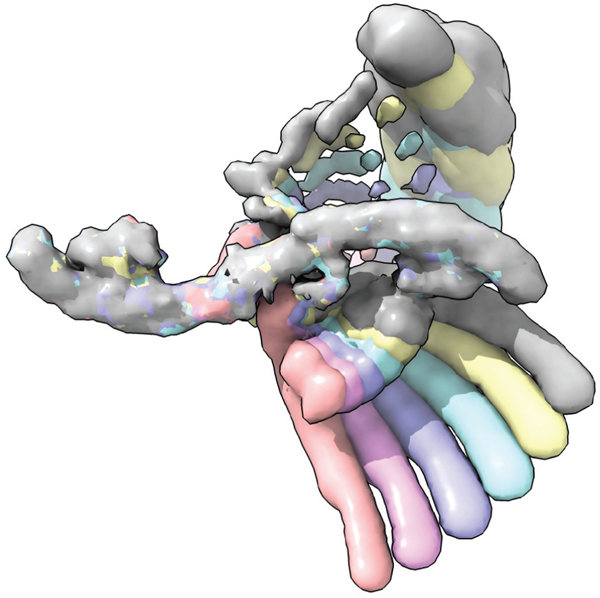
CryoDRGN (114) proposes a deep learning framework for heterogeneous reconstruction that directly learns a continuous representation of 3D density maps without supervision from additional data sets or structures. Shown here are density maps reconstructed by cryoDRGN recapitulating a large continuous motion along a synthetic reaction coordinate. Image provided by Ellen Zhong and rendered with ChimeraX.
Figure 7
Figure 7
Illustration of structures of antibodies (cyan, magenta, and green) targeting the SARS-CoV-2 spike (red) with interfaces highlighted. Advances across the entire cryo-EM pipeline were critical in enabling these structures to be determined in a very short time, thereby contributing to efforts to curb the COVID-19 pandemic.
Figure 8
Figure 8
Schematic depicting lamellae cryo–focused ion beam (cryo-FIB)-milled using the waffle method. By high-pressure freezing then FIB-milling bulk sample on a grid, more and larger lamellae can be made, potentially increasing throughput. Several large (>10 × 10 μm) lamellae are depicted, and the inset shows the relative scale of the lamellae on the grid. Figure adapted from Reference 160 (CC BY-NC-ND 4.0).

References

    1. Cheng Y. 2018. Single-particle cryo-EM—How did it get here and where will it go. Science 361:876–80 - PMC - PubMed
    1. Turk M, Baumeister W. 2020. The promise and the challenges of cryo-electron tomography. FEBS Lett. 594:3243–61 - PubMed
    1. Nakane T, Kotecha A, Sente A, McMullan G, Masiulis S, et al. 2020. Single-particle cryo-EM at atomic-resolution. Nature 587:152–56 - PMC - PubMed
    1. Yip KM, Fischer N, Paknia E, Chari A, Stark H. 2020. Atomic-resolution protein structure determination by cryo-EM. Nature 587:157–61 - PubMed
    1. Zhang K, Pintilie GD, Li S, Schmid MF, Chiu W. 2020. Resolving individual atoms of protein complexby cryo-electron microscopy. Cell Res. 30:1136–39 - PMC - PubMed

Publication types