


Predictors of functional impairment in bipolar disorder: Results from 13 cohorts from seven countries by the global bipolar cohort collaborative
- PMID: 35322518
- PMCID: PMC9500115
- DOI: 10.1111/bdi.13208
Predictors of functional impairment in bipolar disorder: Results from 13 cohorts from seven countries by the global bipolar cohort collaborative
Abstract
Objectives: Persistent functional impairment is common in bipolar disorder (BD) and is influenced by a number of demographic, clinical, and cognitive features. The goal of this project was to estimate and compare the influence of key factors on community function in multiple cohorts of well-characterized samples of individuals with BD.
Methods: Thirteen cohorts from 7 countries included n = 5882 individuals with BD across multiple sites. The statistical approach consisted of a systematic uniform application of analyses across sites. Each site performed a logistic regression analysis with empirically derived "higher versus lower function" as the dependent variable and selected clinical and demographic variables as predictors.
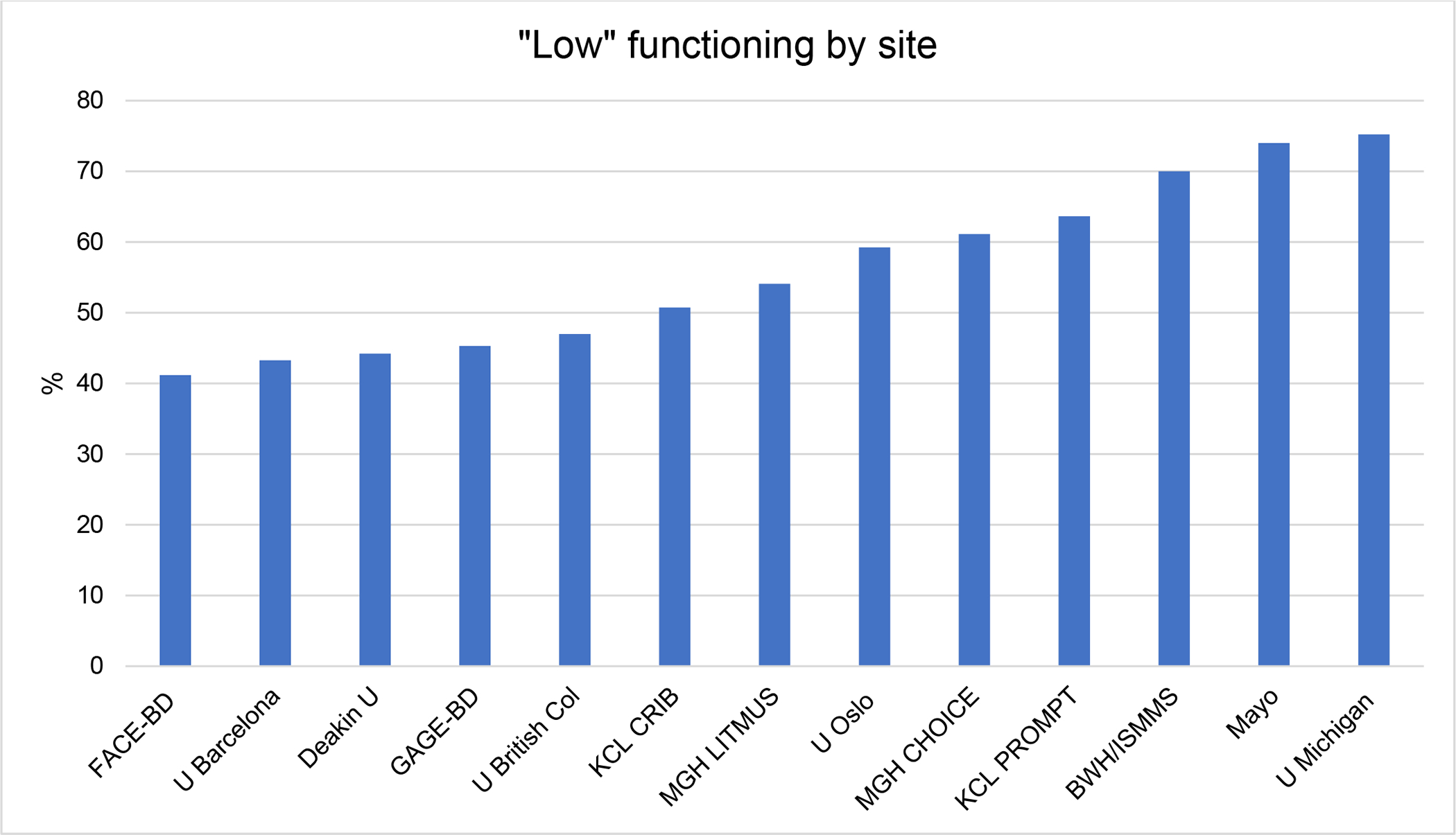
Results: We found high rates of functional impairment, ranging from 41 to 75%. Lower community functioning was associated with depressive symptoms in 10 of 12 of the cohorts that included this variable in the analysis. Lower levels of education, a greater number of prior mood episodes, the presence of a comorbid substance use disorder, and a greater total number of psychotropic medications were also associated with low functioning.
Conclusions: The bipolar clinical research community is poised to work together to characterize the multi-dimensional contributors to impairment and address the barriers that impede patients' complete recovery. We must also identify the core features which enable many to thrive and live successfully with BD. A large-scale, worldwide, prospective longitudinal study focused squarely on BD and its heterogeneous presentations will serve as a platform for discovery and promote major advances toward optimizing outcomes for every individual with this illness.
© 2022 The Authors. Bipolar Disorders published by John Wiley & Sons Ltd.
Figures
References
-
- Sanchez-Moreno J, Martinez-Aran A, Tabares-Seisdedos R, Torrent C, Vieta E, Ayuso-Mateos JL. Functioning and disability in bipolar disorder: an extensive review. Psychother Psychosom. 2009;78(5):285–297. - PubMed
-
- Altshuler LL, Post MR, Black OD, et al. Subsyndromal depressive symptoms are associated with functional impairment in patients with bipolar disorder: results of a large, multisite study. The Journal of clinical psychiatry. 2006;67(10):1551–1560. - PubMed
-
- Crump C, Sundquist K, Winkleby MA, Sundquist J. Comorbidities and mortality in bipolar disorder: A Swedish national cohort study. JAMA Psychiatry. 2013;70(9):931–939. - PubMed
-
- Carney CP, Jones LE. Medical comorbidity in women and men with bipolar disorders: A population-based controlled study. Psychosomatic Medicine. 2006;68(5):684–691. - PubMed
