


Association between Timing of Colonization and Risk of Developing Klebsiella pneumoniae Carbapenemase-Producing K. pneumoniae Infection in Hospitalized Patients
- PMID: 35323035
- PMCID: PMC9045231
- DOI: 10.1128/spectrum.01970-21
Association between Timing of Colonization and Risk of Developing Klebsiella pneumoniae Carbapenemase-Producing K. pneumoniae Infection in Hospitalized Patients
Abstract
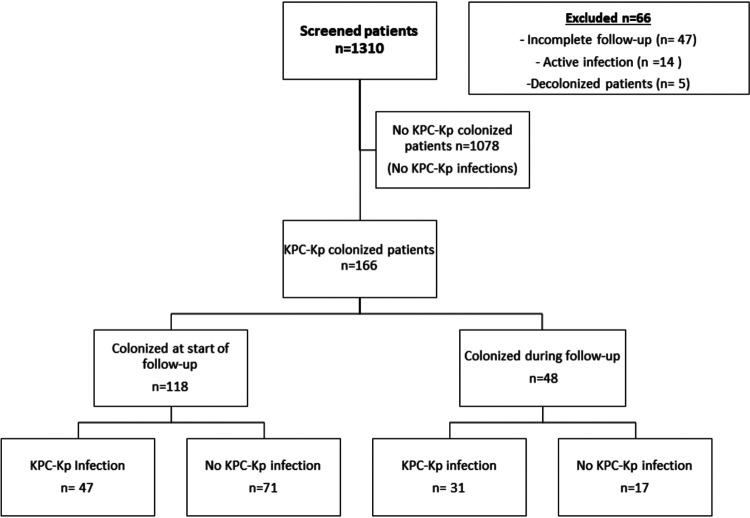
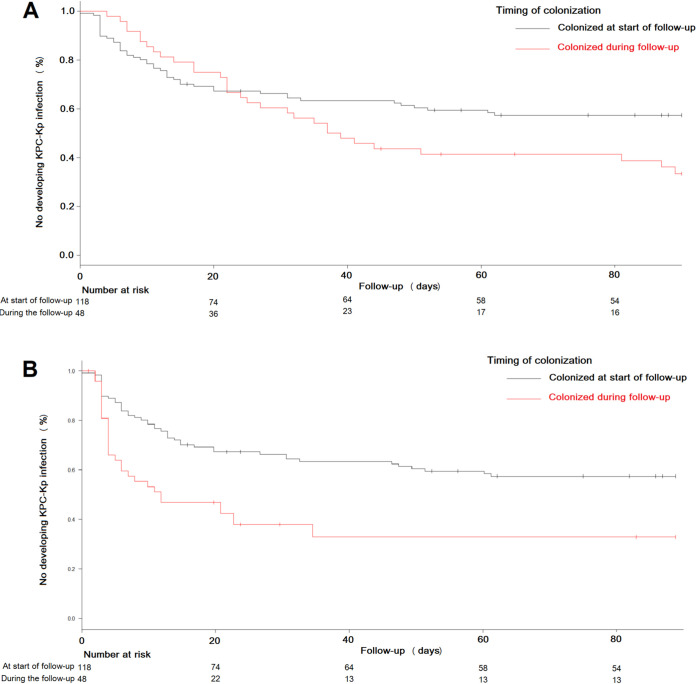
Colonization by KPC-producing Klebsiella pneumoniae (KPC-Kp) is associated with the risk of developing KPC-Kp infection. The impact of the time elapsed since a patient becomes colonized on this risk is not well known. An observational, prospective, longitudinal cohort study of colonized patients undergoing active rectal culture screening to rule out KPC-Kp colonization (July 2012 to November 2017). Patients with a positive culture at inclusion (colonized at start of follow-up) and those with a negative culture at inclusion who became colonized within 90 days (colonized during follow-up) were included in the analysis. CART analysis was used to dichotomize variables according to their association with infection. Kaplan-Meier infection-free survival curves and the log-rank test were used for group comparisons. Logistic regression was used to identify variables associated with KPC-Kp infection. Among 1310 patients included, 166 were colonized at the end of follow-up. Forty-seven out of 118 patients colonized at start of follow-up developed infection (39.8%) versus 31 out of 48 patients colonized during follow-up (64.6%; P = 0.006). Variables associated with KPC-Kp infection in the logistic regression analysis were: colonization detection during follow-up (OR, 2.74; 95% CI, 1.07 to 7.04; P = 0.03), Giannella risk score (OR, 1.51; 95% CI, 1.32 to 1.73; P < 0.001), high-risk ward (OR, 4.77; 95% CI, 1.61 to 14.10; P = 0.005) and urological manipulation after admission (OR, 3.69; 95% CI, 1.08 to 12.60; P = 0.04). In 25 out of 31 patients (80.6%) colonized during follow-up who developed KPC-Kp infection, infection appeared within 15 days after colonization. The risk of KPC-Kp infection was higher when colonization is recently acquired during hospitalization. In this prospective study, we concluded that the timing of colonization was a factor to assess when considering empirical treatment for suspected KPC-Kp infection and prophylaxis or infection control. IMPORTANCE In this study, it was confirmed that patients who became colonized during hospitalization had a higher risk of developing KPC-Kp infection than hospitalized patients who were already colonized at the start of follow-up. Besides, the risk of infection in the group of patients who became colonized during follow-up was greater in the first weeks immediately after colonization was confirmed. Our findings support the need for designing preventive strategies for patients at the highest risk of infection development, including those admitted in high-risk hospital wards and those undergoing urological procedures.
Keywords: carbapenemase-producing Klebsiella pneumoniae; risk of infection; timing of colonization.
Conflict of interest statement
The authors declare a conflict of interest. J.T.C. has served as scientific advisor for a research/consensus project for Pfizer, as an expert in a consensus document for InfectoPharm and has received payment for lectures, including service on speakers bureaus, and for the development of educational presentations for Pfizer, AstraZeneca, Shionogi and Merck. A.C. has received honoraria for the development of educational presentations for Pfizer and Shionogi. L.M.M. has been a consultant for MSD and Shionogi, has served as a speaker for MSD, Becton Dickinson, Pfizer and Shionogi and has received research support from Pfizer and Janssen.
Figures
References
-
- Papadimitriou-Olivgeris M, Marangos M, Fligou F, Christofidou M, Sklavou C, Vamvakopoulou S, Anastassiou ED, Filos KS. 2013. KPC-producing Klebsiella pneumoniae enteric colonization acquired during intensive care unit stay: the significance of risk factors for its development and its impact on mortality. Diagn Microbiol Infect Dis 77:169–173. doi:10.1016/j.diagmicrobio.2013.06.007. - DOI - PubMed
-
- Dautzenberg MJ, Wekesa AN, Gniadkowski M, Antoniadou A, Giamarellou H, Petrikkos GL, Skiada A, Brun-Buisson C, Bonten MJ, Derde LP, Mastering hOSpital Antimicrobial Resistance in Europe Work Package 3 Study Team . 2015. The association between colonization with carbapenemase-producing Enterobacteriaceae and overall ICU mortality: an observational cohort study. Crit Care Med 43:1170–1177. doi:10.1097/CCM.0000000000001028. - DOI - PMC - PubMed
Publication types
MeSH terms
Substances
LinkOut - more resources
Full Text Sources
Medical
