


Role of Telemedicine in Inflammatory Bowel Disease: Systematic Review and Meta-analysis of Randomized Controlled Trials
- PMID: 35323120
- PMCID: PMC8990345
- DOI: 10.2196/28978
Role of Telemedicine in Inflammatory Bowel Disease: Systematic Review and Meta-analysis of Randomized Controlled Trials
Abstract
Background: Telemedicine plays an important role in the management of inflammatory bowel disease (IBD), particularly during a pandemic such as COVID-19. However, the effectiveness and efficiency of telemedicine in managing IBD are unclear.
Objective: This systematic review and meta-analysis aimed to compare the impact of telemedicine with that of standard care on the management of IBD.
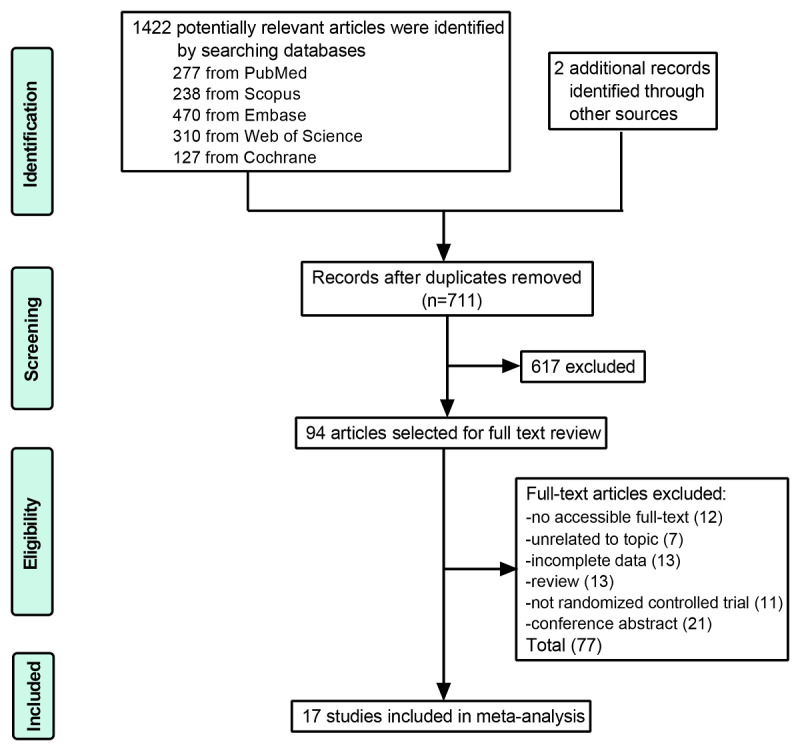
Methods: We systematically searched the PubMed, Cochrane Library, EMBASE, Web of Science, and Scopus databases on April 22, 2020. Randomized controlled trials comparing telemedicine with standard care in patients with IBD were included, while conference abstracts, letters, reviews, laboratory studies, and case reports were excluded. The IBD-specific quality of life (QoL), disease activity, and remission rate in patients with IBD were assessed as primary outcomes, and the number of in-person clinic visits per patient, patient satisfaction, psychological outcome, and medication adherence were assessed as secondary outcomes. Review Manage 5.3 and Stata 15.1 were used for data analysis.
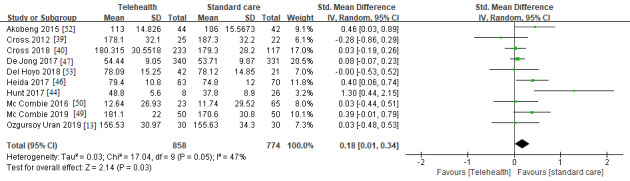
Results: A total of 17 randomized controlled trials (2571 participants) were included in this meta-analysis. The telemedicine group had higher IBD-specific QoL than the standard care group (standard mean difference 0.18, 95% CI 0.01 to 0.34; P.03). The number of clinic visits per patient in the telemedicine group was significantly lower than that in the standard care group (standard mean difference -0.71, 95% CI -1.07 to -0.36; P<.001). Subgroup analysis showed that adolescents in the telemedicine group had significantly higher IBD-specific QoL than those in the standard care group (standard mean difference 0.42, 95% CI 0.15 to 0.69; I2=0; P.002), but there was no significant difference between adults in the 2 groups. There were no significant differences in disease activity, remission rate, patient satisfaction, depression, self-efficacy, generic QoL, and medication adherence outcomes between the telemedicine and standard care groups.
Conclusions: Telemedicine intervention showed a promising role in improving IBD-specific QoL among adolescents and decreased the number of clinic visits among patients with IBD. Further research is warranted to identify the group of patients with IBD who would most benefit from telemedicine.
Keywords: disease activity; inflammatory bowel disease; mobile phone; quality of life; telemedicine.
©Lanlan Pang, Hengyu Liu, Zhidong Liu, Jinyu Tan, Long-yuan Zhou, Yun Qiu, Xiaoqing Lin, Jinshen He, Xuehua Li, Sinan Lin, Subrata Ghosh, Ren Mao, Minhu Chen. Originally published in the Journal of Medical Internet Research (https://www.jmir.org), 24.03.2022.
Conflict of interest statement
Conflicts of Interest: None declared.
Figures
References
-
- Coward S, Clement F, Benchimol Ei, Bernstein Cn, Bitton A, Carroll M, Hazlewood G, Jelinski S, Jones Jl, Kuenzig E, Leddin D, McBrien K, Murthy Sk, Nguyen Gc, Otley A, Rezaie A, Peña-Sánchez Jn, Singh H, Targownik Le, Kaplan G. Tu1698 - Analyzing the rising prevalence of IBD: predicting the prevalence in 2030 by age group. Gastroenterology. 2018 May;154(6):S-992–S-993. doi: 10.1016/S0016-5085(18)33324-9. - DOI
Publication types
MeSH terms
LinkOut - more resources
Full Text Sources
Medical
Miscellaneous
