Review
. 2022 Jun 1;33(4):238-248.
doi: 10.1097/FBP.0000000000000672. Epub 2022 Mar 23.

Biphasic reward effects are characteristic of both lorcaserin and drugs of abuse: implications for treatment of substance use disorders

Affiliations
Review

Biphasic reward effects are characteristic of both lorcaserin and drugs of abuse: implications for treatment of substance use disorders

Ken W Grasing et al. Behav Pharmacol. .

Abstract

Lorcaserin is a modestly selective agonist for 2C serotonin receptors (5-HT2CR). Despite early promising data, it recently failed to facilitate cocaine abstinence in patients and has been compared with dopamine antagonist medications (antipsychotics). Here, we review the effects of both classes on drug reinforcement. In addition to not being effective treatments for cocaine use disorder, both dopamine antagonists and lorcaserin can have biphasic effects on dopamine and reward behavior. Lower doses can cause enhanced drug taking with higher doses causing reductions. This biphasic pattern is shared with certain stimulants, opioids, and sedative-hypnotics, as well as compounds without abuse potential that include agonists for muscarinic and melatonin receptors. Additional factors associated with decreased drug taking include intermittent dosing for dopamine antagonists and use of progressive-ratio schedules for lorcaserin. Clinically relevant doses of lorcaserin were much lower than those that inhibited cocaine-reinforced behavior and can also augment this same behavior in different species. Diminished drug-reinforced behavior only occurred in animals after higher doses that are not suitable for use in patients. In conclusion, drugs of abuse and related compounds often act as biphasic modifiers of reward behavior, especially when evaluated over a broad range of doses. This property may reflect the underlying physiology of the reward system, allowing homeostatic influences on behavior.


Conflict of interest statement

Financial and Competing Interests Disclosure

The authors report no conflicts of interest.

All authors declare that they have no conflict of interest pertaining to this manuscript.

Figures
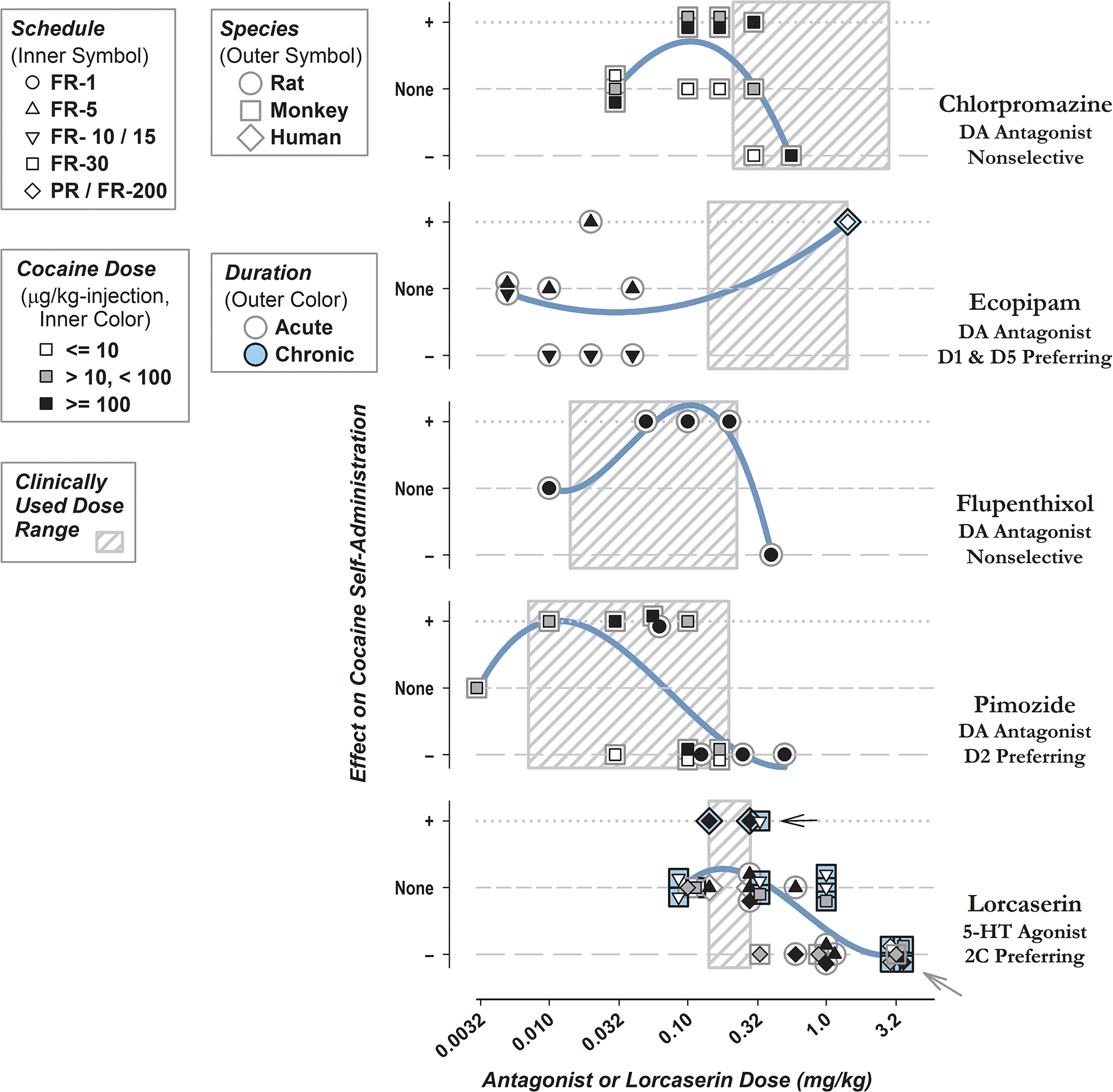
Figure 1.
Figure 1.
Changes in Cocaine Self-Administration following Pretreatment with Dopamine Antagonists or Lorcaserin in Laboratory Studies. Total daily doses of dopamine antagonist or lorcaserin pretreatment are shown on horizontal axes. Effects of either class are divided into different categories according to those reporting increases in drug taking or response rate represented as a positive or ‘+’ effect (dotted lines), decreases illustrated by a negative or ‘−’ (long-dash lines), or no effect (short-dashed lines). Criteria of 25% above or below baseline were used to identify increases or decreases respectively from selected studies, all of which are cited above. Some data points are shifted laterally or vertically to accommodate overlap. Because Glowa et al. (1996) reported only response rate and not the number of self-administered cocaine injections, categories for this study are assigned based on changes in response rate. Otherwise, assignments are according to change in the number of self-administered cocaine injections. Legends show schedule (inner symbol), species (outer symbol), unit dose of cocaine (inner color), and duration of pretreatment (outer color). For example, the gray arrow on the lower right-hand side shows results from five evaluations of lorcaserin administered at 3.2 mg/kg, all conducted using rhesus monkeys, with one using a cocaine unit dose of 10 μg/kg, another testing 100 μg/kg, and the others using intermediate doses of cocaine. The black arrow points to results in which lorcaserin increased cocaine-reinforced behavior after chronic treatment, obtained in humans and rhesus monkeys. Gray boxes indicate the clinically used range of doses for either class with lowest single doses shown by left-hand borders and the maximum daily doses by right-hand borders. Curves show results of third-order linear regression, for effect on cocaine self-administration against dose of antagonist or lorcaserin.
Figure 2.
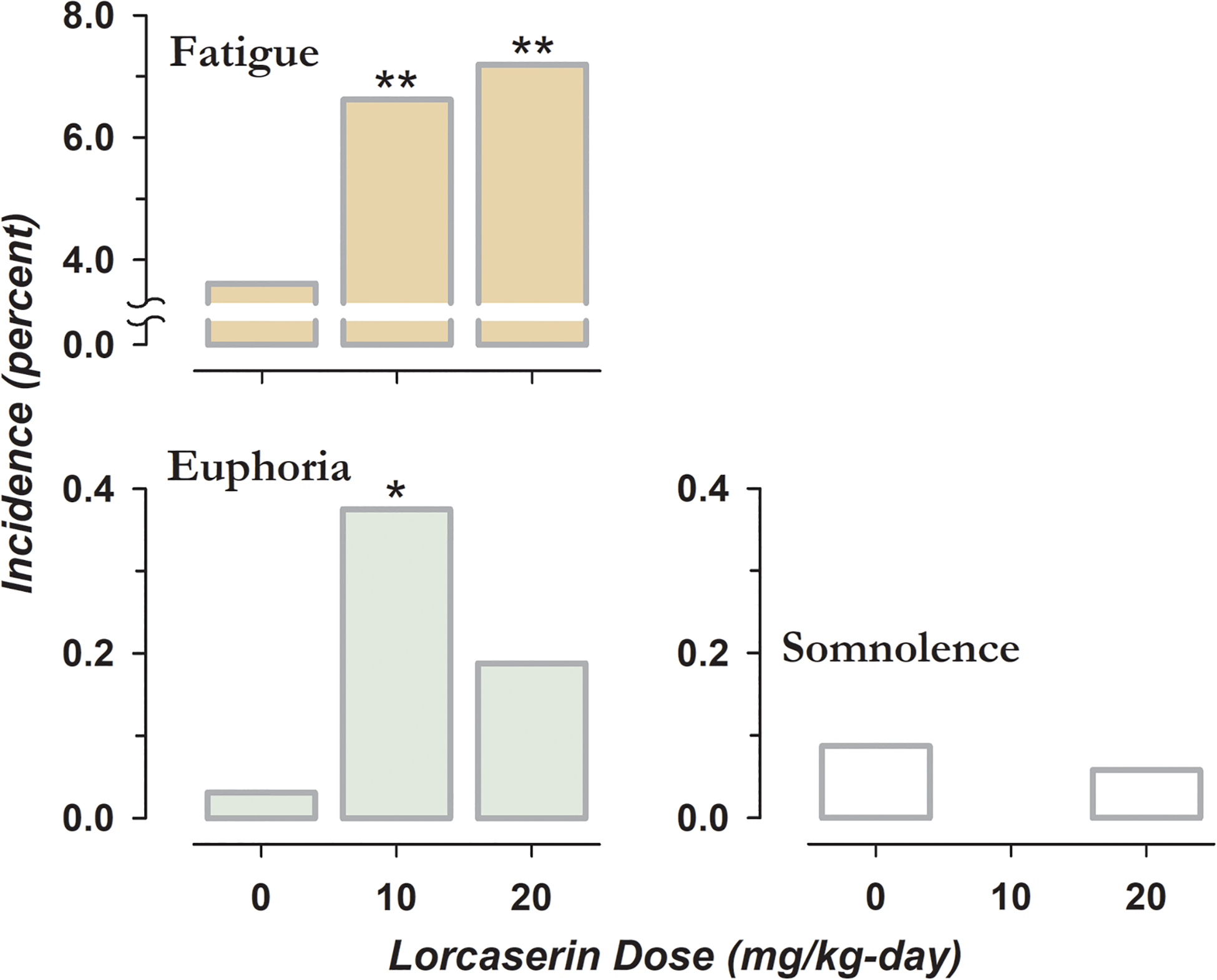
Figure 2.. Selected Adverse Effects of Lorcaserin prior to Approval.
Incidence of fatigue, somnolence, and euphoria in patients receiving lorcaserin for medically-indicated weight loss during phase III testing (Food and Drug Administration Center for Drug Evaluation and Research, 2011). Patients were assigned to oral placebo or 10 mg of lorcaserin administered once or twice-daily. * indicates a significant difference in the proportion of subjects between placebo and active treatments by Chi-square test, with one and two symbols corresponding to p < 0.001 and p < 0.0001, respectively.

References

    1. Althoff KN, Leifheit KM, Park JN, Chandran A and Sherman SG (2020). Opioid-related overdose mortality in the era of fentanyl: Monitoring a shifting epidemic by person, place, and time. Drug Alcohol Depend 216:108321. - PMC - PubMed
    1. Anastasio NC, Sholler DJ, Fox RG, Stutz SJ, Merritt CR, Bjork JM, et al. (2020). Suppression of cocaine relapse-like behaviors upon pimavanserin and lorcaserin co-administration. Neuropharmacology 168:108009. - PMC - PubMed
    1. Augier E, Vouillac C and Ahmed SH (2012). Diazepam promotes choice of abstinence in cocaine self-administering rats. Addict Biol 17:378–391. - PubMed

    1. Ban TA (2007). Fifty years chlorpromazine: a historical perspective. Neuropsychiatr Dis Treat 3:495–500. - PMC - PubMed
    1. Banks ML and Negus SS (2017). Repeated 7-day treatment with the 5-HT2C agonist lorcaserin or the 5-HT2A antagonist pimavanserin alone or in combination fails to reduce cocaine vs food choice in male rhesus monkeys. Neuropsychopharmacology 42:1082–1092. - PMC - PubMed

Publication types