. 2022 Apr 6;144(13):5910-5920.
doi: 10.1021/jacs.1c13377. Epub 2022 Mar 24.

Microscopic Insights into Cation-Coupled Electron Hopping Transport in a Metal-Organic Framework

Affiliations

Microscopic Insights into Cation-Coupled Electron Hopping Transport in a Metal-Organic Framework

Ashleigh T Castner et al. J Am Chem Soc. .

Abstract

Electron transport through metal-organic frameworks by a hopping mechanism between discrete redox active sites is coupled to diffusion-migration of charge-balancing counter cations. Experimentally determined apparent diffusion coefficients, Deapp, that characterize this form of charge transport thus contain contributions from both processes. While this is well established for MOFs, microscopic descriptions of this process are largely lacking. Herein, we systematically lay out different scenarios for cation-coupled electron transfer processes that are at the heart of charge diffusion through MOFs. Through systematic variations of solvents and electrolyte cations, it is shown that the Deapp for charge migration through a PIZOF-type MOF, Zr(dcphOH-NDI) that is composed of redox-active naphthalenediimide (NDI) linkers, spans over 2 orders of magnitude. More importantly, however, the microscopic mechanisms for cation-coupled electron propagation are contingent on differing factors depending on the size of the cation and its propensity to engage in ion pairs with reduced linkers, either non-specifically or in defined structural arrangements. Based on computations and in agreement with experimental results, we show that ion pairing generally has an adverse effect on cation transport, thereby slowing down charge transport. In Zr(dcphOH-NDI), however, specific cation-linker interactions can open pathways for concerted cation-coupled electron transfer processes that can outcompete limitations from reduced cation flux.


Conflict of interest statement

The authors declare no competing financial interest.

Figures
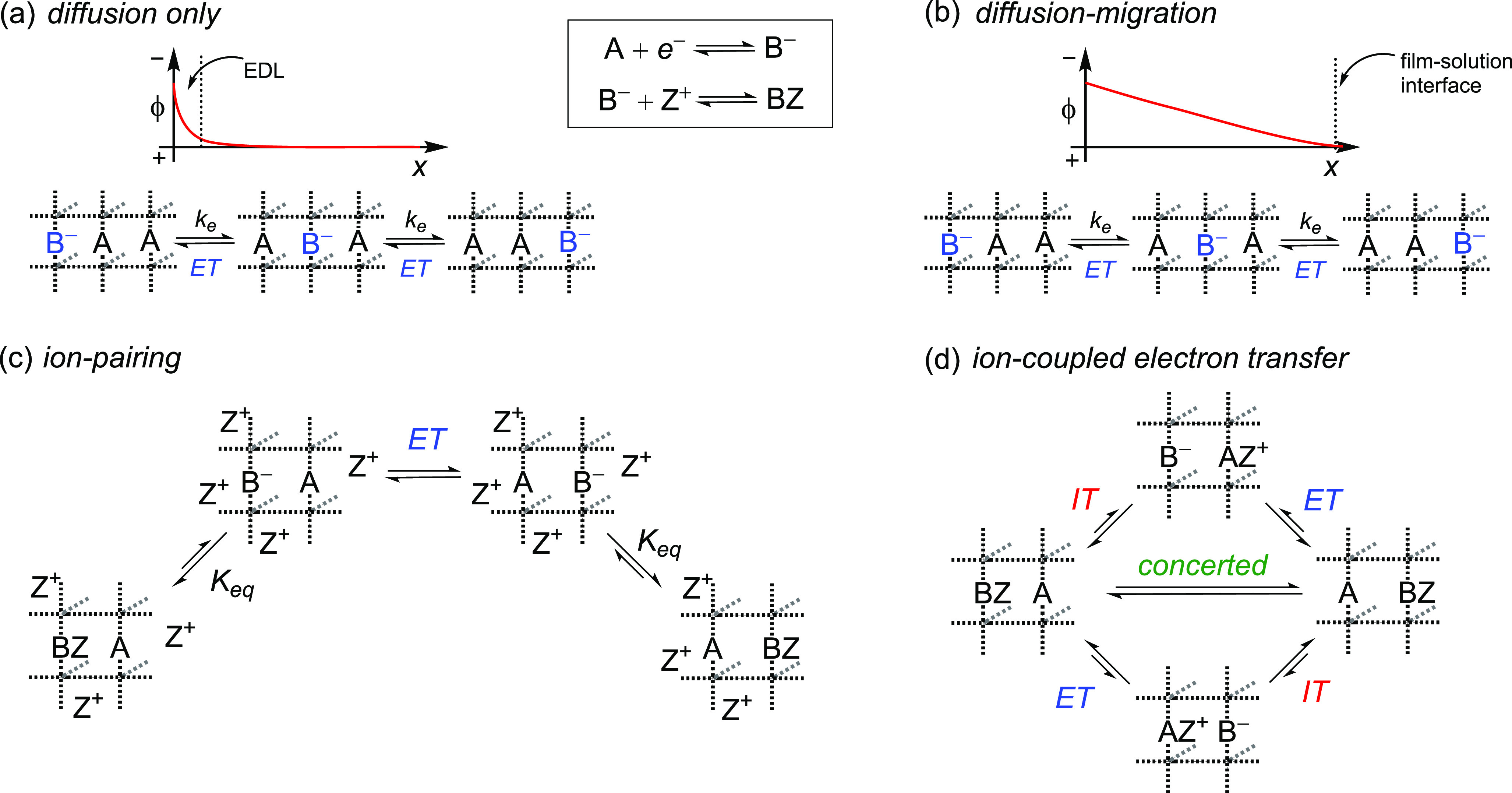
Figure 1
Figure 1
Schematic diagrams showing various microscopic mechanisms of electron-hopping through a redox-active MOF film: (a) Diffusion in the absence of any other effects, fulfilling assumptions made in eq 1; the electrostatic potential (ϕ) is dropped only over the electrical double layer (EDL) near the electrode surface and no electric field is developed within the film. (b) Charge transport by diffusion-migration, where there exists a substantial drop in electrostatic potential across the film. (c) Ion pairing electron transfer where the microscopic reactions include dissociation/association of an ion pair as well as electron self-exchange between an unpaired reduced/oxidized linker. These reactions are accompanied by migration-diffusion of redox-inactive counter ions according to the Nernst–Planck equation under an electroneutrality assumption. (d) Ion-coupled electron transfer occurring from fully associated ion-paired linkers. The microscopic self-exchange reaction follows an ion-coupled electron transfer (ICET) process, which can be represented by a square scheme showing either sequential or concerted pathways.
Figure 2
Figure 2
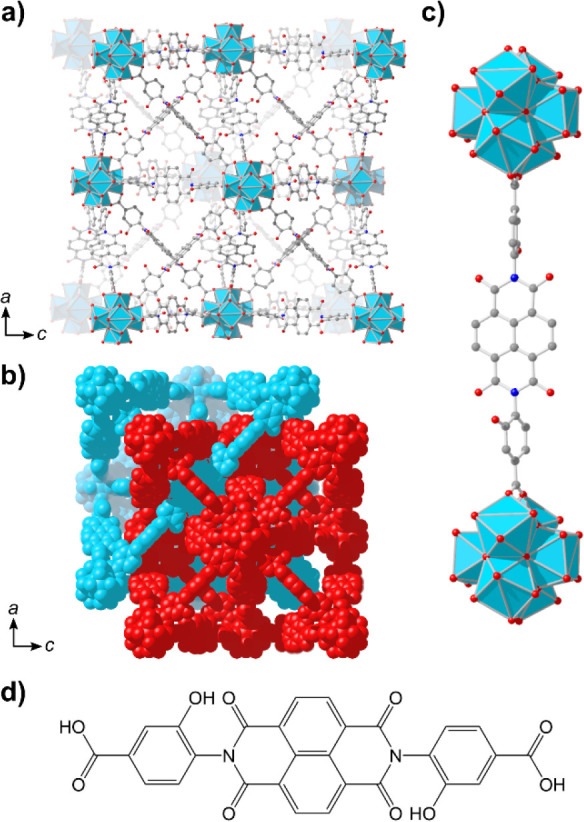
Structure of Zr(dcphOH-NDI) obtained by three-dimensional electron diffraction (3DED) measurements: (a) Non-interpenetrated framework, showing the hexanuclear zirconium clusters, as viewed slightly off-axis along b. (b) Two interpenetrated frameworks, colored blue and red. (c) Two hexanuclear zirconium clusters interconnected by a single dcphOH-NDI linker, showing the staggered confirmation of the NDI. (d) Chemical structure of the dcphOH-NDI linker.
Figure 3
Figure 3
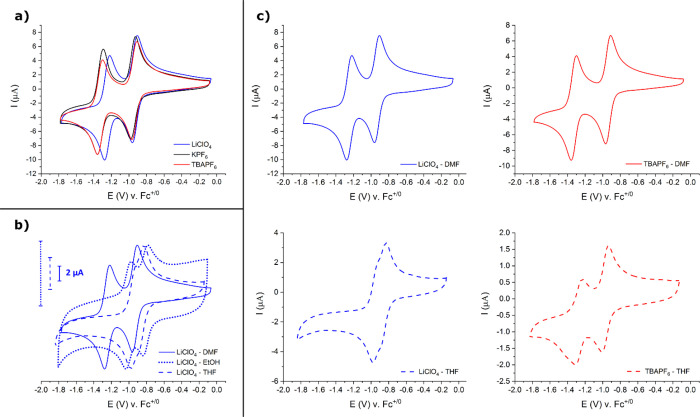
CVs of dcphOH-NDI measured under all supporting electrolyte/solvent conditions used in this study (0.5 M supporting electrolyte in the indicated solvent; ν = 50 mV s–1). (a) CVs measured in DMF with all supporting electrolytes tested. [dcphOH-NDI] = 1 mM for all measurements. (b) Normalized CVs measured in all solvents tested with LiClO4 as the supporting electrolyte. [dcphOH-NDI] = 1 mM in DMF (solid line) but is less than 1 mM in THF (dashed line) and EtOH (dotted line) due to low solubility of dcphOH-NDI in these solvents. Scale bars indicate actual measured current in each solvent, with the line style of the scale bar corresponding to that of the measured CV (refer to legend). (c) CVs illustrating alteration in NDI redox behavior resulting from the choice of supporting electrolyte (LiClO4: blue, TBAPF6: red) and solvent (DMF: solid lines, THF: dashed lines).
Figure 4
Figure 4
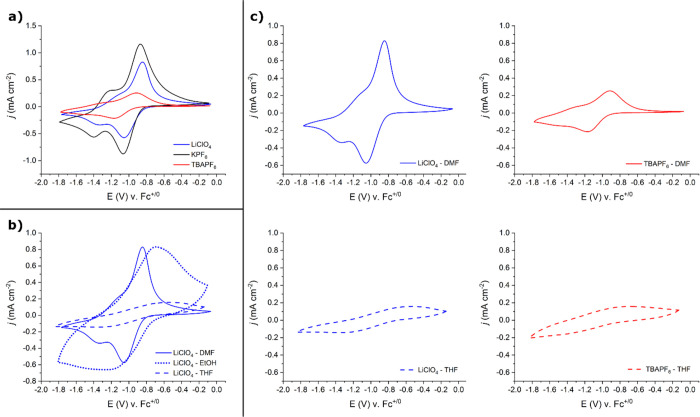
Representative CVs of Zr(dcphOH-NDI)@FTO MOF films after conditioning measured under all supporting electrolyte/solvent conditions used in this study. (a) CVs measured in DMF with all supporting electrolytes tested. (b) CVs measured in all solvents tested with LiClO4 as the supporting electrolyte. (c) CVs demonstrating the change of Zr(dcphOH-NDI)@FTO redox behavior stemming from the choice of supporting electrolyte (LiClO4: blue, TBAPF6: red) and solvent (DMF: solid lines, THF: dashed lines). CV conditions: 0.5 M supporting electrolyte in the indicated solvent; scan rate: 50 mV s–1.
Figure 5
Figure 5
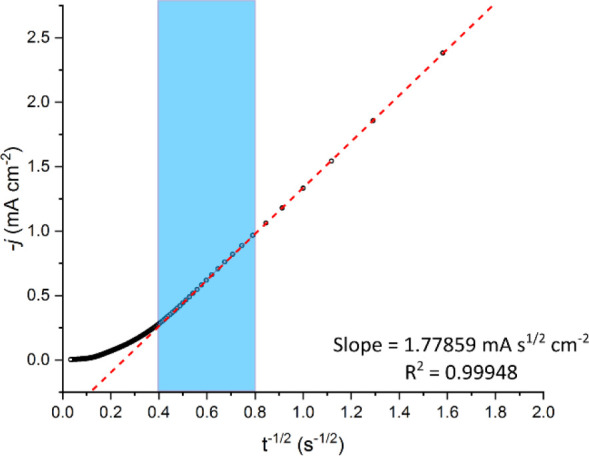
Representative Cottrell plot for Zr(dcphOH-NDI)@FTO measured in 0.5 M KPF6 in DMF with a time step of 0.2 s. The linear fit (red line) from ∼1.6 to 6.4 s after the potential step used to extract Deapp from eq 4 (the blue box indicates the set of points used for the linear fit).
Figure 6
Figure 6
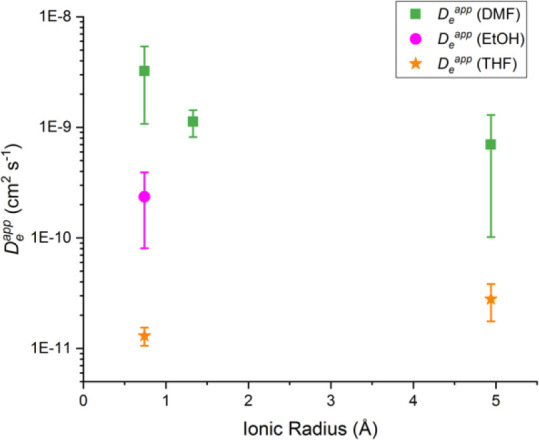
Average Deapp plotted vs the ionic radius of the cations employed in this study.
Figure 7
Figure 7
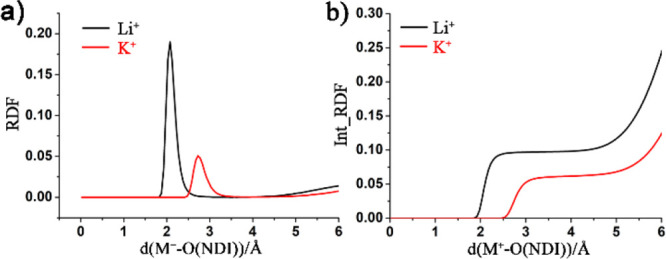
(a) Radial pair distribution functions (RDFs) and (b) integral of RDFs for the interaction between Li+ and K+ and Zr(dcphOH-NDI) in DMF. Every linker in Zr(dcphOH-NDI) is reduced by one electron. The integral RDF shows the number of ions at a distance from the NDI-O; as every NDI contains four O-centers, one cation/NDI corresponds to an integral of 0.25.
Figure 8
Figure 8
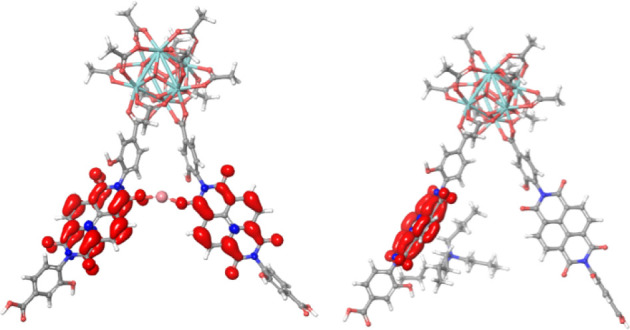
Left: a singly reduced Zr6O4(OH)4(OAc)10(NDI-OH)2 model system with a bridging Li+ counter ion. Right: a singly reduced Zr6O4(OH)4(OAc)10(NDI-OH)2 model system with a TBA+ counter ion. Spin densities (in red) illustrate electron (de)localization in the model systems.

References

    1. Yaghi O. M.; O’Keefe M.; Ockwig N. W.; Chae H. K.; Eddaoudi M.; Kim J. Reticular Synthesis and the Design of New Materials. Nature 2003, 423, 705–714. 10.1038/nature01650. - DOI - PubMed
    1. Zhou H. C.; Kitagawa S. Metal-organic frameworks (MOFs). Chem. Soc. Rev. 2014, 43, 5415–5418. 10.1039/C4CS90059F. - DOI - PubMed
    1. Downes C. A.; Marinescu S. C. Electrocatalytic Metal-Organic Frameworks for Energy Applications. ChemSusChem 2017, 10, 4374–4392. 10.1002/cssc.201701420. - DOI - PubMed
    1. Baumann A. E.; Burns D. A.; Liu B.; Thoi V. S. Metal-organic framework functionalization and design strategies for advanced electrochemical energy storage devices. Commun. Chem. 2019, 2, 86. 10.1038/s42004-019-0184-6. - DOI
    1. Allendorf M. D.; Stavila V. Crystal engineering, structure–function relationships, and the future of metal–organic frameworks. CrystEngComm 2015, 17, 229–246. 10.1039/C4CE01693A. - DOI

Publication types