


MitoQ Prevents Human Breast Cancer Recurrence and Lung Metastasis in Mice
- PMID: 35326639
- PMCID: PMC8946761
- DOI: 10.3390/cancers14061488
MitoQ Prevents Human Breast Cancer Recurrence and Lung Metastasis in Mice
Abstract
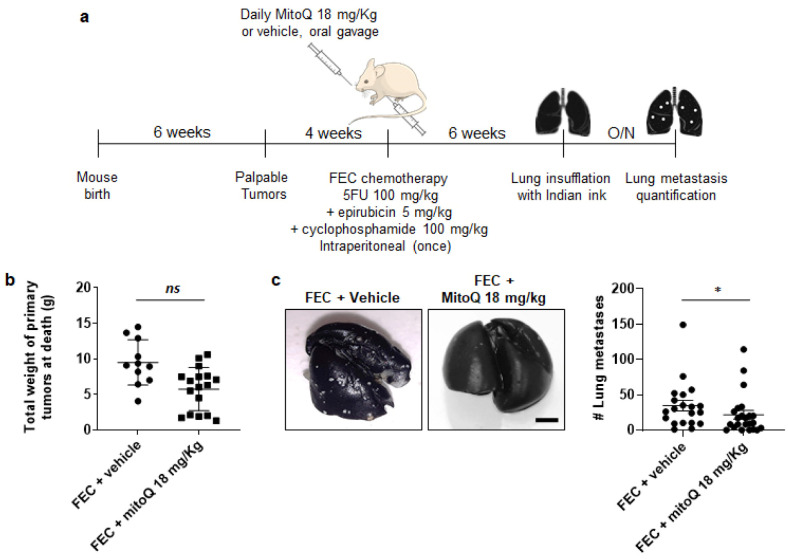
In oncology, the occurrence of distant metastases often marks the transition from curative to palliative care. Such outcome is highly predictable for breast cancer patients, even if tumors are detected early, and there is no specific treatment to prevent metastasis. Previous observations indicated that cancer cell mitochondria are bioenergetic sensors of the tumor microenvironment that produce superoxide to promote evasion. Here, we tested whether mitochondria-targeted antioxidant MitoQ is capable to prevent metastasis in the MDA-MB-231 model of triple-negative human breast cancer in mice and in the MMTV-PyMT model of spontaneously metastatic mouse breast cancer. At clinically relevant doses, we report that MitoQ not only prevented metastatic take and dissemination, but also local recurrence after surgery. We further provide in vitro evidence that MitoQ does not interfere with conventional chemotherapies used to treat breast cancer patients. Since MitoQ already successfully passed Phase I safety clinical trials, our preclinical data collectively provide a strong incentive to test this drug for the prevention of cancer dissemination and relapse in clinical trials with breast cancer patients.
Keywords: MitoQ; breast cancer; cancer relapse; metastasis; metastasis prevention; mitochondria; mitochondria-targeted antioxidant; mitochondrial superoxide; translational research.
Conflict of interest statement
T.C. and P.S. are inventors of patent application EP21175397.5 “Molecular signature for assessing the responsiveness of cancer to mitochondria-targeted antioxidants”. M.P.M. consults for MitoQ Inc. and holds patents in mitochondria-targeted therapies. Authors declare no other conflict of interest. In particular, Antipodean Pharmaceuticals Inc. and its side branch MitoQ Inc., who possess patent rights on the MitoQ molecule, did not fund the study. Neither them nor the funders were involved in the design of the study; in the collection, analyses, or interpretation of data; in the writing of the manuscript, or in the decision to publish the results.
Figures
References
-
- Gennari A., Stockler M., Puntoni M., Sormani M., Nanni O., Amadori D., Wilcken N., D’Amico M., DeCensi A., Bruzzi P. Duration of chemotherapy for metastatic breast cancer: A systematic review and meta-analysis of randomized clinical trials. J. Clin. Oncol. 2011;29:2144–2149. doi: 10.1200/JCO.2010.31.5374. - DOI - PubMed
-
- Li X., Yang J., Peng L., Sahin A.A., Huo L., Ward K.C., O’Regan R., Torres M.A., Meisel J.L. Triple-negative breast cancer has worse overall survival and cause-specific survival than non-triple-negative breast cancer. Breast Cancer Res. Treat. 2017;161:279–287. doi: 10.1007/s10549-016-4059-6. - DOI - PubMed
Grants and funding
- FP7/2007-2013 ERC Independent Researcher Starting Grant 243188 TUMETABO/European Union
- European Union's Horizon 2020 research innovation program under the Marie Skłodow-ska-Curie grant agreement No 722605 TRANSMIT/European Union
- ARC 09/14-020 and ARC 14/19-058/Communauté Française de Belgique
- Interuniversity Attraction Pole (IAP) grant #UP7-03/Belgian Science Policy Office
- Fundamental Research Grants #F86 and #FAF-F/2018/1282/Fondation Belge contre le Cancer
LinkOut - more resources
Full Text Sources
Medical
Miscellaneous
