


Antibacterial Activity of Solanum torvum Leaf Extract and Its Synergistic Effect with Oxacillin against Methicillin-Resistant Staphyloccoci Isolated from Dogs
- PMID: 35326765
- PMCID: PMC8944679
- DOI: 10.3390/antibiotics11030302
Antibacterial Activity of Solanum torvum Leaf Extract and Its Synergistic Effect with Oxacillin against Methicillin-Resistant Staphyloccoci Isolated from Dogs
Abstract
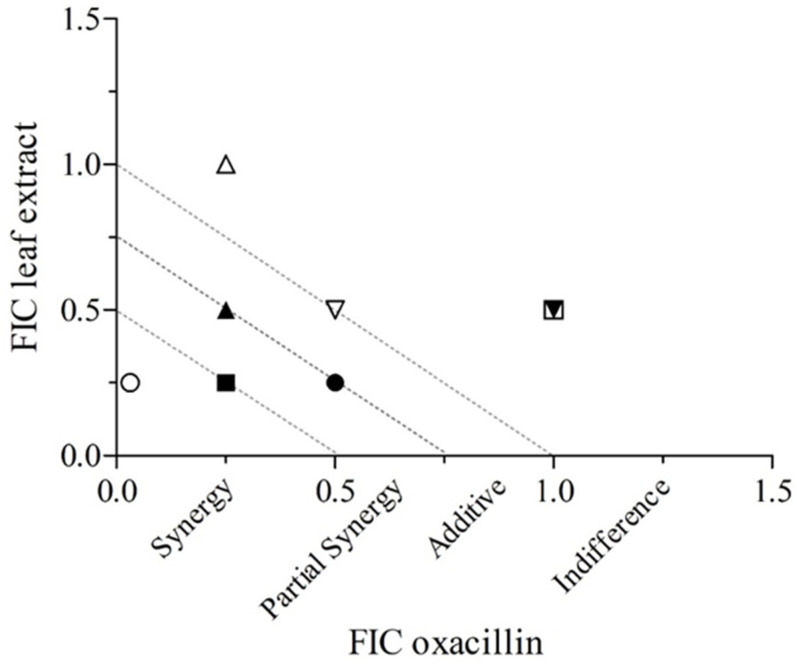
Methicillin-resistant staphylococci (MRS) have been considered a veterinary and public health threat that needs to be addressed, as they are known to cause serious infections, with limited therapeutic options. Thus, in this study, we aimed to examine the potential antibacterial activity of the leaf extract of Solanum torvum against MRS isolated from clinically healthy dogs. In total, seven mecA-positive Staphylococcus isolates tested in this study were identified using 16S rRNA gene sequencing, and all of them were classified as multidrug-resistant using disk diffusion tests. According to gas chromatography-mass spectrometry analysis, the main phytochemical components found in the leaf extract were hexadecanoic acid and its ethyl ester and 9,12,15-octadecatrienoic acid, ethyl ester, (Z,Z,Z). The minimum inhibitory concentration (MIC) breakpoints for the leaf extract against all tested isolates ranged from 2 to 16 mg/mL, while the MIC breakpoints for oxacillin were from 2 to 512 mg/L. Although varying effects were found, the positive effects of the leaf extract were most evident in combination with oxacillin. These results suggested that S. torvum leaf extract may complement classical antibiotics and may potentially drive the development of an effective therapeutic option for MRS.
Keywords: antimicrobials; dog; resistance; staphylococci.
Conflict of interest statement
The authors declare no conflict of interest.
Figures
References
-
- Feßler A.T., Schuenemann R., Kadlec K., Hensel V., Brombach J., Murugaiyan J., Oechtering G., Burgener I.A., Schwarz S. Methicillin-resistant Staphylococcus aureus (MRSA) and methicillin-resistant Staphylococcus pseudintermedius (MRSP) among employees and in the environment of a small animal hospital. Vet. Microbiol. 2018;221:153–158. doi: 10.1016/j.vetmic.2018.06.001. - DOI - PubMed
-
- Ortiz-Díez G., López R., Sánchez-Díaz A.M., Turrientes M.C., Baquero M.R., Luque R., Maroto A., Fernández C., Ayllón T. Epidemiology of the colonization and acquisition of methicillin-resistant staphylococci and vancomycin-resistant enterococci in dogs hospitalized in a clinic veterinary hospital in Spain. Comp. Immunol. Microbiol. Infect. Dis. 2020;72:101501. doi: 10.1016/j.cimid.2020.101501. - DOI - PubMed
-
- Loncaric I., Tichy A., Handler S., Szostak M.P., Tickert M., Diab-Elschahawi M., Spergser J., Künzel F. Prevalence of methicillin-resistant Staphylococcus sp. (MRS) in different companion animals and determination of risk factors for colonization with MRS. Antibiotics. 2019;8:36. doi: 10.3390/antibiotics8020036. - DOI - PMC - PubMed
Grants and funding
LinkOut - more resources
Full Text Sources
