


Development of Desiccation-Tolerant Probiotic Biofilms Inhibitory for Growth of Foodborne Pathogens on Stainless Steel Surfaces
- PMID: 35327253
- PMCID: PMC8950843
- DOI: 10.3390/foods11060831
Development of Desiccation-Tolerant Probiotic Biofilms Inhibitory for Growth of Foodborne Pathogens on Stainless Steel Surfaces
Abstract
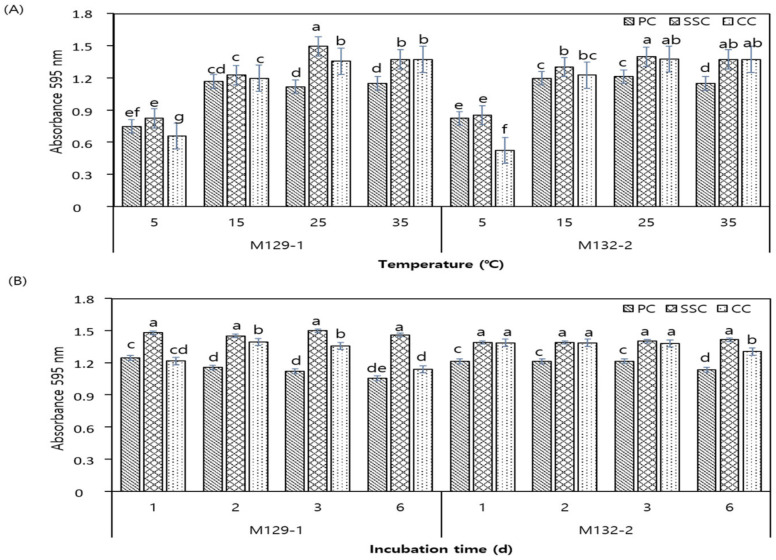
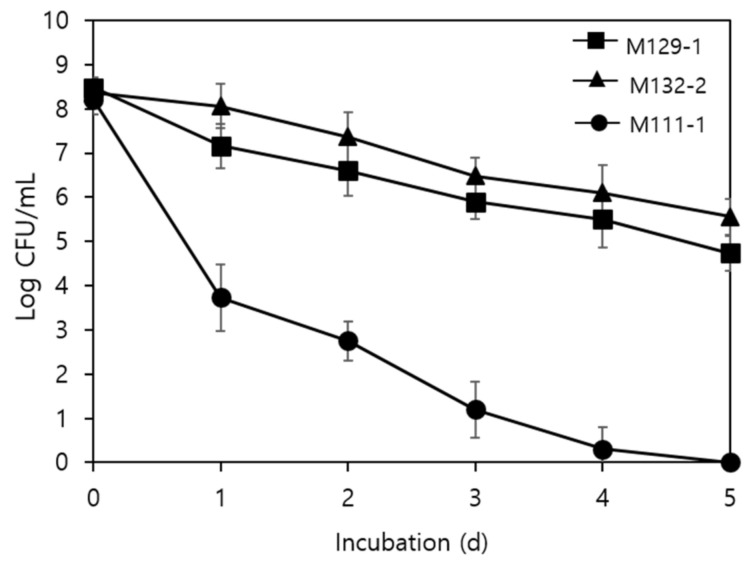
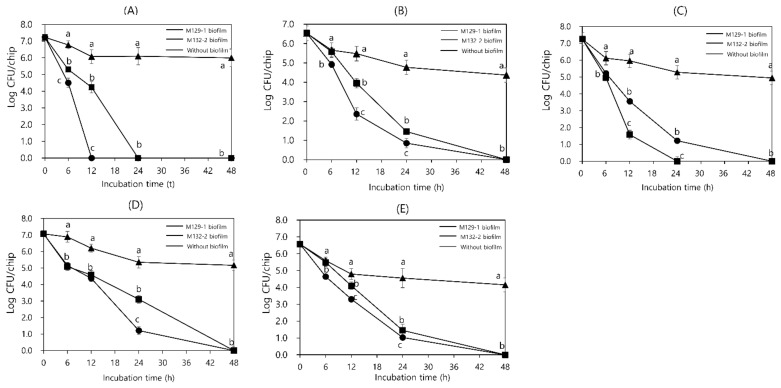
Lactic acid bacteria biofilms can be used to reduce foodborne pathogen contamination in the food industry. However, studies on growth inhibition of foodborne pathogens by inducing biofilm formation of antagonistic microorganisms on abiotic surfaces are rare. We developed a desiccation-tolerant antimicrobial probiotic biofilm. Lactobacillus sakei M129-1 and Pediococcus pentosaceus M132-2 isolated from fermented Korean foods were found to exhibit broad-spectrum antibacterial activity against Bacillus cereus, Escherichia coli O157:H7, Staphylococcus aureus, Listeria monocytogenes, and Salmonella enterica. Their biofilm levels were significantly (p < 0.05) higher on stainless steel than on polyethylene or ceramic. Biofilms of both isolates showed significantly (p < 0.05) enhanced resistance against desiccation (exposure to 43% atmospheric relative humidity) as compared with the isolates not in the biofilm form. The antimicrobial activity of the isolates was sustained in dried biofilms on stainless steel surface; the initial number of foodborne pathogens (average 7.0 log CFU/mL), inoculated on stainless steel chips containing L. sakei M129-1 or P. pentosaceus M132-2 biofilm decreased to less than 1.0 log CFU within 48 h. The lactic acid bacteria antibacterial biofilms developed in this study may be applied to desiccated environmental surfaces in food-related environments to improve microbiological food safety.
Keywords: biofilm; desiccation; lactic acid bacteria; stainless steel.
Conflict of interest statement
The authors declare no conflict of interest.
Figures
References
-
- Srey S., Jahid I.K., Ha S.D. Biofilm formation in food industries: A food safety concern. Food Control. 2013;31:572–585. doi: 10.1016/j.foodcont.2012.12.001. - DOI
-
- World Health Organization (WHO) Food Safety. World Health Organization (WHO); Geneva, Switzerland: 2020. [(accessed on 22 December 2021)]. Available online: https://www.who.int/news-room/fact-sheets/detail/food-safety.
-
- Choi J., Nelson D., Almanza B. Food safety risk for restaurant management: Use of restaurant health inspection report to predict consumers’ behavioral intention. J. Risk Res. 2019;22:1443–1457. doi: 10.1080/13669877.2018.1501590. - DOI
-
- Vert M., Doi Y., Hellwich K.H., Hess M., Hodge P., Kubisa P., Rinaudo M., Schue F. Terminology for biorelated polymers and applications (IUPAC Recommendations 2012) Pure Appl. Chem. 2012;84:377–410. doi: 10.1351/PAC-REC-10-12-04. - DOI
Grants and funding
LinkOut - more resources
Full Text Sources
Other Literature Sources
Molecular Biology Databases
