


Research on Rapid Detection Technology for β2-Agonists: Multi-Residue Fluorescence Immunochromatography Based on Dimeric Artificial Antigen
- PMID: 35327285
- PMCID: PMC8949518
- DOI: 10.3390/foods11060863
Research on Rapid Detection Technology for β2-Agonists: Multi-Residue Fluorescence Immunochromatography Based on Dimeric Artificial Antigen
Abstract
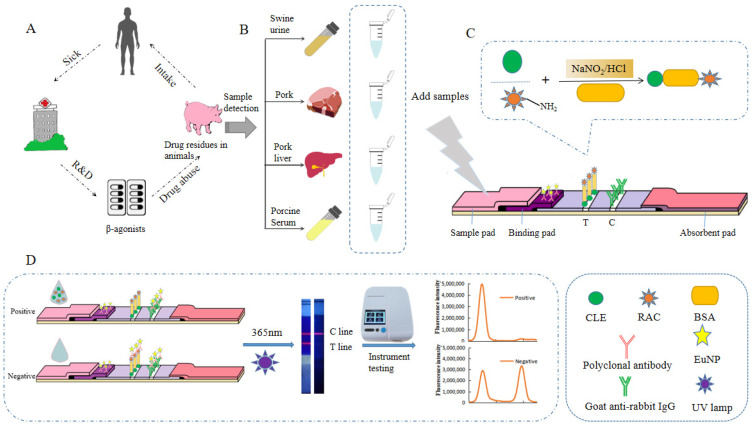
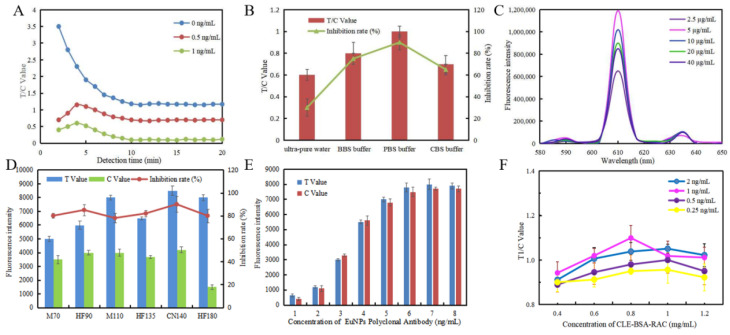
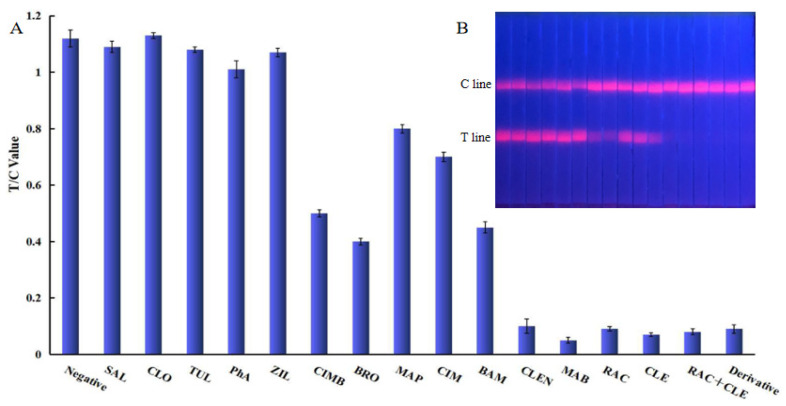
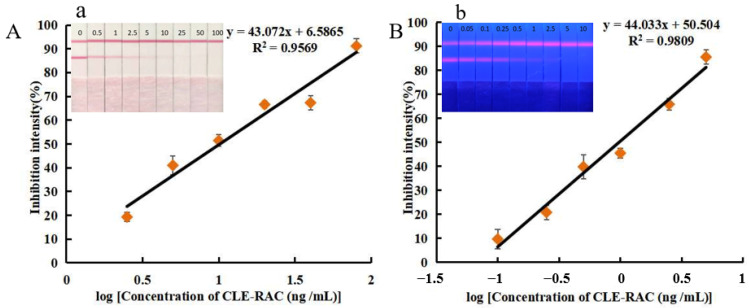
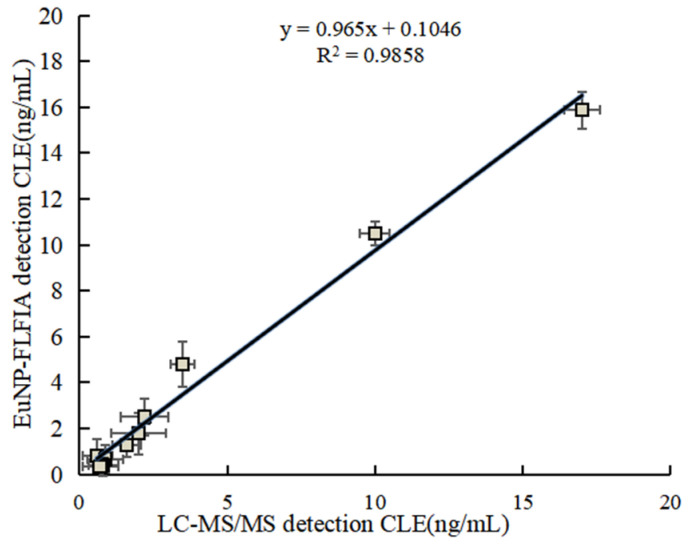
To detect two types of β2-agonist residues at the same time, we coupled two haptens of clenbuterol (CLE) and ractopamine (RAC) to the same carrier protein through diazotization to prepare dimeric artificial antigen, and a fluorescent lateral flow immunoassay method based on europium nanoparticles (EuNP-FLFIA) was established by combining polyclonal antibodies with europium nanoparticles to form probes. Under optimized conditions, the EuNP-FLFIA could simultaneously detect eight aniline-type and one phenol-type β2-agonists, and the limits of detection (LOD) were 0.11−0.19 ng/mL and 0.12 ng/mL, respectively. The recovery rate of this method was 84.00−114.00%. This method was verified by liquid chromatography−tandem mass spectrometry (LC-MS/MS), and the test results were consistent (R2 > 0.98). Therefore, the method established in this study could be used as a high-throughput screening for the efficient and sensitive detection of β2-agonists in food.
Keywords: dimeric artificial antigen; europium nanoparticles; fluorescent lateral flow immunoassay; multi-residue analysis; β2-agonists.
Conflict of interest statement
The authors declare no conflict of interest.
Figures
References
-
- Kaufmann A., Widmer M., Maden K., Butcher P., Walker S. High resolution mass spectrometry-based detection and quantification of β-agonists at relevant trace levels in a variety of animal-based food matrices. Food Addit. Contam. Part A Chem. Anal. Control. Expo. Risk Assess. 2021;38:1350–1363. doi: 10.1080/19440049.2021.1922759. - DOI - PubMed
Grants and funding
LinkOut - more resources
Full Text Sources
Miscellaneous
