. 2022 Mar 4;10(3):607.
doi: 10.3390/biomedicines10030607.

Plasma Metabolomic Profiling Reveals Four Possibly Disrupted Mechanisms in Systemic Sclerosis

Affiliations

Plasma Metabolomic Profiling Reveals Four Possibly Disrupted Mechanisms in Systemic Sclerosis

Thomas Bögl et al. Biomedicines. .

Abstract

Systemic sclerosis (SSc) is a rare systemic autoimmune disorder marked by high morbidity and increased risk of mortality. Our study aimed to analyze metabolomic profiles of plasma from SSc patients by using targeted and untargeted metabolomics approaches. Furthermore, we aimed to detect biochemical mechanisms relevant to the pathophysiology of SSc. Experiments were performed using high-performance liquid chromatography coupled to mass spectrometry technology. The investigation of plasma samples from SSc patients (n = 52) compared to a control group (n = 48) allowed us to identify four different dysfunctional metabolic mechanisms, which can be assigned to the kynurenine pathway, the urea cycle, lipid metabolism, and the gut microbiome. These significantly altered metabolic pathways are associated with inflammation, vascular damage, fibrosis, and gut dysbiosis and might be relevant for the pathophysiology of SSc. Further studies are needed to explore the role of these metabolomic networks as possible therapeutic targets of SSc.

Keywords: LC-MS/MS; gut dysbiosis; ion mobility; kynurenine pathway; lipids; metabolomics; systemic sclerosis; urea cycle.


Conflict of interest statement

The authors declare no conflict of interest. The funders had no role in the design of the study; in the collection, analyses, or interpretation of data; in the writing of the manuscript, or in the decision to publish the results.

Figures
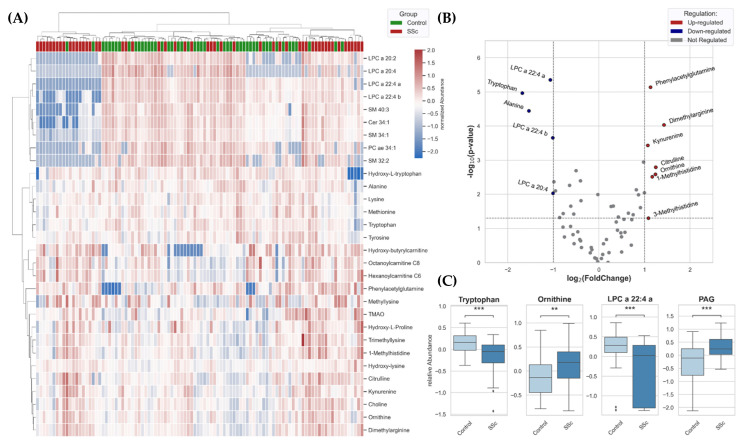
Figure 1
Figure 1
(A) Heatmap for all identified features from plasma of SSc patients (n = 52) and controls (n = 48) was generated based on a selection of the best 30 molecules due to t-tests using clustering method (Distance measure: Euclidean, Algorithm: Ward). (B) p-values and fold change were used for creating a two-dimensional volcano plot of summarized metabolites identified in metabolomics approaches. (C) Box Plots (Box = IQR, whiskers = 1.5 × IQR, horizontal bars = median) of significantly dysregulated metabolites. LPC = lysophosphatidylcholine, PAG = phenylacetylglutamine. p-values were determined using a two-tailed Student’s t-test; p < 0.05 was considered significant (** p < 0.01, *** p < 0.001).
Figure 2
Figure 2
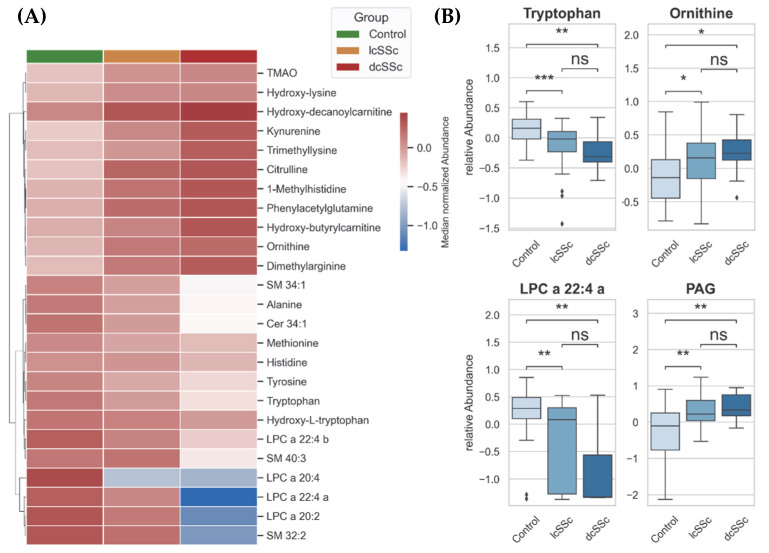
(A) Hierarchical heatmap showing a gradient of metabolites from plasma of control group, patients with limited cutaneous SSc and patients with diffuse cutaneous SSc. Distance measure: Euclidean, Clustering-Algorithm: Ward. (B) Box Plots (Box = IQR, whiskers = 1.5 × IQR, horizontal bars = median) of significantly changed metabolites: tryptophan, ornithine, LPC = lysophosphatidylcholine, and PAG = phenylacetylglutamine. p-values were determined using a two-tailed Student’s t-test; p < 0.05 was considered significant (* p < 0.05, ** p < 0.01, *** p < 0.001, ns: not significant).
Figure 3
Figure 3
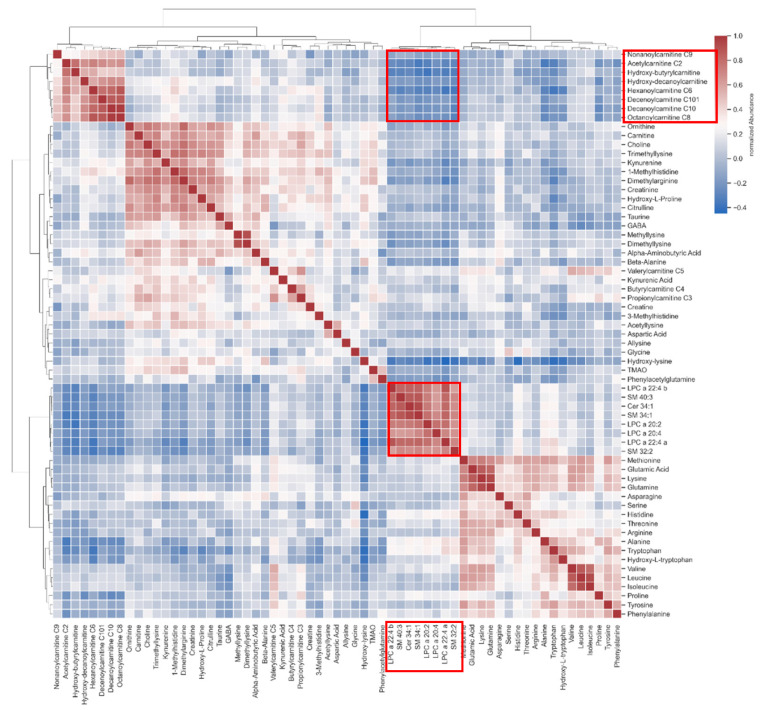
Correlation heatmap showing an interaction of lipids with acyl-carnitines (marked with red squares).
Figure 4
Figure 4
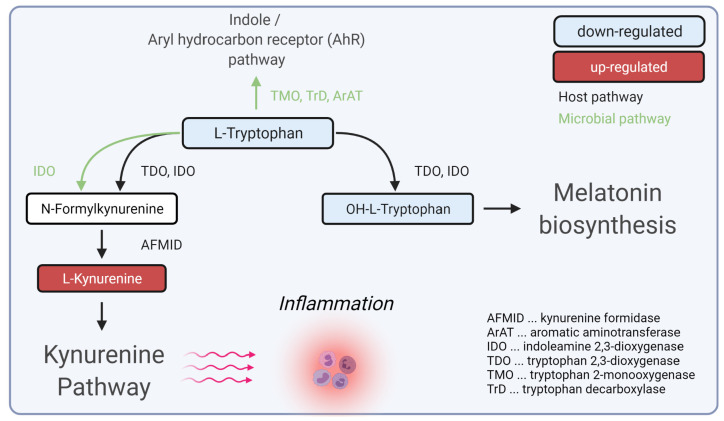
Hypotheses for the role of dysregulated tryptophan/kynurenine pathway during inflammation in SSc. Created with BioRender.com (accessed on 31 December 2021).
Figure 5
Figure 5
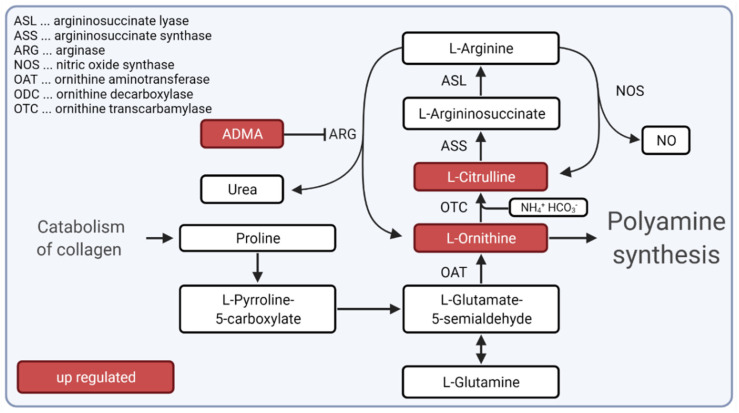
Hypotheses for the role of urea cycle during inflammation and fibrosis in SSc. Our hypothesis suggests that the urea cycle is fueled by collagen catabolism during SSc. Metabolites citrulline and ornithine and dimethylarginine (depicted as ADMA), which is known to inhibit arginase (ARG), were up-regulated in SSc patients. Created with BioRender.com (accessed on 31 December 2021).

References

    1. Varga J., Abraham D. Systemic sclerosis: A prototypic multisystem fibrotic disorder. J. Clin. Invest. 2007;117:557–567. doi: 10.1172/JCI31139. - DOI - PMC - PubMed
    1. Allanore Y., Simms R., Distler O., Trojanowska M., Pope J., Denton C.P., Varga J. Systemic sclerosis. Nat. Rev. Dis. Primers. 2015;1:1–21. doi: 10.1038/nrdp.2015.2. - DOI - PubMed
    1. Denton C.P., Khanna D. Systemic sclerosis. Lancet. 2017;390:1685–1699. doi: 10.1016/S0140-6736(17)30933-9. - DOI - PubMed
    1. Van Den Hoogen F., Khanna D., Fransen J., Johnson S.R., Baron M., Tyndall A., Matucci-Cerinic M., Naden R.P., Medsger T.A., Carreira P.E., et al. 2013 classification criteria for systemic sclerosis: An American College of Rheumatology/European League against Rheumatism collaborative initiative. Arthritis. Rheum. 2013;65:2737–2747. doi: 10.1002/art.38098. - DOI - PMC - PubMed
    1. Gabrielli A., Avvedimento E.V., Krieg T. Scleroderma. N. Engl. J. Med. 2009;360:1989–2003. doi: 10.1056/NEJMra0806188. - DOI - PubMed

LinkOut - more resources