. 2022 Mar 10;13(3):491.
doi: 10.3390/genes13030491.

Pleiotropic Effects of Common and Rare GCKR Exonic Mutations on Cardiometabolic Traits

Affiliations

Pleiotropic Effects of Common and Rare GCKR Exonic Mutations on Cardiometabolic Traits

Kuan-Hung Yeh et al. Genes (Basel). .

Abstract

Background: The common non-synonymous mutation of the glucokinase regulator (GCKR) gene, namely rs1260326, is widely reported to have pleiotropic effects on cardio-metabolic traits and hematological parameters.

Objective: This study aimed to identify whether other GCKR variants may have pleiotropic effects independent of the rs1260326 genotypes.

Methods: In total, 81,097 Taiwan Biobank participants were enrolled for the regional plot association studies and candidate variant analysis of the region around the GCKR gene.

Results: The initial candidate variant approach showed the significant association of the rs1260326 genotypes with multiple phenotypes. Regional plot association analysis of the GCKR gene region further revealed genome-wide significant associations between GCKR variants and serum total and low-density lipoprotein cholesterol; triglyceride, uric acid, creatinine, aspartate aminotransferase, γ-Glutamyl transferase, albumin, and fasting plasma glucose levels; estimated glomerular filtration rate; leukocyte and platelet counts; microalbuminuria, and metabolic syndrome, with rs1260326 being the most common lead polymorphism. Serial conditional analysis identified genome-wide significant associations of two low-frequency exonic mutations, rs143881585 and rs8179206, with high serum triglyceride and albumin levels. In five rare GCKR exonic non-synonymous or nonsense mutations available for analysis, GCKR rs146175795 showed an independent association with serum triglyceride and albumin levels and rs150673460 showed an independent association with serum triglyceride levels. Weighted genetic risk scores from the combination of GCKR rs143881585 and rs146175795 revealed a significant association with metabolic syndrome.

Conclusion: In addition to the rs1260326 variant, low-frequency and rare GCKR exonic mutations exhibit pleiotropic effects on serum triglyceride and albumin levels and the risk of metabolic syndrome. These results provide evidence that both common and rare GCKR variants may play a critical role in predicting the risk of cardiometabolic disorders.

Keywords: GCKR gene; exonic mutation; pleiotropic effect; serum albumin level; serum triglyceride level.


Conflict of interest statement

The authors declare no conflict of interest.

Figures
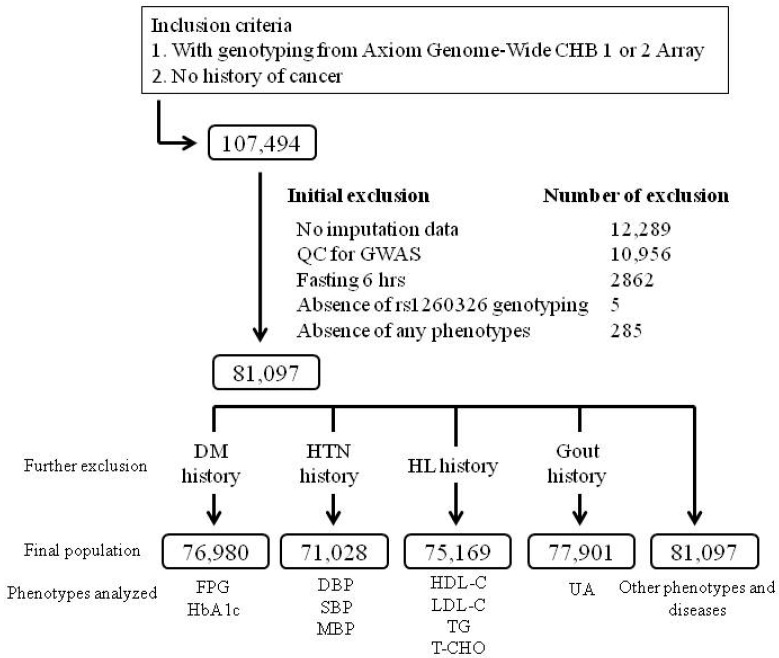
Figure 1
Figure 1
Study flowchart of inclusion and exclusion criteria used to screen Taiwan Biobank project participants. Other phenotypes include age; body mass index; waist circumference; waist–hip ratio; aspartate aminotransferase, alanine aminotransferase, γ-glutamyl transferase, and serum creatinine levels; estimated glomerular filtration rate; serum albumin; total bilirubin; hemoglobin; hematocrit; red blood cell, leukocyte, and platelet counts; and blood urea nitrogen, albuminuria, microalbuminuria, and metabolic syndrome. Abbreviations: QC, quality control; HL, hyperlipidemia; HTN, hypertension; DM, diabetes mellitus; HbA1C, hemoglobin A1C; SBP, systolic blood pressure; DBP, diastolic blood pressure; MBP, mean blood pressure; LDL-C, low-density lipoprotein cholesterol; HDL-C, high-density lipoprotein cholesterol; TG, triglyceride; T-CHO, total cholesterol; UA, uric acid.
Figure 2
Figure 2
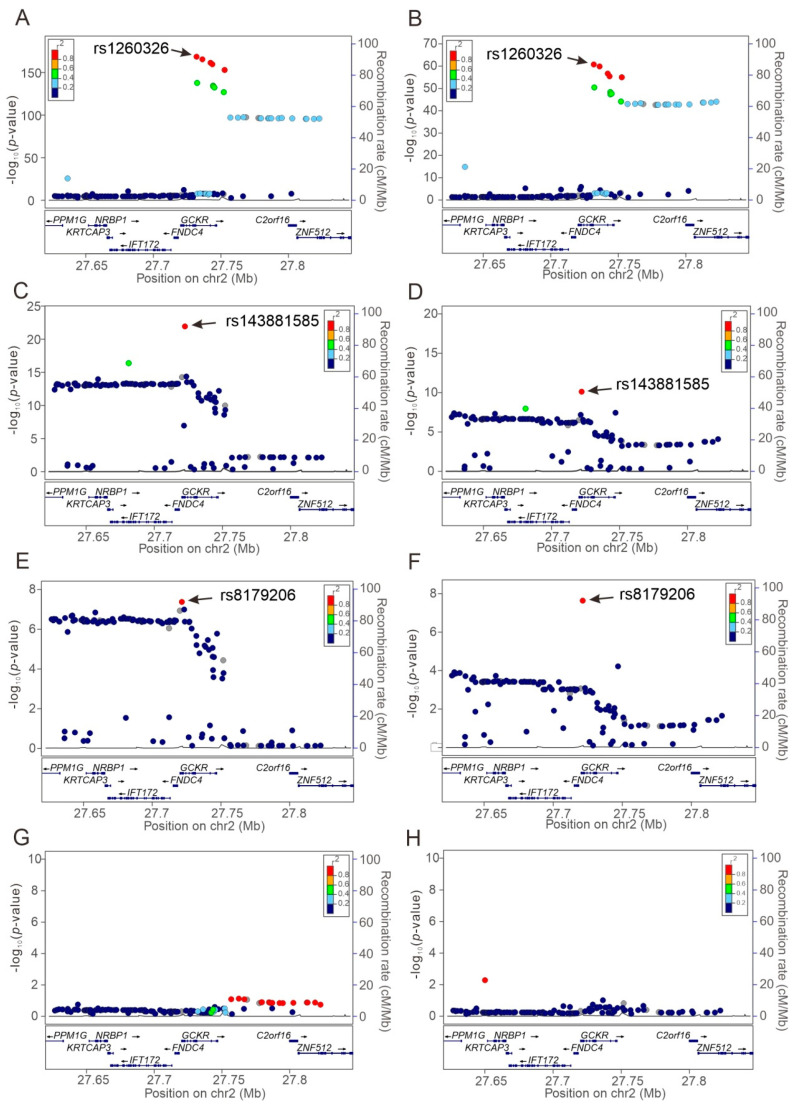
Regional plot associations of the GCKR gene region for the serum triglyceride and albumin levels. Regional plot associations are shown without (A,B) or with serial conditional analysis after further adjustment for rs1260326 (C,D), rs143881585 (E,F), and rs8179206 (G,H) genotypes. Association analyses were performed for serum triglyceride (A,C,E,G) and albumin (B,D,F,H) levels. GCKR, glucokinase regulator.
Figure 3
Figure 3
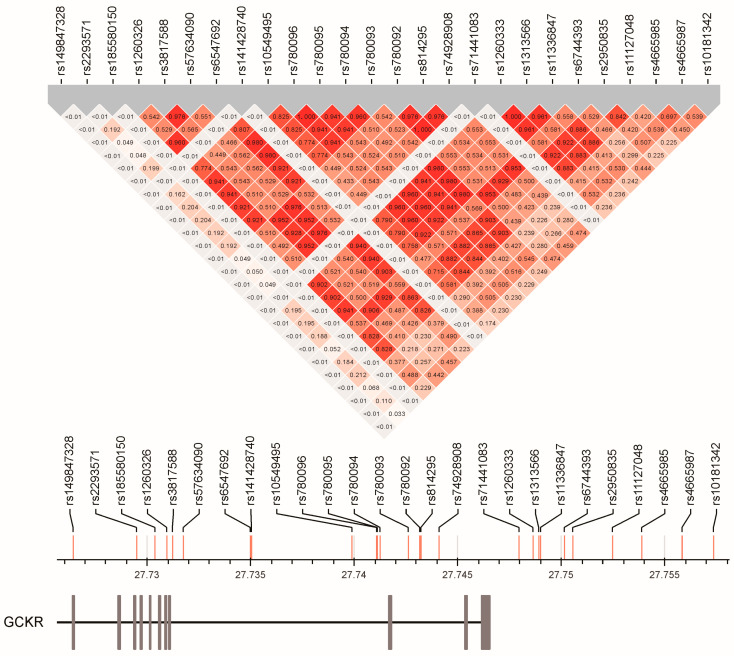
Linkage disequilibrium map of GCKR gene region single-nucleotide polymorphisms.
Figure 4
Figure 4
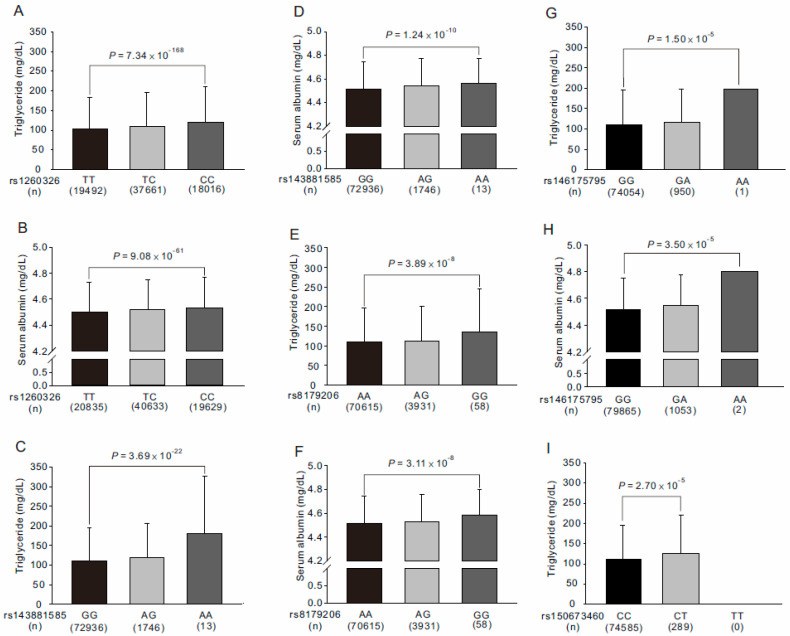
Association of GCKR exonic mutations with serum triglyceride (A,C,E,G,I) and albumin (B,D,F,H) levels in Taiwan Biobank project participants. Further adjusted for rs1260326 genotypes in conditional analysis (C,D). Further adjusted for rs1260326 and rs143881585 genotypes in conditional analysis (E,F).
Figure 5
Figure 5
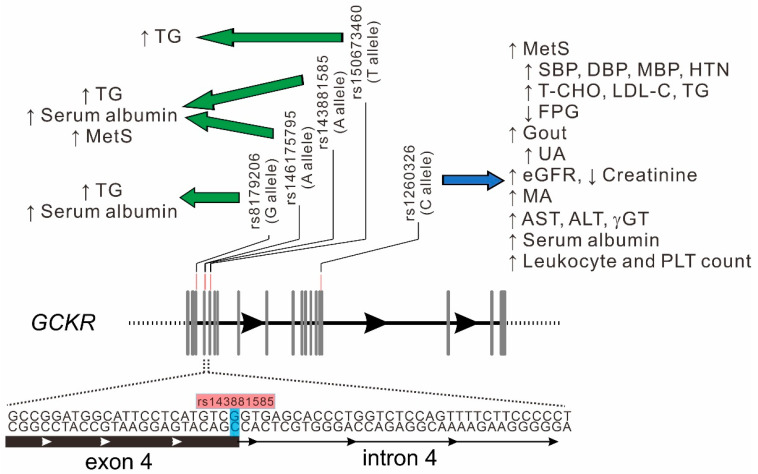
Genomic structure of GCKR variants and their association with various phenotypes/diseases. Green arrow: association with low-frequency and rare GCKR variants. Blue arrow: association with rs1260326 genotypes. Abbreviations: MetS, metabolic syndrome; MA, microalbuminuria; PLT, platelet. Other abbreviations as in Figure 1 and Table 2.

References

    1. Moore M.C., Coate K.C., Winnick J.J., An Z., Cherrington A.D. Regulation of hepatic glucose uptake and storage in vivo. Adv. Nutr. 2012;3:286–294. doi: 10.3945/an.112.002089. - DOI - PMC - PubMed
    1. Iynedjian P.B. Molecular physiology of mammalian glucokinase. Cell. Mol. Life Sci. 2009;66:27–42. doi: 10.1007/s00018-008-8322-9. - DOI - PMC - PubMed
    1. Raimondo A., Rees M.G., Gloyn A.L. Glucokinase regulatory protein: Complexity at the crossroads of triglyceride and glucose metabolism. Curr. Opin. Lipidol. 2015;26:88–95. doi: 10.1097/MOL.0000000000000155. - DOI - PMC - PubMed
    1. Toyoda Y., Miwa I., Satake S., Anai M., Oka Y. Nuclear location of the regulatory protein of glucokinase in rat liver and translocation of the regulator to the cytoplasm in response to high glucose. Biochem. Biophys. Res. Commun. 1995;215:467–473. doi: 10.1006/bbrc.1995.2488. - DOI - PubMed
    1. Veiga-da-Cunha M., Van Schaftingen E. Identification of fructose 6-phosphate- and fructose 1-phosphate-binding residues in the regulatory protein of glucokinase. J. Biol. Chem. 2002;277:8466–8473. doi: 10.1074/jbc.M105984200. - DOI - PubMed

Publication types