


Chronic Pain and Work Conditions of Hotel Housekeepers: A Descriptive Study
- PMID: 35329070
- PMCID: PMC8950313
- DOI: 10.3390/ijerph19063383
Chronic Pain and Work Conditions of Hotel Housekeepers: A Descriptive Study
Abstract
Objectives: To estimate the prevalence of musculoskeletal pain of hotel housekeepers (HHs) and to describe the work conditions and perception of health in this occupational group in the Balearic Islands, Spain.
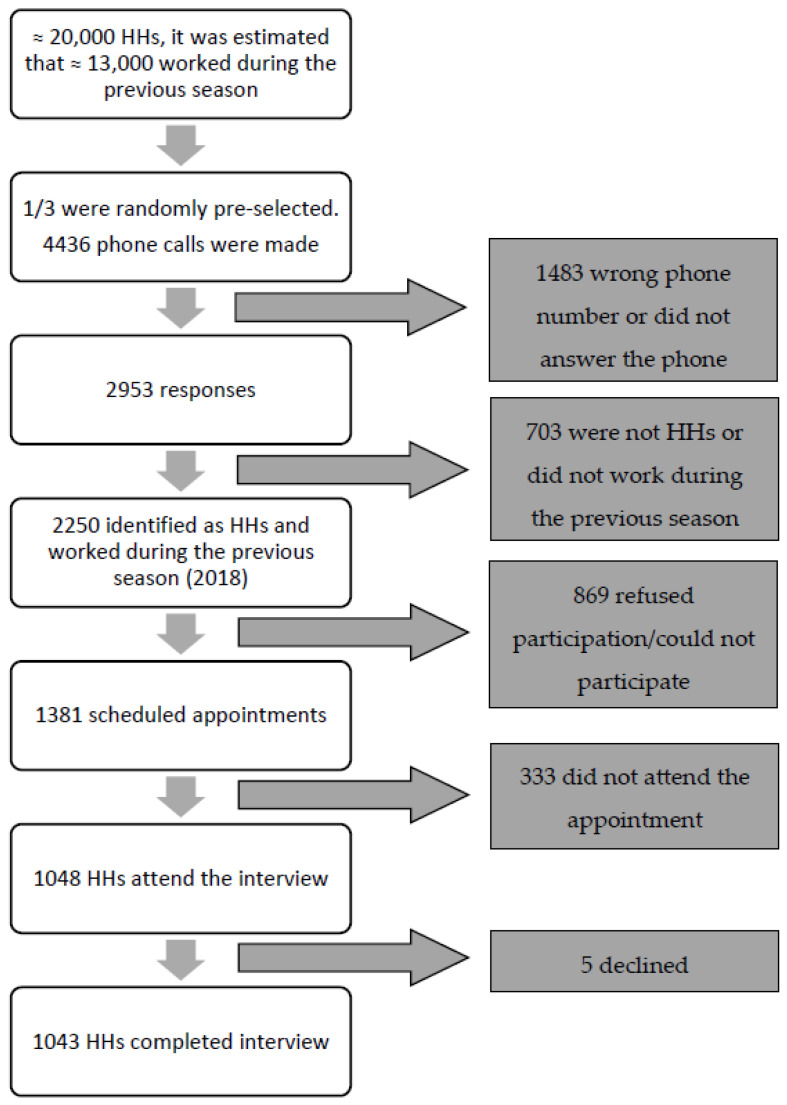
Methods: Cross-sectional descriptive study with HHs of the Balearic Islands, performed in primary care. Random sample of HHs who worked during the 2018 season. We collected information on sociodemographic variables, job characteristics, workload, pain, perceived health, and physical activity. After participants signed the informed consent form, we conducted a face-to-face interview in the primary care centre and accessed the participants' electronic health records.
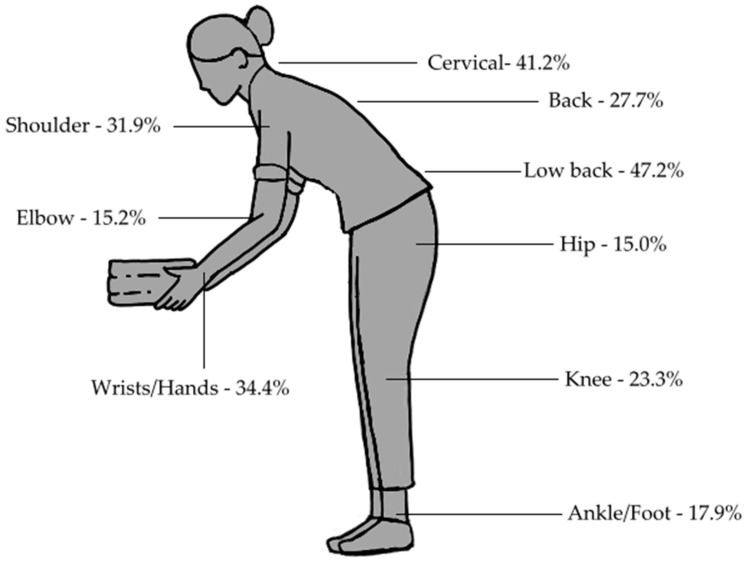
Results: 1043 HHs aged 43.3 ± 10 years and with 10.7 ± 9.1 years worked as HHs were included. 51% (95% CI: 48-54%) reported chronic pain, mainly in the lower back 28.7% (95% CI: 25.9-31.5%), hands/wrists 23.7% (95% CI: 21.1-26.4%), neck 21.6% (95% CI: 19.1-24.3%), shoulders 19.9% (95% CI: 17.4-22.4%), and back 17.8% (95% CI: 15.4-20.2%). Pain was associated with older age, more years worked, more beds made/day and difficulty in pushing the housekeeping cart. More than half HHs reported that they did not incorporate occupational risk prevention measures (ORPMs) into their routine; 17.3% (95% CI: 15.1-19.7%) HHs considered their health as poor or very poor. Perception of health was worse in HHs with chronic pain.
Conclusions: A high percentage of HHs of the Balearic Islands reported chronic pain, a low compliance with ORPMs and compared to women of the same sociodemographic profile they perceive a worse health status.
Keywords: hotel maids; musculoskeletal pain; occupational health; occupational risk; perceived health status.
Conflict of interest statement
The authors declare that they have no conflict of interest.
Figures
Similar articles
-
Psychosocial Work Factors, Job Stress, and Self-Rated Health Among Hotel Housekeepers.Workplace Health Saf. 2025 Mar;73(3):116-130. doi: 10.1177/21650799241282787. Epub 2024 Oct 30. Workplace Health Saf. 2025. PMID: 39475436 Free PMC article.
-
Socioeconomic determinants and self-rated health among hotel housekeepers in the Balearic Islands (Spain).Front Public Health. 2024 Sep 2;12:1390582. doi: 10.3389/fpubh.2024.1390582. eCollection 2024. Front Public Health. 2024. PMID: 39286742 Free PMC article.
-
The impact of work-related risk factors on the development of neck and upper limb pain among low wage hotel housekeepers in Gondar town, Northwest Ethiopia: institution-based cross-sectional study.Environ Health Prev Med. 2019 May 3;24(1):27. doi: 10.1186/s12199-019-0779-7. Environ Health Prev Med. 2019. PMID: 31053058 Free PMC article.
-
Prevalence of Musculoskeletal Disorders for Nurses in Hospitals, Long-Term Care Facilities, and Home Health Care: A Comprehensive Review.Hum Factors. 2015 Aug;57(5):754-92. doi: 10.1177/0018720815581933. Epub 2015 Apr 21. Hum Factors. 2015. PMID: 25899249 Review.
-
Agency-hired hotel housekeepers: an at-risk group for adverse health outcomes.Workplace Health Saf. 2014 Feb;62(2):81-5; quiz 86. doi: 10.1177/216507991406200205. Workplace Health Saf. 2014. PMID: 24512722 Free PMC article. Review.
Cited by
-
Psychosocial Work Factors, Job Stress, and Self-Rated Health Among Hotel Housekeepers.Workplace Health Saf. 2025 Mar;73(3):116-130. doi: 10.1177/21650799241282787. Epub 2024 Oct 30. Workplace Health Saf. 2025. PMID: 39475436 Free PMC article.
-
Socioeconomic determinants and self-rated health among hotel housekeepers in the Balearic Islands (Spain).Front Public Health. 2024 Sep 2;12:1390582. doi: 10.3389/fpubh.2024.1390582. eCollection 2024. Front Public Health. 2024. PMID: 39286742 Free PMC article.
-
Investigation of Working Conditions and Health Status in Platform Workers in the Republic of Korea.Saf Health Work. 2024 Mar;15(1):17-23. doi: 10.1016/j.shaw.2024.01.002. Epub 2024 Jan 20. Saf Health Work. 2024. PMID: 38496284 Free PMC article.
References
-
- Fingerhut M., Nelson D.I., Driscoll T., Concha-Barrientos M., Steenland K., Punnett L., Prüss-Ustün A., Leigh J., Corvalan C., Eijkemans G., et al. The contribution of occupational risks to the global burden of disease: Summary and next steps. Med. Lav. 2006;97:313–321. - PubMed
-
- Abdol Rahman M.N., Muhamad Jaffar M.S., Hassan M.F., Ngali M.Z., Pauline O. Exposure level of ergonomic risk factors in hotel industries. IOP Conf Ser Mater Sci Eng. 2017;226:012018. doi: 10.1088/1757-899X/226/1/012018. - DOI
-
- Abdol Rahman M.N., Muhamad Jaffar M.S. Musculoskeletal Symptoms and Ergonomic Hazards Among Room Attendants in Hotel Industries. Malays. J. Hum. Factors Ergon. 2017;1:25–34.
Publication types
MeSH terms
LinkOut - more resources
Full Text Sources
Medical
