


Exposure and Risk Assessment of Second- and Third-Hand Tobacco Smoke Using Urinary Cotinine Levels in South Korea
- PMID: 35329433
- PMCID: PMC8948619
- DOI: 10.3390/ijerph19063746
Exposure and Risk Assessment of Second- and Third-Hand Tobacco Smoke Using Urinary Cotinine Levels in South Korea
Abstract
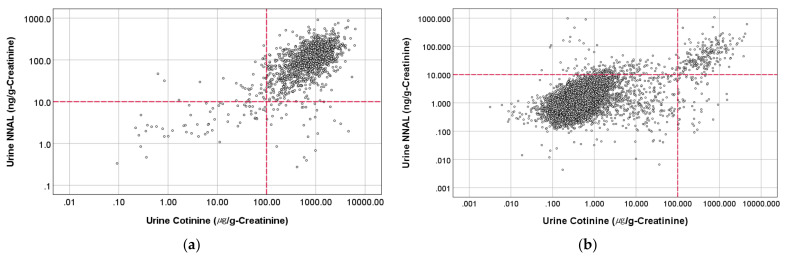
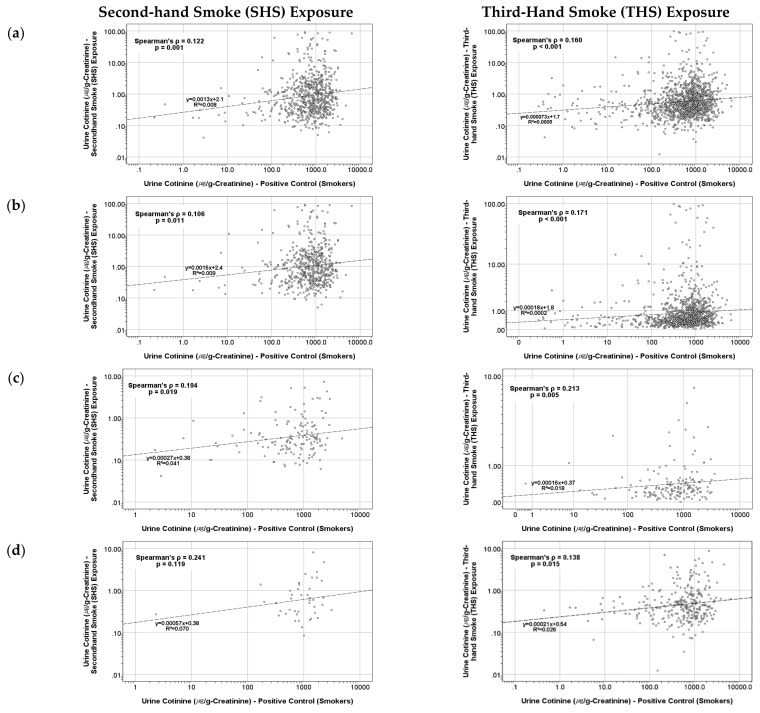
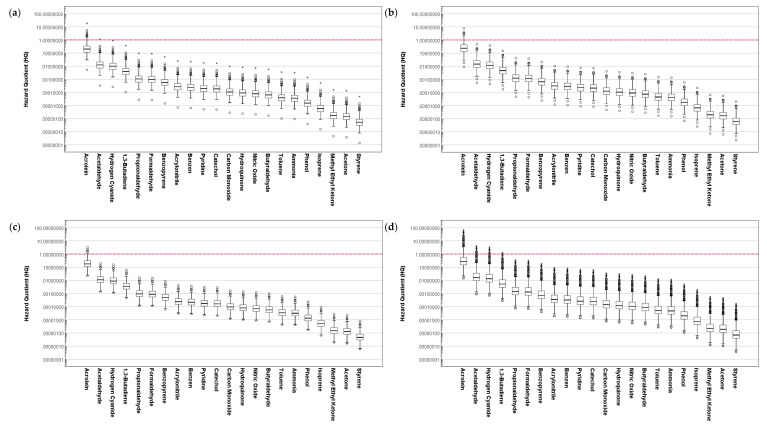
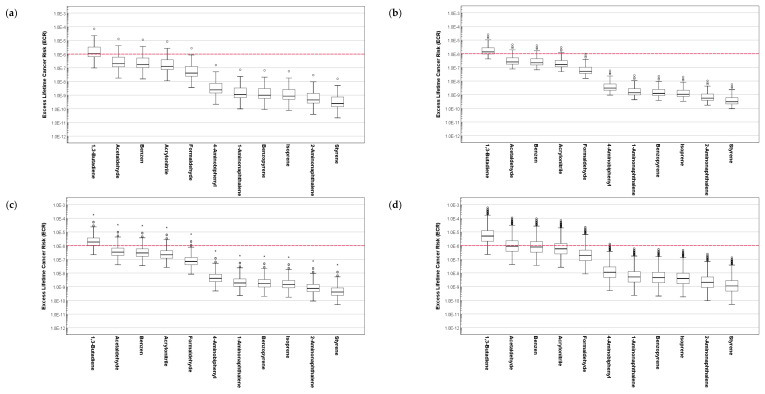
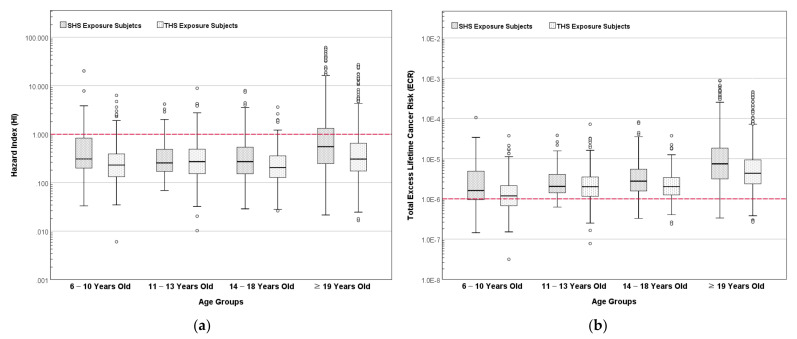
Exposure to environmental tobacco smoke (ETS) is the reason for approximately 1% of global mortality. ETS exposure can happen either as inhalation of direct cigarette smoke (second-hand smoke) or its associated residue particles (third-hand smoke), especially when living with a smoker in the same family. This study investigated the association between the urinary cotinine levels, as biomarkers of exposure to tobacco smoke, of smokers and those exposed to second-hand and third-hand smoke while living in the same family, through a Korean nationwide survey. Direct assessment of ETS exposure and its lifetime effect on human health is practically difficult. Therefore, this study evaluated the internal estimated daily intake (I-EDI) of nicotine and equivalent smoked cigarette per day (CPD). The carcinogenic and non-carcinogenic inhalation risks of ETS exposure were assessed by considering the calculated equivalent CPD and composition of cigarette smoke of high-selling cigarette brands in South Korea. The results show that there is a statistically significant positive correlation between the cotinine levels of smokers and those of the non-smokers living in the same family. The risk assessment results yielded that hazard index (HI) and total excess lifetime cancer risk (ECR) for both second-hand and third-hand smoke exposure can exceed 1 and 1 × 10⁻⁶, respectively, especially in women and children. In the composition of the cigarette smoke, 1,3-butadiene and acrolein substances had the highest contribution to HI and ECR. Consequently, the provision of appropriate plans for smoking cessation as a strategy for the prevention of ETS exposure to women and children is deemed necessary.
Keywords: cotinine; environmental tobacco smoke; excess lifetime cancer risk; hazard index; second-hand smoke; third-hand smoke.
Conflict of interest statement
The authors declare no conflict of interest.
Figures


References
-
- World Health Organization Tobacco. [(accessed on 12 October 2021)]. Available online: https://www.who.int/news-room/fact-sheets/detail/tobacco.
-
- Sadreameli S.C., Kopp B.T., Creary S.E., Eakin M.N., McGrath-Morrow S., Strouse J.J. Secondhand Smoke Is an Important Modifiable Risk Factor in Sickle Cell Disease: A Review of the Current Literature and Areas for Future Research. Int. J. Environ. Res. Public Health. 2016;13:1131. doi: 10.3390/ijerph13111131. - DOI - PMC - PubMed
-
- Kopp B.T., Ortega-García J.A., Sadreameli S.C., Wellmerling J., Cormet-Boyaka E., Thompson R., McGrath-Morrow S., Groner J.A. The Impact of Secondhand Smoke Exposure on Children with Cystic Fibrosis: A Review. Int. J. Environ. Res. Public Health. 2016;13:1003. doi: 10.3390/ijerph13101003. - DOI - PMC - PubMed
Publication types
MeSH terms
Substances
LinkOut - more resources
Full Text Sources
Medical
