Review
. 2022 Mar 17;12(3):446.
doi: 10.3390/life12030446.

Near-Infrared Fluorescence Tumor-Targeted Imaging in Lung Cancer: A Systematic Review

Affiliations
Review

Near-Infrared Fluorescence Tumor-Targeted Imaging in Lung Cancer: A Systematic Review

Lisanne K A Neijenhuis et al. Life (Basel). .

Abstract

Lung cancer is the most common cancer type worldwide, with non-small cell lung cancer (NSCLC) being the most common subtype. Non-disseminated NSCLC is mainly treated with surgical resection. The intraoperative detection of lung cancer can be challenging, since small and deeply located pulmonary nodules can be invisible under white light. Due to the increasing use of minimally invasive surgical techniques, tactile information is often reduced. Therefore, several intraoperative imaging techniques have been tested to localize pulmonary nodules, of which near-infrared (NIR) fluorescence is an emerging modality. In this systematic review, the available literature on fluorescence imaging of lung cancers is presented, which shows that NIR fluorescence-guided lung surgery has the potential to identify the tumor during surgery, detect additional lesions and prevent tumor-positive resection margins.

Keywords: fluorescence-guided surgery; lung cancer; molecular imaging; near-infrared fluorescence imaging; optical imaging.


Conflict of interest statement

The authors declare no conflict of interest.

Figures
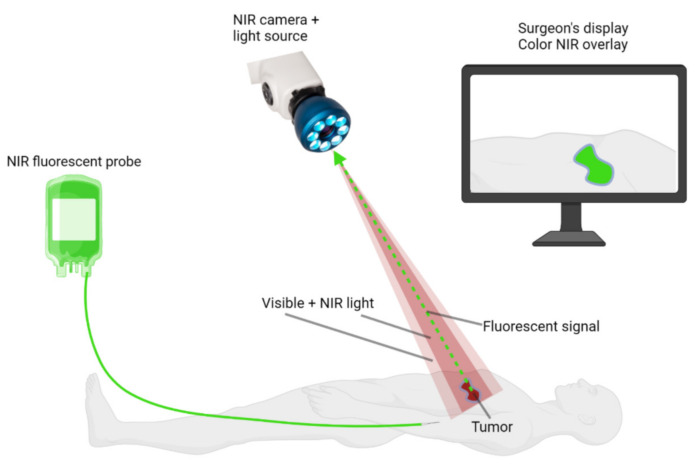
Figure 1
Figure 1
Basic principles of NIR fluorescence-guided surgery. A NIR fluorescent probe is administered to the patient intravenously, intraparenchymally, or topically. A NIR fluorescence imaging system is used to visualize the probe during surgery. These systems require NIR excitation light, collection optics and filtration, and a camera sensitive to NIR fluorescence emission light. NIR fluorescence images are displayed on a screen, and these images are merged with white-light images of the surgical field. Created with BioRender.com.
Figure 2
Figure 2
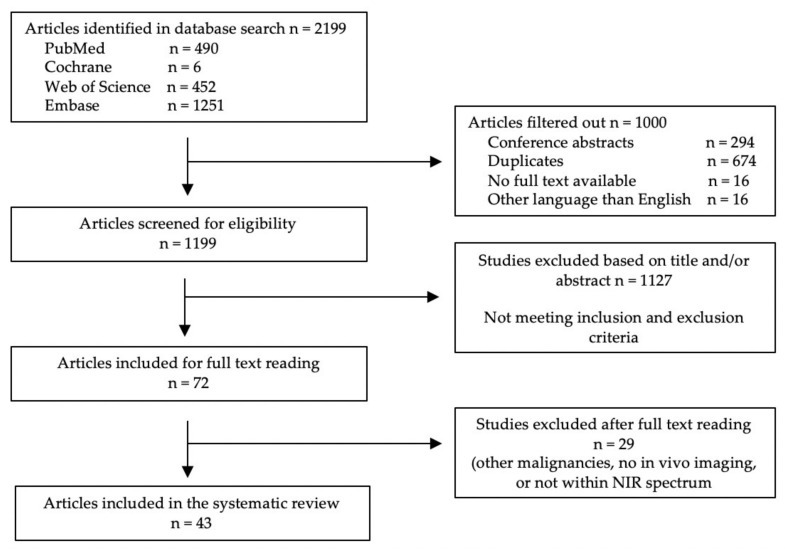
Summary of study selection.
Figure 3
Figure 3
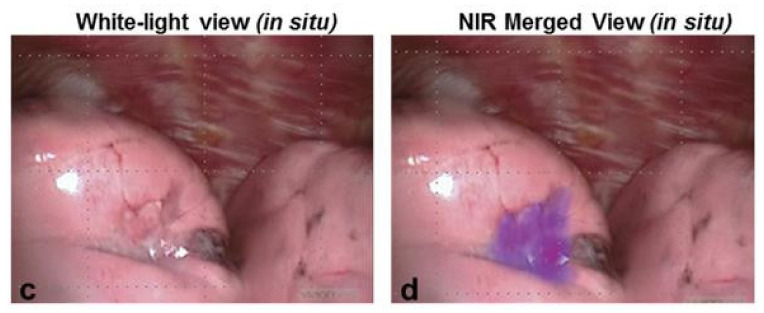
Fluorescence imaging results using OTL38. A squamous cell lung cancer was clearly visible (TBR 3.7) with intraoperative fluorescence imaging after intravenous injection of 0.025 mg/kg OTL38 6 h prior to surgery [76]. It shows an image in white light (c) and a merged image of white light and near-infrared (d).

References

    1. Bray F., Ferlay J., Soerjomataram I., Siegel R.L., Torre L.A., Jemal A. Global cancer statistics 2018: GLOBOCAN estimates of incidence and mortality worldwide for 36 cancers in 185 countries. CA Cancer J. Clin. 2018;68:394–424. doi: 10.3322/caac.21492. - DOI - PubMed
    1. Lemjabbar-Alaoui H., Hassan O.U., Yang Y.-W., Buchanan P. Lung cancer: Biology and treatment options. Biochim. Biophys. Acta BBA Rev. Cancer. 2015;1856:189–210. doi: 10.1016/j.bbcan.2015.08.002. - DOI - PMC - PubMed
    1. Snijder R.J., de la Rivière A.B., Elbers H.J., Bosch J.M.V.D. Survival in Resected Stage I Lung Cancer with Residual Tumor at the Bronchial Resection Margin. Ann. Thorac. Surg. 1998;65:212–216. doi: 10.1016/S0003-4975(97)01114-4. - DOI - PubMed
    1. Riquet M., Achour K., Foucault C., Barthes F.L.P., Dujon A., Cazes A. Microscopic Residual Disease after Resection for Lung Cancer: A Multifaceted but Poor Factor of Prognosis. Ann. Thorac. Surg. 2010;89:870–875. doi: 10.1016/j.athoracsur.2009.11.052. - DOI - PubMed
    1. Hofmann H., Taege C., Lautenschläger C., Neef H., Silber R. Microscopic (R1) and macroscopic (R2) residual disease in patients with resected non-small cell lung cancer. Eur. J. Cardio-Thoracic Surg. 2002;21:606–610. doi: 10.1016/S1010-7940(02)00030-1. - DOI - PubMed

LinkOut - more resources