. 2022 Feb 23;8(3):220.
doi: 10.3390/jof8030220.

Terbinafine Resistance in Dermatophytes: A French Multicenter Prospective Study

Affiliations

Terbinafine Resistance in Dermatophytes: A French Multicenter Prospective Study

Alicia Moreno-Sabater et al. J Fungi (Basel). .

Abstract

In recent years, we have moved from the sporadic description of terbinafine-resistant (TerR) Trichophyton spp. isolates to the Indian outbreak due to T. indotineae. Population flows have spread TerR worldwide, altering local epidemiology. We conducted a prospective multicentric study to determine the relative frequency of TerR isolates in France (Paris area) and of the newly introduced T. indotineae species. TerR isolates were screened by the terbinafine-containing-agar-medium (TCAM) method and confirmed by EUCAST. Sequencing methods were used to identify isolates to the species/genotype level and to analyze substitutions in the squalene epoxidase gene (SQLE). In total, 3 isolates out of 580 (T. rubrumn = 1; T. interdigitalen = 1; T. indotineaen = 1) grew on TCAM, showed terbinafine resistance by EUCAST and harbored the Phe397Leu (n = 2) or Leu393Ser (n = 1) substitution in the SQLE. ITS-sequencing of isolates of the T. mentagrophytes/interdigitale complex (n = 125) revealed a relative frequency of 4.8% for T. indotineae and the presence of T. mentagrophytes genotype VII. Despite the detection of terbinafine resistance, isolates from this complex remained susceptible to itraconazole, voriconazole and amorolfine. Terbinafine resistance is present in France and the dermatophyte epidemiology is changing. Efficient systems must be implemented to survey the evolution of newly introduced species and to identify TerR isolates.

Keywords: Trichophyton; Trichophyton indotineae; dermatophytes; resistance; terbinafine.


Conflict of interest statement

During the past 5 years, Eric Dannaoui has received research grants from MSD and Gilead; travel grants from Gilead, MSD, Pfizer, and Astellas; and speaker’s fees from Gilead, MSD, and Astellas.

Figures
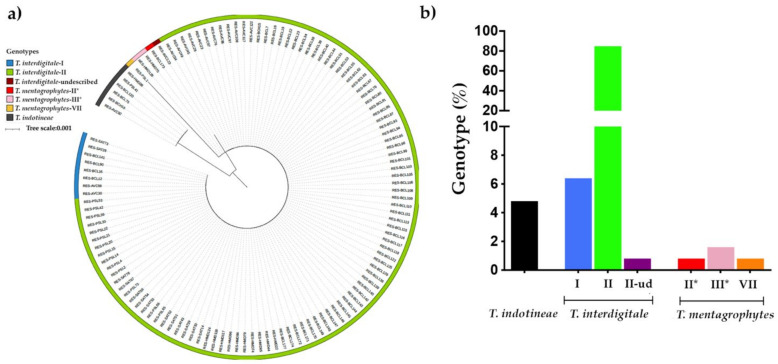
Figure 1
Figure 1
Molecular identification of 125 T. indotineae, T. interdigitale, and T. mentagrophytes isolates collected in Paris area, France. (a) Phylogenetic maximum likelihood tree based on ITS-sequences of the clinical isolates from the T. mentagrophytes/interdigitale complex included in this study. (b) Relative frequency of each dermatophyte species and genotype from the T. mentagrophytes/interdigitale complex. Ud = undescribed.
Figure 2
Figure 2
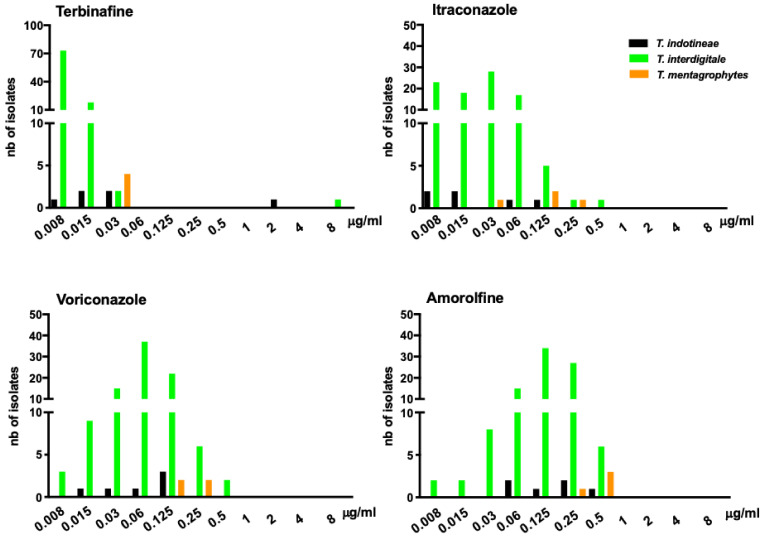
Distribution of terbinafine, itraconazole, voriconazole and amorolfine MIC values for 104 clinical isolates of T. indotineae, T. interdigitale and T. mentagrophytes collected in the Paris area, France. Terbinafine-resistant strains are limited to T. indotineae and T. interdigitale. MIC distribution shows that isolate population studied remains susceptible to the four antifungal drugs, despite the detection of two TerR isolates. T. indotineae n = 6; T. interdigitale n = 94; T. mentagrophytes n = 4.

References

    1. Martinez-Rossi N.M., Peres N.T.A., Bitencourt T.A., Martins M.P., Rossi A. State-of-the-Art Dermatophyte Infections: Epidemiology Aspects, Pathophysiology, and Resistance Mechanisms. J. Fungi. 2021;7:629. doi: 10.3390/jof7080629. - DOI - PMC - PubMed
    1. Mukherjee P.K., Leidich S.D., Isham N., Leitner I., Ryder N.S., Ghannoum M.A. Clinical Trichophyton rubrum strain exhibiting primary resistance to terbinafine. Antimicrob. Agents Chemother. 2003;47:82–86. doi: 10.1128/AAC.47.1.82-86.2003. - DOI - PMC - PubMed
    1. Favre B., Ghannoum M.A., Ryder N.S. Biochemical characterization of terbinafine-resistant Trichophyton rubrum isolates. Med. Mycol. 2004;42:525–529. doi: 10.1080/13693780410001661482. - DOI - PubMed
    1. Osborne C.S., Leitner I., Favre B., Ryder N.S. Amino acid substitution in Trichophyton rubrum squalene epoxidase associated with resistance to terbinafine. Antimicrob. Agents Chemother. 2005;49:2840–2844. doi: 10.1128/AAC.49.7.2840-2844.2005. - DOI - PMC - PubMed
    1. Osborne C.S., Leitner I., Hofbauer B., Fielding C.A., Favre B., Ryder N.S. Biological, biochemical, and molecular characterization of a new clinical Trichophyton rubrum isolate resistant to terbinafine. Antimicrob. Agents Chemother. 2006;50:2234–2236. doi: 10.1128/AAC.01600-05. - DOI - PMC - PubMed

LinkOut - more resources