. 2022 Feb 26;8(3):230.
doi: 10.3390/jof8030230.

Ganoderma zonatum Is the Causal Agent of Basal Stem Rot in Oil Palm in Colombia

Affiliations

Ganoderma zonatum Is the Causal Agent of Basal Stem Rot in Oil Palm in Colombia

Sandra Yulieth Castillo et al. J Fungi (Basel). .

Abstract

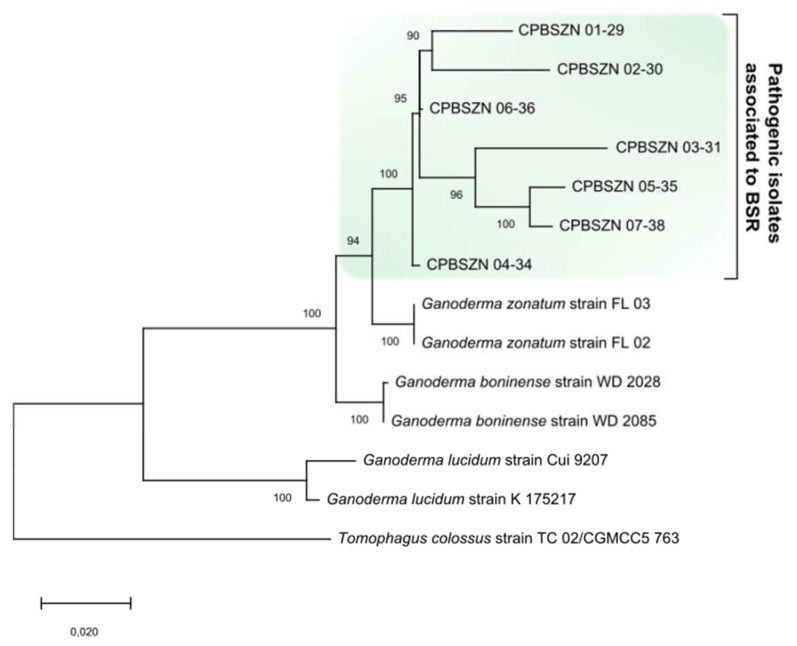
Basal stem rot (BSR), caused by Ganoderma spp., is one of the most important emerging oil palm diseases in Colombia, and is restricted to two oil palm production areas in the country. To identify the causal agent of the disease, basidiocarp of oil palms affected by BSR were used to prepare isolates, and their pathogenicity was then assessed in pre-nursery plants. Four-month-old oil palm seedlings were inoculated with rubber wood (Hevea brasiliensis) blocks colonized with dikaryotic mycelia of Ganoderma. The incidence, severity, and symptoms of the pathogen were assessed. A multiregional analysis (ITS, rpb2, and tef1-α) was carried out to identify the isolates; all isolates were determined to be Ganoderma zonatum. Phylogenetic analyses with the three regions yielded concordant phylogenetic information and supported the distinction of the isolates with high bootstrap support. Seven isolates (CPBsZN-01-29, CPBsZN-02-30, CPBsZN-03-31, CPBsZN-04-34, CPBsZN-05-35, CPBsZN-06-36, and CPBsZN-07-38) were pathogenic in oil palm, with incidences greater than 90% and a maximum severity of 34%, and the highest severity index was found in isolates CPBsZN-03-31, CPBsZN-04-34, and CPBsZN-06-36. The pathogen was recovered from inoculated oil palms in all cases. This study reveals the pathogenic association of Ganoderma zonatum with BSR in Colombia.

Keywords: Elaeis guineensis; pathogenicity; phylogenetic analysis.


Conflict of interest statement

The authors declare that they have no conflict of interest.

Figures
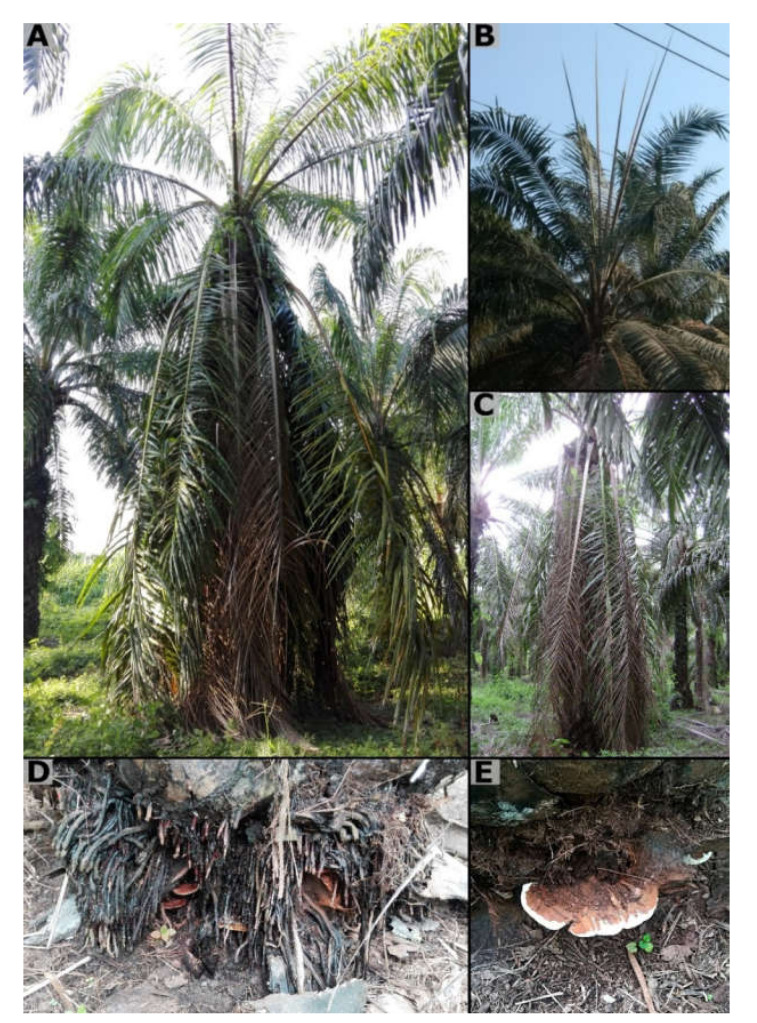
Figure 1
Figure 1
External symptoms observed in oil palms affected by BSR in the field in Colombia. (A) Oil palm with symptoms of wilting and chlorosis. (B) Unopened spears. (C) Snapping/flattening of the crown. (D) Formation of adventitious roots. (E) Typical basidiocarps of Ganoderma zonatum on a BSR affected palm.
Figure 2
Figure 2
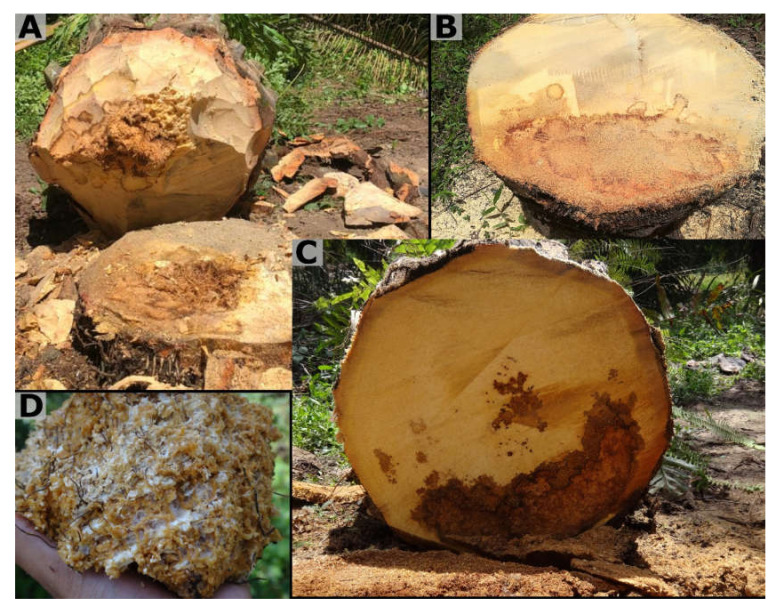
Internal development of lesions of Ganoderma in oil palms in Colombia. (A,B) Presence of lesions with irregular border (C) Delimitation of light and dark areas. (D) Presence of mycelium in debris stem.
Figure 3
Figure 3
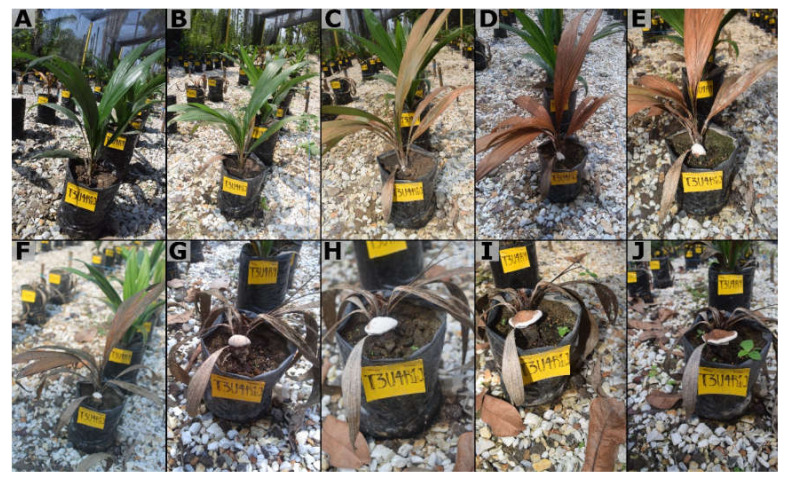
Progression of the symptom of basal stem rot in four-month-old oil palm seedlings inoculated with Ganoderma zonatum. (A) Asymptomatic infected seedlings at 15 weeks post inoculation (wpi). (B) Seedling infected at 18 (wpi) with necrosis on lower leaves. (C) Seedling at 21 wpi with generalized necrosis and mycelium formation at the base of the stem. (DF) Infected seedling >23 wpi with visible basidiocarp. (GJ) seedling infected at >26 wpi shows complete basidiocarp formation.
Figure 4
Figure 4
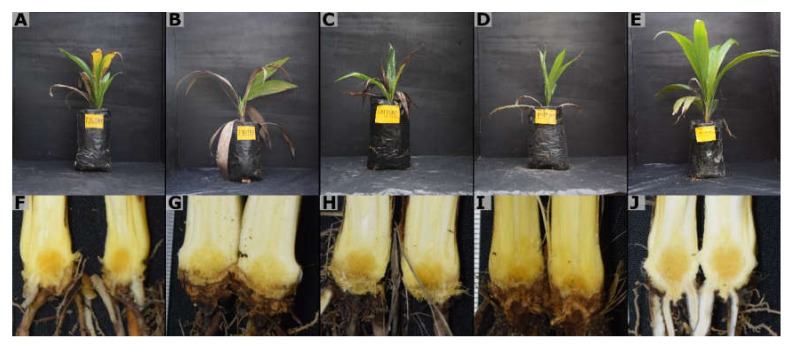
Oil palm seedlings exhibit external and internal symptoms. (AD) Foliar symptoms in plants inoculated. (FI) Bulb of the infected seedlings show brown coloration and necrosis. (E,J) Control (uninoculated) without signs of necrosis and healthy bulb.
Figure 5
Figure 5
Seedlings inoculated with isolates of Ganoderma zonatum that presented the formation of basidiocarp. (A) CPBsZN-01-29. (B) CPBsZN-03-31. (C) CPBsZN-04-34. (D) CPBsZN-06-36.
Figure 6
Figure 6
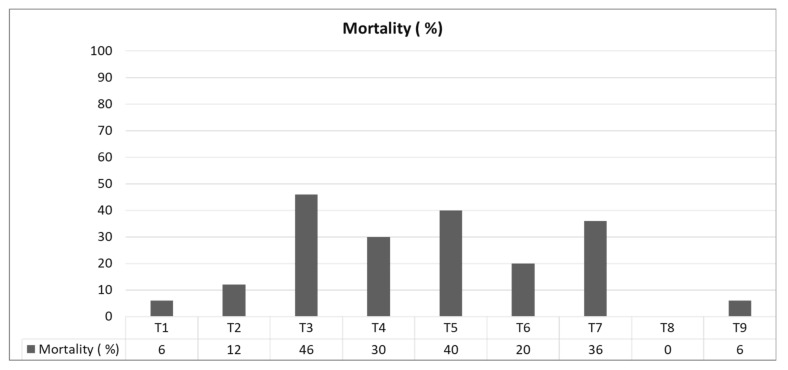
Mortality rate in nursery oil palms inoculated with isolates of Ganoderma obtained from oil palms affected by BSR in northern Colombia after 29 weeks.
Figure 7
Figure 7
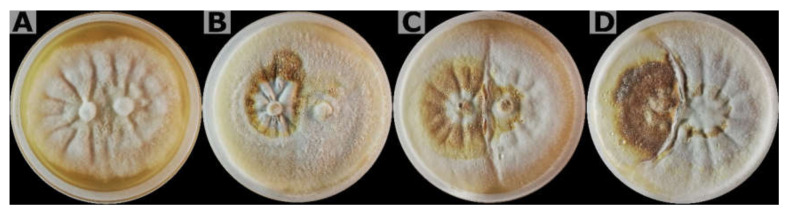
Somatic compatibility of seven isolates of Ganoderma using in this study, showing formation of inhibition zone or barrage in incompatible reactions. (A) compatible reaction of self-pairing (control) between CPBsZN-01-29; (B) incompatible reaction between isolates CPBsZN-03-31 and CPBsZN-07-38 (weak interaction); (C) incompatible reaction between isolates CPBsZN-04-34 and CPBsZN-05-35 (moderate interaction); and (D) incompatible reaction between isolates CPBsZN-02-30 and CPBsZN-03-31 (strong interaction).
Figure 8
Figure 8
Phylogenetic tree of isolates associated with BSR based on data provided by a combination of the ITS, rpb2, and tef1α regions. The numbers above the nodes represent bootstrap values. The topology and values are derived from maximum likelihood analysis.

References

    1. Fedepalma . Principales Cifras de la Agroindustria de la Palma de Aceite en Colombia y en el Mundo 2016–2020. Fedepalma; Bogotá, Colombia: 2021. Anuario estadístico 2021; p. 244.
    1. Afandi D., Basyuni M., Putri L.A., Chalil D., Syahputra I. Expression of oil palm (Elaeis guineensis) polyisoprenoids in response to Ganoderma boninense infection. Biodiversitas J. Biol. Divers. 2018;20:68–76. doi: 10.13057/biodiv/d200109. - DOI
    1. Nusaibah S.A., Akmar A.S.N., Idris A.S., Sariah M., Pauzi Z.M. Involvement of metabolites in early defense mechanism of oil palm (Elaeis guineensis Jacq.) against Ganoderma disease. Plant Physiol. Biochem. 2016;109:156–165. doi: 10.1016/j.plaphy.2016.09.014. - DOI - PubMed
    1. Wong L.C., Bong C.F.J., Idris A. Ganoderma species associated with basal stem rot Disease of Oil Palm. Am. J. Appl. Sci. 2012;9:879–885. doi: 10.3844/ajassp.2012.879.885. - DOI
    1. Idris A., Ariffin D., Swinburne T., Watt T. The identity of Ganoderma species responsible for BSR disease of oil palm in Malaysia—morphological characteristics. MPOB Inf. Ser. 2000;14:225.

LinkOut - more resources