


A Fitness-Fatigue Model of Performance in Peripheral Artery Disease: Predicted and Measured Effects of a Pain-Free Exercise Program
- PMID: 35330397
- PMCID: PMC8949585
- DOI: 10.3390/jpm12030397
A Fitness-Fatigue Model of Performance in Peripheral Artery Disease: Predicted and Measured Effects of a Pain-Free Exercise Program
Abstract
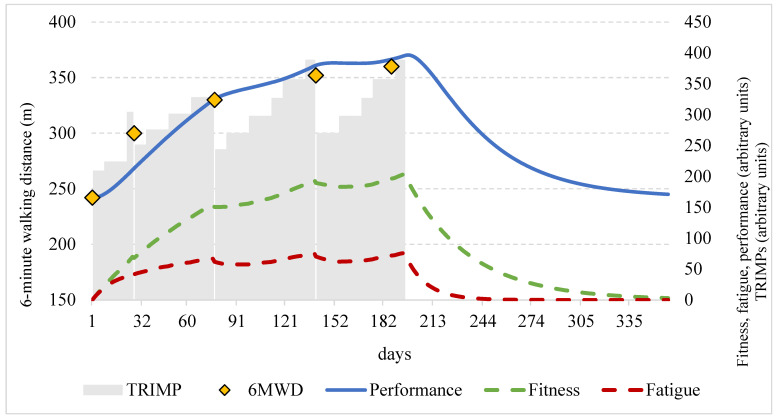
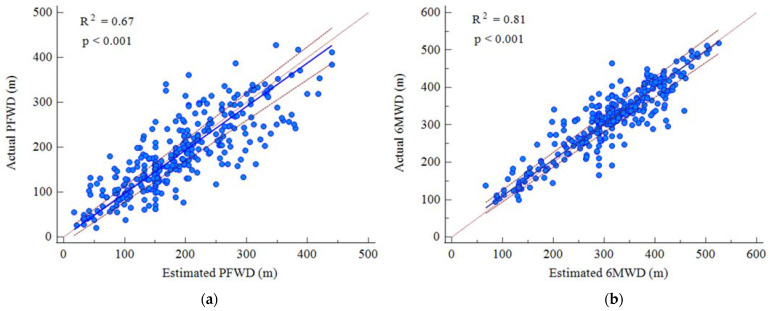
Banister impulse-response (IR) model estimates the performance in response to the training impulses (TRIMPs). In 100 patients with peripheral artery disease (PAD), we tested by an IR model the predictability of the effects of a 6-month structured home-based exercise program. The daily TRIMPs obtained from prescribed walking speed, relative intensity and time of exercise determined the fitness-fatigue components of performance. The estimated performance values, calculated from the baseline 6-min and pain-free walking distance (6MWD and PFWD, respectively) were compared with values measured at visits through regression models. Interval pain-free walking at controlled speed prescribed during circa-monthly hospital visits (5 ± 1) was safely performed at home with good adherence (92% of scheduled sessions, 144 ± 25 km walked in 50 ± 8 training hours). The mean TRIMP rose throughout the program from 276 to 601 a.u. The measured 6MWD and PFWD values increased (+33 m and +121 m, respectively) showing a good fit with those estimated by the IR model (6MWD: R2 0.81; PFWD: R2 0.68) and very good correspondence (correlation coefficients: 0.91 to 0.95), without sex differences. The decay of performance without training was estimated at 18 ± 3 weeks. In PAD, an IR model predicted the walking performance following a pain-free exercise program. IR models may contribute to design and verify personalized training programs.
Keywords: exercise therapy; gender differences; impulse-response; peripheral artery disease; rehabilitation; training.
Conflict of interest statement
The authors declare no conflict of interest.
Figures
References
-
- Banister E.W., Calvert T.W., Savage M.V., Bach T. A Systems Model of Training for Athletic Performance. Austr. J. Sports Med. 1975;7:57–61.
