


Health care workers' experiences during the COVID-19 pandemic: a scoping review
- PMID: 35331261
- PMCID: PMC8943506
- DOI: 10.1186/s12960-022-00724-1
Health care workers' experiences during the COVID-19 pandemic: a scoping review
Abstract
Background: COVID-19 has challenged health systems worldwide, especially the health workforce, a pillar crucial for health systems resilience. Therefore, strengthening health system resilience can be informed by analyzing health care workers' (HCWs) experiences and needs during pandemics. This review synthesizes qualitative studies published during the first year of the COVID-19 pandemic to identify factors affecting HCWs' experiences and their support needs during the pandemic. This review was conducted using the Joanna Briggs Institute methodology for scoping reviews. A systematic search on PubMed was applied using controlled vocabularies. Only original studies presenting primary qualitative data were included.
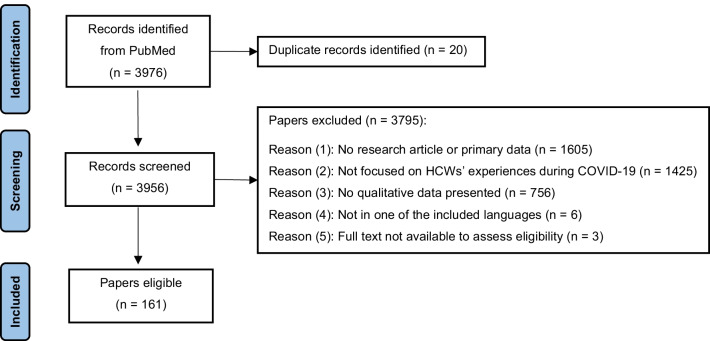
Results: 161 papers that were published from the beginning of COVID-19 pandemic up until 28th March 2021 were included in the review. Findings were presented using the socio-ecological model as an analytical framework. At the individual level, the impact of the pandemic manifested on HCWs' well-being, daily routine, professional and personal identity. At the interpersonal level, HCWs' personal and professional relationships were identified as crucial. At the institutional level, decision-making processes, organizational aspects and availability of support emerged as important factors affecting HCWs' experiences. At community level, community morale, norms, and public knowledge were of importance. Finally, at policy level, governmental support and response measures shaped HCWs' experiences. The review identified a lack of studies which investigate other HCWs than doctors and nurses, HCWs in non-hospital settings, and HCWs in low- and lower middle income countries.
Discussion: This review shows that the COVID-19 pandemic has challenged HCWs, with multiple contextual factors impacting their experiences and needs. To better understand HCWs' experiences, comparative investigations are needed which analyze differences across as well as within countries, including differences at institutional, community, interpersonal and individual levels. Similarly, interventions aimed at supporting HCWs prior to, during and after pandemics need to consider HCWs' circumstances.
Conclusions: Following a context-sensitive approach to empowering HCWs that accounts for the multitude of aspects which influence their experiences could contribute to building a sustainable health workforce and strengthening health systems for future pandemics.
Keywords: COVID-19; Coping; Experiences; Health care workers; Health systems; Pandemic; Resilience.
© 2022. The Author(s).
Conflict of interest statement
The authors declare that they have no competing interests.
References
-
- World Health Organization. Strengthening health systems to improve health outcomes—WHO framework for action 2007. https://www.who.int/healthsystems/strategy/everybodys_business.pdf?ua=1. Accessed 29 July 2020.
-
- Houghton C, Meskell P, Delaney H, Smalle M, Glenton C, Booth A, et al. Barriers and facilitators to healthcare workers’ adherence with infection prevention and control (IPC) guidelines for respiratory infectious diseases: a rapid qualitative evidence synthesis. Cochrane Database Syst Rev. 2020;4(4):CD013582. - PMC - PubMed
Publication types
MeSH terms
LinkOut - more resources
Full Text Sources
Medical
