


NAFLD in normal weight individuals
- PMID: 35331317
- PMCID: PMC8944050
- DOI: 10.1186/s13098-022-00814-z
NAFLD in normal weight individuals
Abstract
Nonalcoholic fatty liver disease (NAFLD) can develop in lean individuals. Despite a better metabolic profile, the risk of disease progression to hepatic inflammation, fibrosis, and decompensated cirrhosis in the lean is similar to that in obesity-related NAFLD and lean individuals may experience more severe hepatic consequences and higher mortality relative to those with a higher body mass index (BMI). In the absence of early symptoms and abnormal laboratory findings, lean individuals are not likely to be screened for NAFLD or related comorbidities; however, given the progressive nature of the disease and the increased risk of morbidity and mortality, a clearer understanding of the natural history of NAFLD in lean individuals, as well as efforts to raise awareness of the potential health risks of NAFLD in lean individuals, are warranted. In this review, we summarize available data on NAFLD prevalence, clinical characteristics, outcomes, and mortality in lean individuals and discuss factors that may contribute to the development of NAFLD in this population, including links between dietary and genetic factors, menopausal status, and ethnicity. We also highlight the need for greater representation of lean individuals in NAFLD-related clinical trials, as well as more studies to better characterize lean NAFLD, develop improved screening algorithms, and determine specific treatment strategies based on underlying etiology.
Keywords: BMI; Choline deficiency; Clinical outcomes; Genetic variation; Lean; Menopause; Metabolic syndrome; NAFLD; NASH; Nonobese; Prevalence.
© 2022. The Author(s).
Conflict of interest statement
The authors declare that they have no competing interests.
Figures
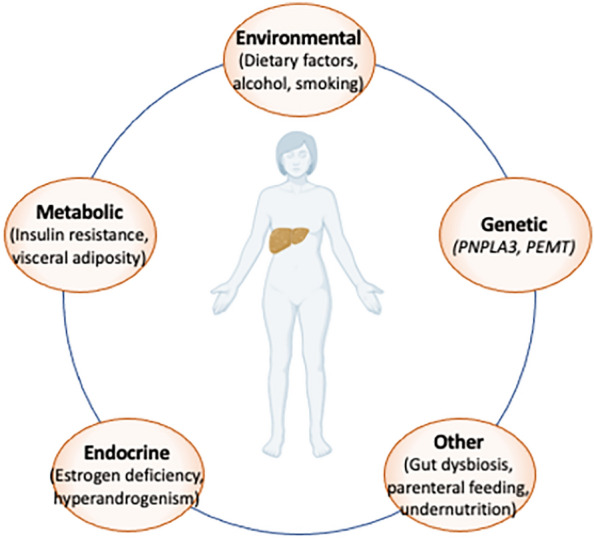
References
-
- Vos MB, Abrams SH, Barlow SE, Caprio S, Daniels SR, Kohli R, et al. NASPGHAN clinical practice guideline for the diagnosis and treatment of nonalcoholic fatty liver disease in children: recommendations from the expert committee on NAFLD (ECON) and the North American society of pediatric gastroenterology, hepatology and nutrition (NASPGHAN) J Pediatr Gastroenterol Nutr. 2017;64(2):319–334. - PMC - PubMed
-
- Ludwig J, Viggiano TR, McGill DB, Oh BJ. Nonalcoholic steatohepatitis: Mayo clinic experiences with a hitherto unnamed disease. Mayo Clin Proc. 1980;55(7):434–438. - PubMed
-
- European Association for the Study of the L, European Association for the Study of D, European Association for the Study of O. EASL–EASD–EASO clinical practice guidelines for the management of non-alcoholic fatty liver disease. J Hepatol. 2016;64(6):1388–402. - PubMed
-
- Younossi ZM, Blissett D, Blissett R, Henry L, Stepanova M, Younossi Y, et al. The economic and clinical burden of nonalcoholic fatty liver disease in the United States and Europe. Hepatology. 2016;64(5):1577–1586. - PubMed
-
- Younossi Z, Anstee QM, Marietti M, Hardy T, Henry L, Eslam M, et al. Global burden of NAFLD and NASH: trends, predictions, risk factors and prevention. Nat Rev Gastroenterol Hepatol. 2018;15(1):11–20. - PubMed
Publication types
Grants and funding
LinkOut - more resources
Full Text Sources
