


Host specificity and the reproductive strategies of parasites
- PMID: 35331349
- PMCID: PMC11010520
- DOI: 10.1017/S0031182021002122
Host specificity and the reproductive strategies of parasites
Abstract
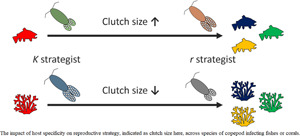
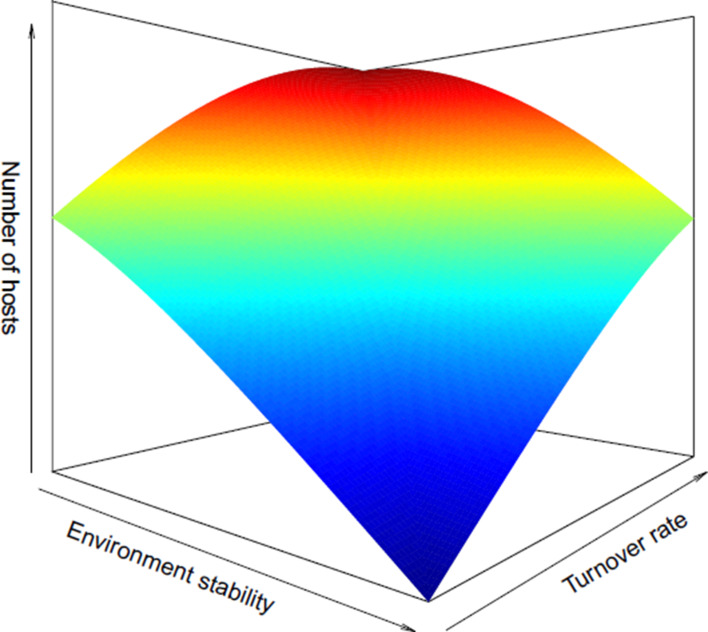
Environmental stability can have profound impacts on life history trait evolution in organisms, especially with respect to development and reproduction. In theory, free-living species, when subjected to relatively stable and predictable conditions over many generations, should evolve narrow niche breadths and become more specialized. In parasitic organisms, this level of specialization is reflected by their host specificity. Here, we tested how host specificity impacts the reproductive strategies of parasites, a subject seldomly addressed for this group. Through an extensive review of the literature, we collated a worldwide dataset to predict, through Bayesian multilevel modelling, the effect of host specificity on the reproductive strategies of parasitic copepods of fishes or corals. We found that copepods of fishes with low host specificity (generalists) invest more into reproductive output with larger clutch sizes, whereas generalist copepods of corals invest less into reproductive output with smaller clutch sizes. The differences in host turnover rates through an evolutionary timescale could explain the contrasting strategies across species observed here, which should still favour the odds of parasites encountering and infecting a host. Ultimately, the differences found in this study reflect the unique evolutionary history that parasites share both intrinsically and extrinsically with their hosts.
Keywords: Host specificity; host–parasite interaction; parasitic copepod; r/K selection; reproductive strategy.
Conflict of interest statement
The authors declare there are no conflicts of interest.
Figures

References
-
- Agosta SJ, Janz N and Brooks DR (2010) How specialists can be generalists: resolving the ‘parasite paradox’ and implications for emerging infectious disease. Zoologia 27, 151–162.
-
- Bauer G (1994) The adaptive value of offspring size among freshwater mussels (Bivalvia; Unionoidea). Journal of Animal Ecology 63, 933–944.
-
- Bertram J and Masel J (2019) Density-dependent selection and the limits of relative fitness. Theoretical Population Biology 129, 81–92. - PubMed
-
- Blasco-Costa I and Poulin R (2013) Host traits explain the genetic structure of parasites: a meta-analysis. Parasitology 140, 1316–1322. - PubMed
-
- Blasco-Costa I, Waters JM and Poulin R (2012) Swimming against the current: genetic structure, host mobility and the drift paradox in trematode parasites. Molecular Ecology 21, 207–217. - PubMed
Publication types
MeSH terms
LinkOut - more resources
Full Text Sources
