. 2022 May;24(5):1062-1072.
doi: 10.1016/j.gim.2022.01.022. Epub 2022 Mar 21.

Implementation of preemptive DNA sequence-based pharmacogenomics testing across a large academic medical center: The Mayo-Baylor RIGHT 10K Study

Liewei Wang  1 Steven E Scherer  2 Suzette J Bielinski  3 Donna M Muzny  4 Leila A Jones  5 John Logan Black 3rd  6 Ann M Moyer  6 Jyothsna Giri  5 Richard R Sharp  7 Eric T Matey  8 Jessica A Wright  8 Lance J Oyen  8 Wayne T Nicholson  9 Mathieu Wiepert  10 Terri Sullard  5 Timothy B Curry  11 Carolyn R Rohrer Vitek  5 Tammy M McAllister  5 Jennifer L St Sauver  12 Pedro J Caraballo  13 Konstantinos N Lazaridis  14 Eric Venner  4 Xiang Qin  15 Jianhong Hu  4 Christie L Kovar  4 Viktoriya Korchina  4 Kimberly Walker  4 HarshaVardhan Doddapaneni  15 Tsung-Jung Wu  4 Ritika Raj  4 Shawn Denson  4 Wen Liu  4 Gauthami Chandanavelli  4 Lan Zhang  4 Qiaoyan Wang  15 Divya Kalra  15 Mary Beth Karow  6 Kimberley J Harris  6 Hugues Sicotte  6 Sandra E Peterson  6 Amy E Barthel  6 Brenda E Moore  6 Jennifer M Skierka  6 Michelle L Kluge  6 Katrina E Kotzer  6 Karen Kloke  6 Jessica M Vander Pol  6 Heather Marker  5 Joseph A Sutton  10 Adrijana Kekic  16 Ashley Ebenhoh  8 Dennis M Bierle  13 Michael J Schuh  17 Christopher Grilli  16 Sara Erickson  18 Audrey Umbreit  19 Leah Ward  17 Sheena Crosby  17 Eric A Nelson  16 Sharon Levey  20 Michelle Elliott  21 Steve G Peters  22 Naveen Pereira  23 Mark Frye  24 Fadi Shamoun  25 Matthew P Goetz  26 Iftikhar J Kullo  23 Robert Wermers  27 Jan A Anderson  8 Christine M Formea  8 Razan M El Melik  8 John D Zeuli  8 Joseph R Herges  8 Carrie A Krieger  8 Robert W Hoel  8 Jodi L Taraba  8 Scott R St Thomas  5 Imad Absah  28 Matthew E Bernard  29 Stephanie R Fink  30 Andrea Gossard  31 Pamela L Grubbs  32 Therese M Jacobson  32 Paul Takahashi  30 Sharon C Zehe  33 Susan Buckles  34 Michelle Bumgardner  32 Colette Gallagher  34 Kelliann Fee-Schroeder  5 Nichole R Nicholas  5 Melody L Powers  35 Ahmed K Ragab  5 Darcy M Richardson  5 Anthony Stai  10 Jaymi Wilson  5 Joel E Pacyna  7 Janet E Olson  36 Erica J Sutton  7 Annika T Beck  7 Caroline Horrow  7 Krishna R Kalari  37 Nicholas B Larson  37 Hongfang Liu  38 Liwei Wang  38 Guilherme S Lopes  39 Bijan J Borah  40 Robert R Freimuth  38 Ye Zhu  41 Debra J Jacobson  37 Matthew A Hathcock  37 Sebastian M Armasu  37 Michaela E McGree  37 Ruoxiang Jiang  37 Tyler H Koep  42 Jason L Ross  42 Matthew G Hilden  42 Kathleen Bosse  42 Bronwyn Ramey  42 Isabelle Searcy  42 Eric Boerwinkle  43 Richard A Gibbs  44 Richard M Weinshilboum  45
Affiliations

Implementation of preemptive DNA sequence-based pharmacogenomics testing across a large academic medical center: The Mayo-Baylor RIGHT 10K Study

Liewei Wang et al. Genet Med. 2022 May.

Abstract

Purpose: The Mayo-Baylor RIGHT 10K Study enabled preemptive, sequence-based pharmacogenomics (PGx)-driven drug prescribing practices in routine clinical care within a large cohort. We also generated the tools and resources necessary for clinical PGx implementation and identified challenges that need to be overcome. Furthermore, we measured the frequency of both common genetic variation for which clinical guidelines already exist and rare variation that could be detected by DNA sequencing, rather than genotyping.

Methods: Targeted oligonucleotide-capture sequencing of 77 pharmacogenes was performed using DNA from 10,077 consented Mayo Clinic Biobank volunteers. The resulting predicted drug response-related phenotypes for 13 genes, including CYP2D6 and HLA, affecting 21 drug-gene pairs, were deposited preemptively in the Mayo electronic health record.

Results: For the 13 pharmacogenes of interest, the genomes of 79% of participants carried clinically actionable variants in 3 or more genes, and DNA sequencing identified an average of 3.3 additional conservatively predicted deleterious variants that would not have been evident using genotyping.

Conclusion: Implementation of preemptive rather than reactive and sequence-based rather than genotype-based PGx prescribing revealed nearly universal patient applicability and required integrated institution-wide resources to fully realize individualized drug therapy and to show more efficient use of health care resources.

Keywords: Clinical translation; Implementation; Individualized medicine; Pharmacogenomics; Pre-emptive clinical DNA sequencing.


Conflict of interest statement

Conflict of Interest Liewei Wang, John Logan Black III, and Richard M. Weinshilboum are cofounders of and stockholders in OneOme, LLC, which was used only to return results to the study participants. Additionally, John Logan Black III and Mayo Clinic Ventures have applied for a patent on the CNVAR software cited in this study as well as the methodology upon which the software is based. All other authors declare no conflicts of interest.

Figures
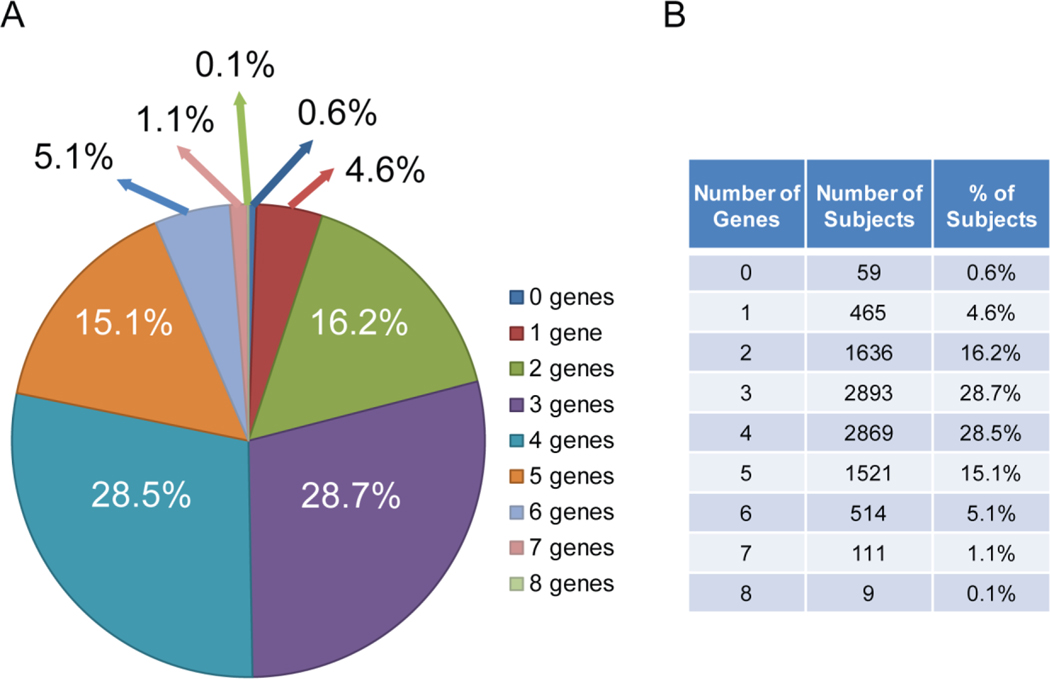
Figure 1.
Figure 1.
The Figure shows the number of genes that contained clinically actionable genomic variants for the 13 genes included in the Drug-Gene Pair Alerts listed in Table 1 that were observed in each of the 10,077 RIGHT 10K Study subjects as well as the percentage of study subjects included in each group. A. The “pie chart” shows these data graphically while the table in B lists the information upon which the pie chart is based.

References

    1. Weinshilboum RM, Wang L. Pharmacogenomics: Precision Medicine and Drug Response. Mayo Clin Proc. 2017;92(11):1711–1722. doi: 10.1016/j.mayocp.2017.09.001 - DOI - PMC - PubMed
    1. Wang L, McLeod HL, Weinshilboum RM. Genomics and drug response. N Engl J Med. 2011;364(12):1144–1153. doi: 10.1056/NEJMra1010600 - DOI - PMC - PubMed
    1. Roden DM, Van Driest SL, Wells QS, Mosley JD, Denny JC, Peterson JF. Opportunities and Challenges in Cardiovascular Pharmacogenomics: From Discovery to Implementation. Circ Res. 2018;122(9):1176–1190. doi: 10.1161/CIRCRESAHA.117.310965 - DOI - PMC - PubMed
    1. Marrero RJ, Cicali EJ, Arwood MJ, et al. How to Transition from Single-Gene Pharmacogenetic Testing to Preemptive Panel-Based Testing: A Tutorial. Clin Pharmacol Ther. 2020;108(3):557–565. doi: 10.1002/cpt.1912 - DOI - PMC - PubMed
    1. van der Wouden CH, Cambon-Thomsen A, Cecchin E, et al. Implementing Pharmacogenomics in Europe: Design and Implementation Strategy of the Ubiquitous Pharmacogenomics Consortium. Clin Pharmacol Ther. 2017;101(3):341–358. doi: 10.1002/cpt.602 - DOI - PubMed

Publication types

Substances
