


Ethnic markers and the emergence of group-specific norms: an experiment
- PMID: 35332142
- PMCID: PMC8948296
- DOI: 10.1038/s41598-022-07981-z
Ethnic markers and the emergence of group-specific norms: an experiment
Abstract
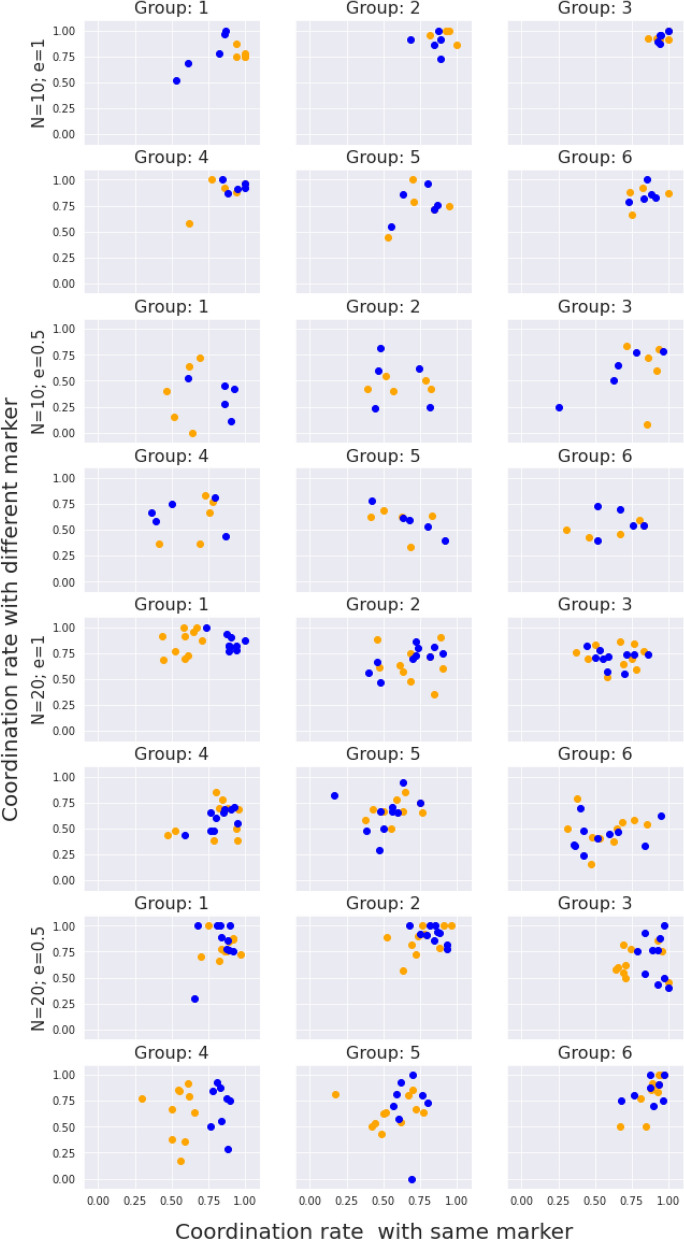
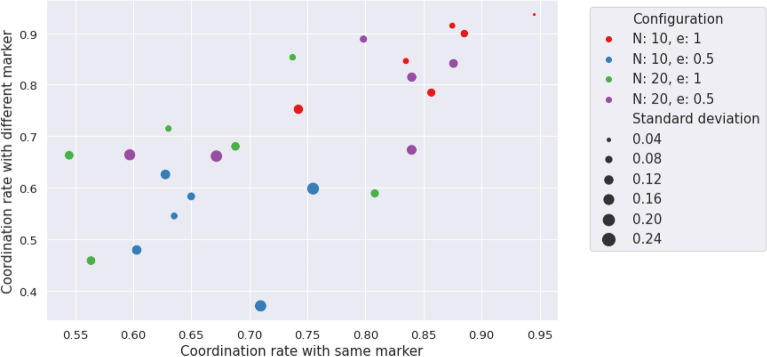
Visible markers are an important factor in social interactions. Some researchers have argued that one of their roles is to promote cooperation, but models designed to address this issue have yielded contradictory results. Here we present an experimental study of the effect of visible markers on the emergence of social norms where human subjects play a binary coordination game. Our results do not show different, marker-dependent behaviors. Instead, in practically all sessions participants achieved a global equilibrium disregarding the markers. Our findings suggest that simple markers may have a limited role in promoting the emergence of group-dependent social norms and call for further research investigating the role of markers in more sophisticated social settings.
© 2022. The Author(s).
Conflict of interest statement
The authors declare no competing interests.
Figures



References
-
- Boyd R, Richerson PJ. The evolution of ethnic markers. Cult. Anthropol. 1987;2:65–79. doi: 10.1525/can.1987.2.1.02a00070. - DOI
-
- Barth, F. Introduction. In Ethnic Groups and Boundaries (ed. Barth, F.) 9–38. (Little, Brown, 1969).
-
- Nettle D, Dunbar RIM. Social markers and the evolution of reciprocal exchange. Curr. Anthropol. 1997;38:93–99. doi: 10.1086/204588. - DOI
Publication types
MeSH terms
LinkOut - more resources
Full Text Sources
Miscellaneous
