


The impact of socioeconomic status on telemedicine utilization during the COVID-19 pandemic among surgical clinics at an academic tertiary care center
- PMID: 35332387
- PMCID: PMC8945866
- DOI: 10.1007/s00464-022-09186-x
The impact of socioeconomic status on telemedicine utilization during the COVID-19 pandemic among surgical clinics at an academic tertiary care center
Abstract
Background: The COVID-19 pandemic caused many surgical providers to conduct outpatient evaluations using remote audiovisual conferencing technology (i.e., telemedicine) for the first time in 2020. We describe our year-long institutional experience with telemedicine in several general surgery clinics at an academic tertiary care center and examine the relationship between area-based socioeconomic measures and the likelihood of telemedicine participation.
Methods: We performed a retrospective review of our outpatient telemedicine utilization among four subspecialty clinics (including two acute care and two elective surgery clinics). Geocoding was used to link patient visit data to area-based socioeconomic measures and a multivariable analysis was performed to examine the relationship between socioeconomic indicators and patient participation in telemedicine.
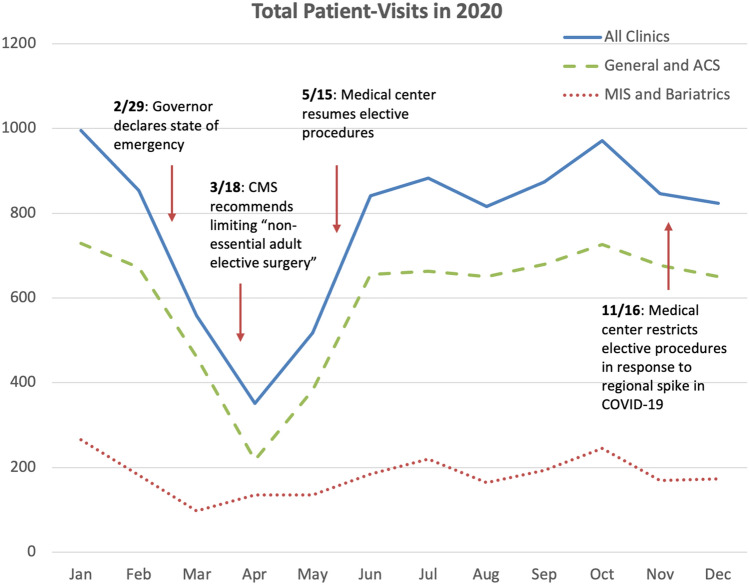
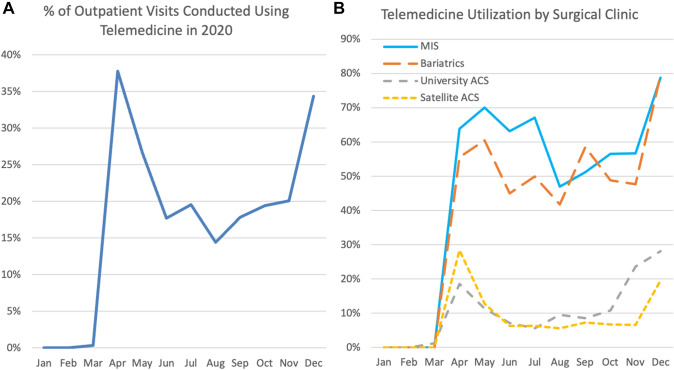
Results: While total outpatient visits per month reached a nadir in April 2020 (65% decrease in patient visits when compared to January 2020), there was a sharp increase in telemedicine utilization during the same month (38% of all visits compared to 0.8% of all visits in the month prior). Higher rates of telemedicine utilization were observed in the two elective surgery clinics (61% and 54%) compared to the two acute care surgery clinics (14% and 9%). A multivariable analysis demonstrated a borderline-significant linear trend (p = 0.07) between decreasing socioeconomic status and decreasing odds of telemedicine participation among elective surgery visits. A sensitivity analysis to examine the reliability of this trend showed similar results.
Conclusion: Telemedicine has many patient-centered benefits, and this study demonstrates that for certain elective subspecialty clinics, telemedicine may be utilized as the preferred method for surgical consultations. However, to ensure the equitable adoption and advancement of telemedicine services, healthcare providers will need to focus on mitigating the socioeconomic barriers to telemedicine participation.
Keywords: COVID-19; Census tract; Geocoding; Poverty; Socioeconomic status; Telemedicine.
© 2022. The Author(s), under exclusive licence to Springer Science+Business Media, LLC, part of Springer Nature.
Conflict of interest statement
Baraka Gitonga and Jay Zhu, Alex W. Lois, Judy Y. Chen-Meekin, Estell J. Williams, Saurabh Khandelwal, Rocio Carrera Ceron, Brant K. Oelschlager, and Andrew S. Wright have no conflicts of interest or financial ties to disclose.
Figures
References
MeSH terms
LinkOut - more resources
Full Text Sources
Medical
Miscellaneous
