Randomized Controlled Trial
. 2022 Jul 20;40(21):2321-2332.
doi: 10.1200/JCO.21.02198. Epub 2022 Mar 25.

Pembrolizumab Alone or With Chemotherapy for Recurrent/Metastatic Head and Neck Squamous Cell Carcinoma in KEYNOTE-048: Subgroup Analysis by Programmed Death Ligand-1 Combined Positive Score

Affiliations
Randomized Controlled Trial

Pembrolizumab Alone or With Chemotherapy for Recurrent/Metastatic Head and Neck Squamous Cell Carcinoma in KEYNOTE-048: Subgroup Analysis by Programmed Death Ligand-1 Combined Positive Score

Barbara Burtness et al. J Clin Oncol. .

Abstract

Purpose: The phase III KEYNOTE-048 (ClinicalTrials.gov identifier: NCT02358031) trial of pembrolizumab in recurrent or metastatic (R/M) head and neck squamous cell carcinoma (HNSCC) included planned efficacy analyses in the total population and in participants with programmed death ligand-1 (PD-L1) combined positive score (CPS) ≥ 1 and CPS ≥ 20. To further characterize the predictive value of PD-L1 expression on outcome, we conducted efficacy analyses in the PD-L1 CPS < 1 and CPS 1-19 subgroups in KEYNOTE-048.

Methods: Participants with R/M HNSCC and no prior systemic therapy for R/M disease were randomly assigned 1:1:1 to pembrolizumab, pembrolizumab-chemotherapy, or cetuximab-chemotherapy. Post hoc efficacy analyses of the PD-L1 CPS < 1 and CPS 1-19 subgroups were performed.

Results: Of 882 participants enrolled, 128 had PD-L1 CPS < 1 and 373 had CPS 1-19. For pembrolizumab versus cetuximab-chemotherapy, the median overall survival was 7.9 versus 11.3 months in the PD-L1 CPS < 1 subgroup (hazard ratio [HR], 1.51 [95% CI, 0.96 to 2.37]) and 10.8 versus 10.1 months in the CPS 1-19 subgroup (HR, 0.86 [95% CI, 0.66 to 1.12]). For pembrolizumab-chemotherapy versus cetuximab-chemotherapy, the median overall survival was 11.3 versus 10.7 months in the PD-L1 CPS < 1 subgroup (HR, 1.21 [95% CI, 0.76 to 1.94]) and 12.7 versus 9.9 months in the CPS 1-19 subgroup (HR, 0.71 [95% CI, 0.54 to 0.94]).

Conclusion: Increased efficacy of pembrolizumab or pembrolizumab-chemotherapy was observed with increasing PD-L1 expression. PD-L1 CPS < 1 subgroup analysis was limited by small participant numbers. Results from the PD-L1 CPS 1-19 subgroup support previous findings of treatment benefit with pembrolizumab monotherapy and pembrolizumab-chemotherapy in patients with PD-L1 CPS ≥ 1 tumors. Although PD-L1 expression is informative, exploration of additional predictive biomarkers is needed for low PD-L1-expressing HNSCC.


Conflict of interest statement

Kevin Harrington

This author is a member of the Journal of Clinical Oncology Editorial Board. Journal policy recused the author from having any role in the peer review of this manuscript.

Honoraria: Arch Oncology (Inst), AstraZeneca (Inst), BMS (Inst), Boehringer Ingelheim (Inst), Merck Serono (Inst), MSD (Inst), Oncolys BioPharma (Inst), Pfizer (Inst), Replimune (Inst), Inzen Therapeutics (Inst), Codiak Biosciences (Inst)

Consulting or Advisory Role: Arch Oncology (Inst), AstraZeneca (Inst), BMS (Inst), Boehringer Ingelheim (Inst), Merck Serono (Inst), MSD (Inst), Oncolys BioPharma (Inst), Replimune (Inst), Inzen Therapeutics (Inst)

Speakers' Bureau: BMS (Inst), Merck Serono (Inst), MSD (Inst)

Research Funding: AstraZeneca (Inst), Merck Sharp & Dohme (Inst), Replimune (Inst), Boehringer Ingelheim (Inst)

No other potential conflicts of interest were reported.

Figures
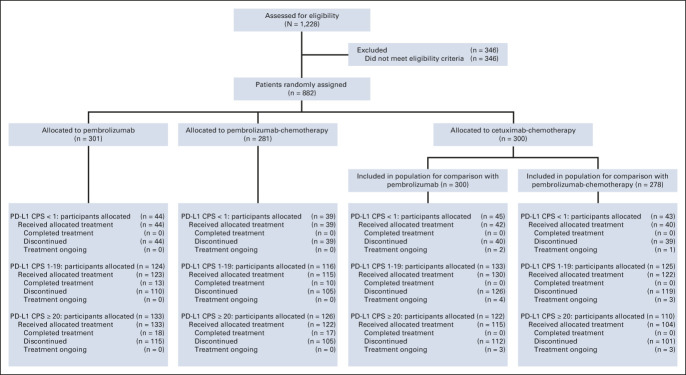
FIG 1.
FIG 1.
Trial profile. Analysis in participants with PD-L1 CPS ≥ 20 was prespecified, and the trial profile for these participants has been published previously. Reasons that patients discontinued treatment in each subgroup are presented in the Data Supplement. CPS, combined positive score; PD-L1, programmed death ligand-1.
FIG 2.
FIG 2.
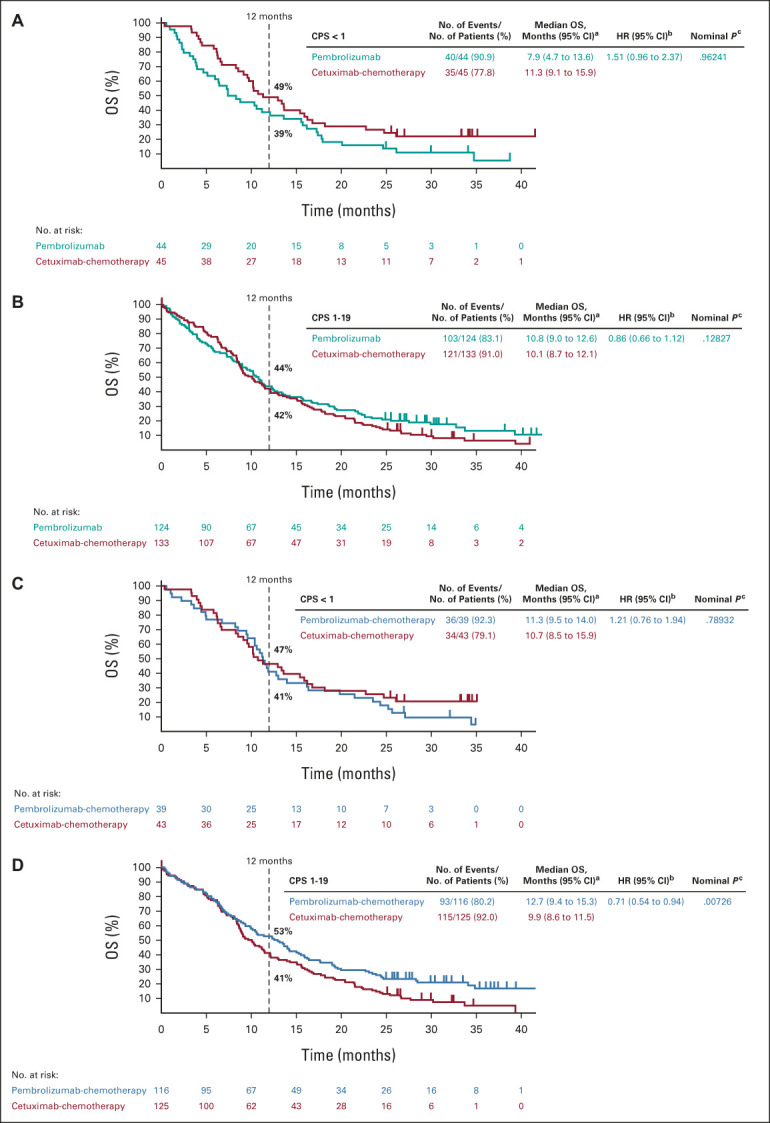
Kaplan-Meier estimates of OS. Tick marks show censoring of the data at the last time the participant was known to be alive. Pembrolizumab alone versus cetuximab-chemotherapy in the (A) PD-L1 CPS < 1 subgroup and (B) PD-L1 CPS 1-19 subgroup. Pembrolizumab-chemotherapy versus cetuximab-chemotherapy in the (C) PD-L1 CPS < 1 subgroup and (D) PD-L1 CPS 1-19 subgroup. Kaplan-Meier estimates of OS in the PD-L1 CPS ≥ 20 subgroup at final analysis have been published previously. aFrom the product-limit (Kaplan-Meier) method for censored data. bBased on a Cox proportional hazards model with the Efron method of tie handling with treatment as a covariate. cOne-sided P values based on the log-rank test. All P values for the PD-L1 CPS < 1 and CPS 1-19 subgroups are nominal and are presented as a measure of the strength of the association between the end point (OS) and the treatment effect. CPS, combined positive score; HR, hazard ratio; OS, overall survival; PD-L1, programmed death ligand-1.
FIG 3.
FIG 3.
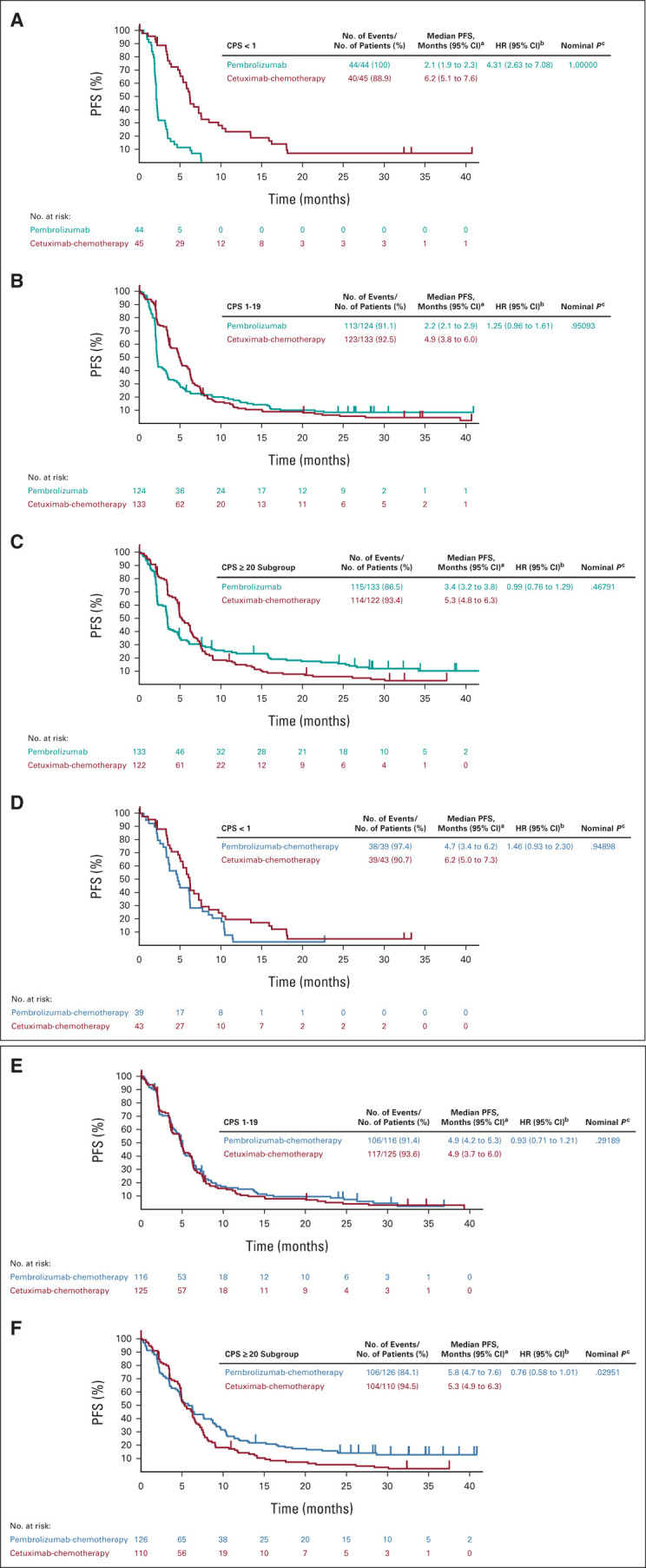
Kaplan-Meier estimates of PFS assessed per RECIST v1.1 by blinded independent central review. Tick marks show censoring of the data at the time of the last imaging assessment. Pembrolizumab alone versus cetuximab-chemotherapy in the (A) PD-L1 CPS < 1 subgroup, (B) PD-L1 CPS 1-19 subgroup, and (C) PD-L1 CPS ≥ 20 subgroup. Pembrolizumab-chemotherapy versus cetuximab-chemotherapy in the (D) PD-L1 CPS < 1 subgroup, (E) PD-L1 CPS 1-19 subgroup, and (F) PD-L1 CPS ≥ 20 subgroup. aFrom the product-limit (Kaplan-Meier) method for censored data. bBased on a Cox proportional hazards model with the Efron method of tie handling with treatment as a covariate. cOne-sided P values based on the log-rank test. All P values for the PD-L1 CPS < 1 and CPS 1-19 subgroups are nominal and are presented as a measure of the strength of the association between the end point (PFS) and the treatment effect. Definitive results in the PD-L1 CPS ≥ 20 population have been published previously. CPS, combined positive score; HR, hazard ratio; PD-L1, programmed death ligand-1; PFS, progression-free survival.

References

    1. Seiwert TY, Burtness B, Mehra R, et al. : Safety and clinical activity of pembrolizumab for treatment of recurrent or metastatic squamous cell carcinoma of the head and neck (KEYNOTE-012): An open-label, multicentre, phase 1b trial. Lancet Oncol 17:956-965, 2016 - PubMed
    1. Patel SP, Kurzrock R: PD-L1 expression as a predictive biomarker in cancer immunotherapy. Mol Cancer Ther 14:847-856, 2015 - PubMed
    1. Sharpe AH, Wherry EJ, Ahmed R, et al. : The function of programmed cell death 1 and its ligands in regulating autoimmunity and infection. Nat Immunol 8:239-245, 2007 - PubMed
    1. Alsaab HO, Sau S, Alzhrani R, et al. : PD-1 and PD-L1 checkpoint signaling inhibition for cancer immunotherapy: Mechanism, combinations, and clinical outcome. Front Pharmacol 8:561, 2017 - PMC - PubMed
    1. Ferris RL, Blumenschein G, Jr, Fayette J, et al. : Nivolumab for recurrent squamous-cell carcinoma of the head and neck. N Engl J Med 375:1856-1867, 2016 - PMC - PubMed

Publication types

MeSH terms

Associated data