


Proteomic differences in hippocampus and cortex of sudden unexplained death in childhood
- PMID: 35333953
- PMCID: PMC8953962
- DOI: 10.1007/s00401-022-02414-7
Proteomic differences in hippocampus and cortex of sudden unexplained death in childhood
Abstract
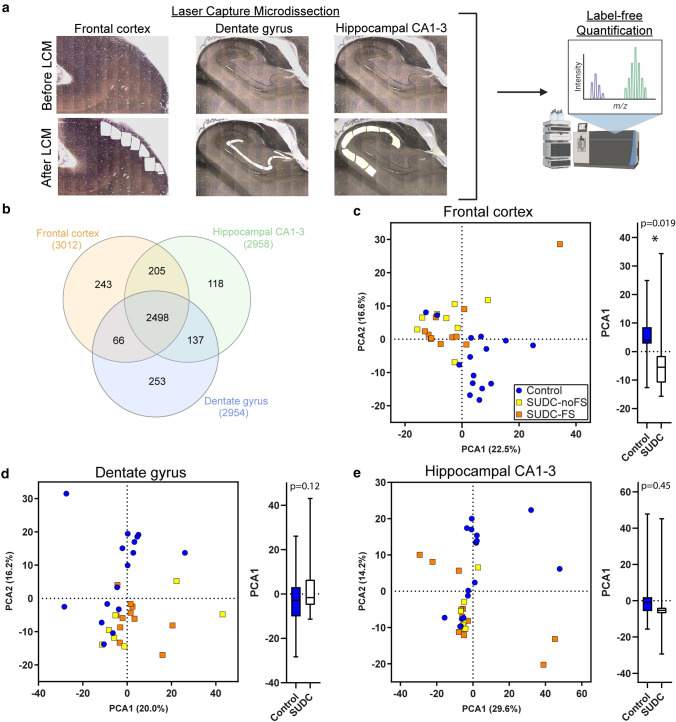
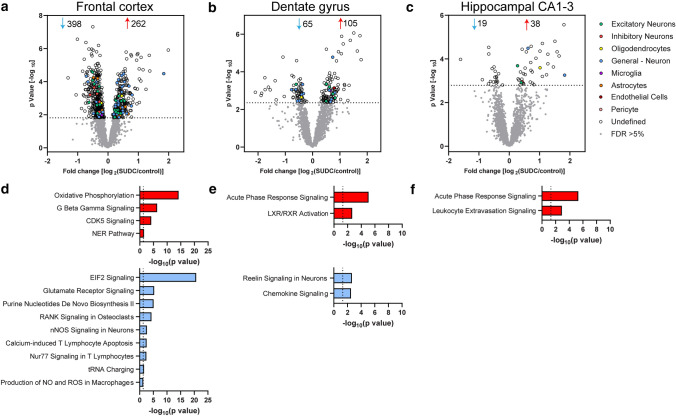
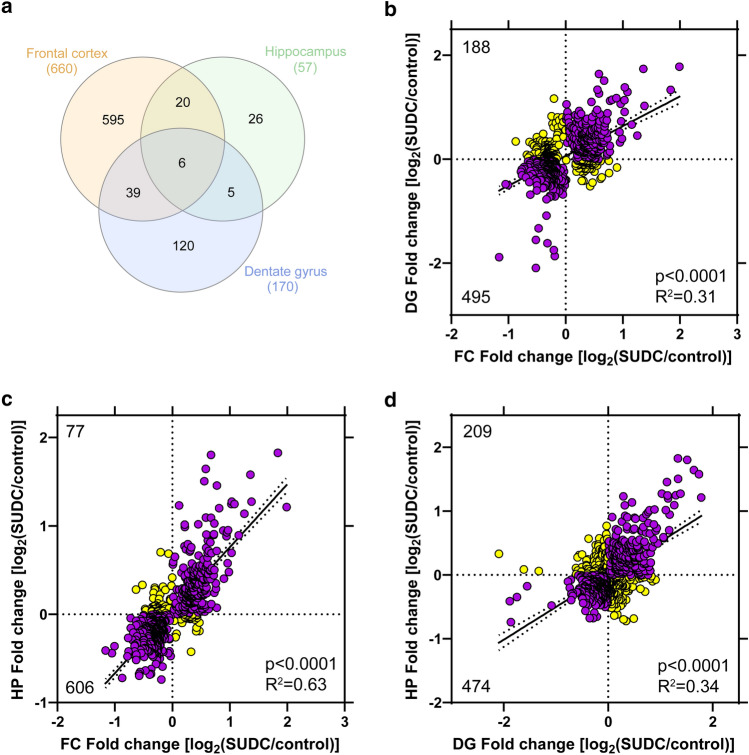
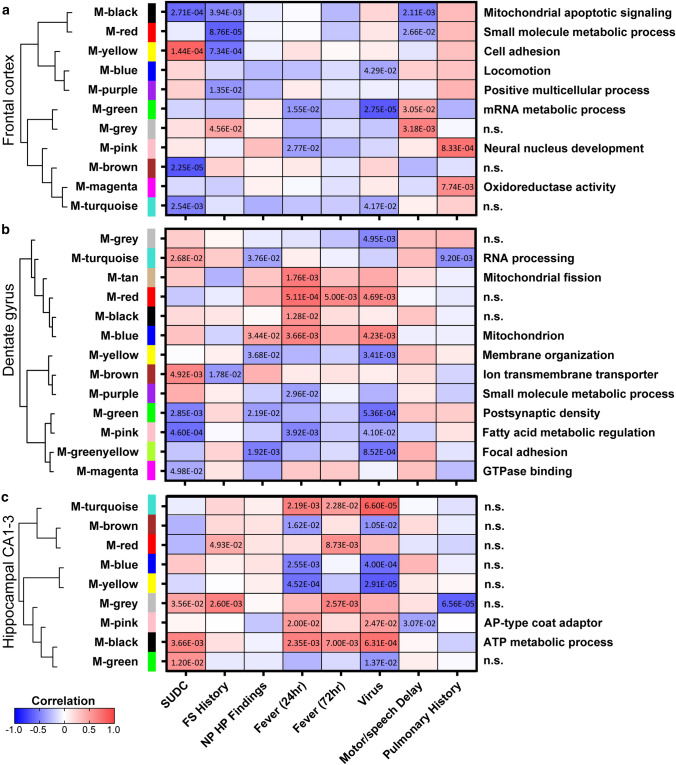
Sudden unexplained death in childhood (SUDC) is death of a child over 1 year of age that is unexplained after review of clinical history, circumstances of death, and complete autopsy with ancillary testing. Multiple etiologies may cause SUDC. SUDC and sudden unexpected death in epilepsy (SUDEP) share clinical and pathological features, suggesting some similarities in mechanism of death and possible abnormalities in hippocampus and cortex. To identify molecular signaling pathways, we performed label-free quantitative mass spectrometry on microdissected frontal cortex, hippocampal dentate gyrus (DG), and cornu ammonis (CA1-3) in SUDC (n = 19) and pediatric control cases (n = 19) with an explained cause of death. At a 5% false discovery rate (FDR), we found differential expression of 660 proteins in frontal cortex, 170 in DG, and 57 in CA1-3. Pathway analysis of altered proteins identified top signaling pathways associated with activated oxidative phosphorylation (p = 6.3 × 10⁻¹⁵, z = 4.08) and inhibited EIF2 signaling (p = 2.0 × 10⁻²¹, z = - 2.56) in frontal cortex, and activated acute phase response in DG (p = 8.5 × 10⁻⁶, z = 2.65) and CA1-3 (p = 4.7 × 10⁻⁶, z = 2.00). Weighted gene correlation network analysis (WGCNA) of clinical history indicated that SUDC-positive post-mortem virology (n = 4/17) had the most significant module in each brain region, with the top most significant associated with decreased mRNA metabolic processes (p = 2.8 × 10⁻⁵) in frontal cortex. Additional modules were associated with clinical history, including fever within 24 h of death (top: increased mitochondrial fission in DG, p = 1.8 × 10⁻³) and febrile seizure history (top: decreased small molecule metabolic processes in frontal cortex, p = 8.8 × 10⁻⁵) in all brain regions, neuropathological hippocampal findings in the DG (top: decreased focal adhesion, p = 1.9 × 10⁻³). Overall, cortical and hippocampal protein changes were present in SUDC cases and some correlated with clinical features. Our studies support that proteomic studies of SUDC cohorts can advance our understanding of the pathogenesis of these tragedies and may inform the development of preventive strategies.
Keywords: Febrile seizures; Laser capture microdissection; Proteomics; SUDC.
© 2022. The Author(s).
Figures
References
-
- Brace LE, Vose SC, Stanya K, Gathungu RM, Marur VR, Longchamp A, Treviño-Villarreal H, Mejia P, Vargas D, Inouye K, Bronson RT, Lee CH, Neilan E, Kristal BS, Mitchell JR. Increased oxidative phosphorylation in response to acute and chronic DNA damage. NPJ Aging Mech Dis. 2016;2:16022. doi: 10.1038/npjamd.2016.22. - DOI - PMC - PubMed
-
- Broadbelt KG, Rivera KD, Paterson DS, Duncan JR, Trachtenberg FL, Paulo JA, Stapels MD, Borenstein NS, Belliveau RA, Haas EA, Stanley C, Krous HF, Steen H, Kinney HC. Brainstem deficiency of the 14-3-3 regulator of serotonin synthesis: a proteomics analysis in the sudden infant death syndrome. Mol Cell Proteom. 2012;11(M111):009530. doi: 10.1074/mcp.M111.009530. - DOI - PMC - PubMed
-
- Bundock E, Corey T, Andrew T, Crandall L, Eason E, Gunther W, Moon R, Palusci V, Schmidt C, Sens M (2019) Unexplained pediatric deaths: investigation, certification, and family needs [Internet]. Academic Forensic Pathology International San Diego (CA) - PubMed
Publication types
MeSH terms
Grants and funding
LinkOut - more resources
Full Text Sources
Miscellaneous
