


A Rare Case of Upper Gastrointestinal Bleeding: Osler-Weber-Rendu Syndrome
- PMID: 35334510
- PMCID: PMC8951266
- DOI: 10.3390/medicina58030333
A Rare Case of Upper Gastrointestinal Bleeding: Osler-Weber-Rendu Syndrome
Abstract
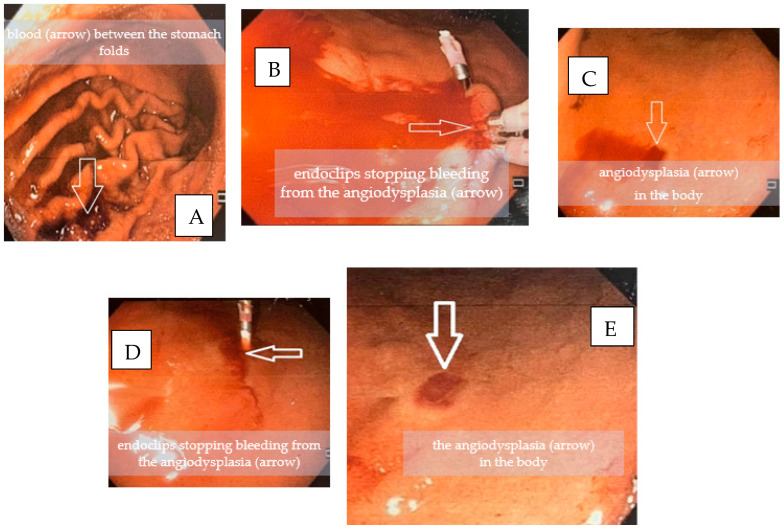
Osler-Weber-Rendu disease, also known as hereditary hemorrhagic telangiectasia (HHT), is a rare, autosomal dominant condition that affects approximately 1 in 5000 patients causing abnormal blood vessel formation. HHT patients have mucocutaneous telangiectasias and arteriovenous malformations in various organs. The most prominent symptom of HHT is epistaxis, which, together with gastrointestinal bleeding, may cause iron deficiency anemia. This study is a case report of a 62-year-old patient who was admitted to the Department of Gastroenterology due to acute upper gastrointestinal bleeding and a history of recurrent epistaxis and melena for 4 days, which was confirmed in digital rectal examination. Urgent upper gastrointestinal endoscopy revealed active bleeding from multiple angioectatic spots with bright-looking salmon-colored patches in the antrum and the body suggestive of HHT. The bleeding from two angioectatic spots was stopped by argon plasma coagulation, and four clips were placed to provide good hemostasis. The patient was treated with a proton pomp inhibitor infusion and iron infusion. She was discharged with no signs of GI bleeding, normalized iron levels and a diagnosis of HHT. She was referred to further genetic testing, including evaluation of first-degree relatives. She also had performed unenhanced thin-cut computed tomography (CT) with angiography to exclude the presence of pulmonary arteriovenous malformations (PAVMs). Due to the fact that the patient did not manifest any other HHT-related symptoms and that the instrumental screening discloses no silent AVMs in other organs, the "watch-and-wait strategy" was applied. Although, Osler-Weber-Rendu syndrome is widely described in the medical literature, effective treatment of gastrointestinal telangiectasias is not always available and still lacks standardization to date, which makes the management of gastroenterological involvement still a challenging issue.
Keywords: Curaçao criteria; Osler-Weber-Rendu disease; arterio-venous malformations; hereditary hemorrhagic telangiectasia (HHT); mucocutaneous telangiectasias; upper gastrointestinal bleeding; vascular malformations (VMs).
Conflict of interest statement
The authors declare no conflict of interest.
Figures
References
-
- Alicea-Guevara R., Cruz Caliz M., Adorno J., Fernandez R., Rivera K., Gonzalez G., Hernandez-Castillo R.A., Fernandez R., Latorre C.C. Life-threatening hemoptysis: Case of Osler-Weber-Rendu Syndrome. [(accessed on 6 June 2021)];Oxf. Med. Case Rep. 2018 22:omx108. doi: 10.1093/omcr/omx108. Available online: https://www.ncbi.nlm.nih.gov/pmc/articles/PMC5865522/ - DOI - PMC - PubMed
Publication types
MeSH terms
LinkOut - more resources
Full Text Sources
