. 2022 Mar 16;27(6):1930.
doi: 10.3390/molecules27061930.

Thiazolidin-4-Ones as Potential Antimicrobial Agents: Experimental and In Silico Evaluation

Affiliations

Thiazolidin-4-Ones as Potential Antimicrobial Agents: Experimental and In Silico Evaluation

Christophe Tratrat et al. Molecules. .

Abstract

Herein, we report computational and experimental evaluations of the antimicrobial activity of twenty one 2,3-diaryl-thiazolidin-4-ones. All synthesized compounds exhibited an antibacterial activity against six Gram-positive and Gram-negative bacteria to different extents. Thus, the MIC was in the range of 0.008-0.24 mg/mL, while the MBC was 0.0016-0.48 mg/mL. The most sensitive bacterium was S. Typhimurium, whereas S. aureus was the most resistant. The best antibacterial activity was observed for compound 5 (MIC at 0.008-0.06 mg/mL). The three most active compounds 5, 8, and 15, as well as compound 6, which were evaluated against three resistant strains, MRSA, P. aeruginosa, and E. coli, were more potent against all bacterial strains used than ampicillin. The antifungal activity of some compounds exceeded or were equipotent with those of the reference antifungal agents bifonazole and ketoconazole. The best activity was expressed by compound 5. All compounds exhibited moderate to good drug-likeness scores ranging from -0.39 to 0.39. The docking studies indicated a probable involvement of E. coli Mur B inhibition in the antibacterial action, while CYP51 inhibition is likely responsible for the antifungal activity of the tested compounds. Finally, the assessment of cellular cytotoxicity of the compounds in normal human MRC-5 cells revealed that the compounds were not toxic.

Keywords: CYP51; MRC-5; MurB; antibacterial; antifungal; docking; microdilution method; thiazolidine-4-one.


Conflict of interest statement

The authors declare no conflict of interest.

Figures

Figure 1
Figure 1
Approved drugs with benzothiazole scaffold.
Figure 2
Figure 2
Approved drugs with thiazolidinone scaffold.
Scheme 1
Scheme 1
Synthesis of titled compounds.
Figure 3
Figure 3
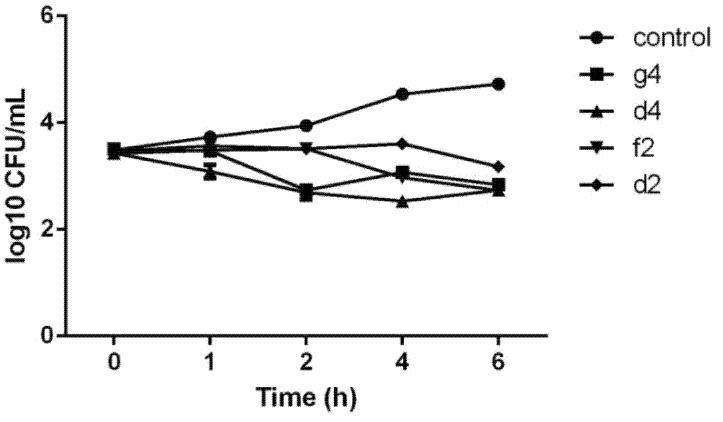
P. aeruginosa CFU (log10) after different time intervals of antimicrobial treatment with the MBC of tested compounds.
Figure 4
Figure 4
MurB-catalyzed reactions. The first reaction of the transfer of 4-pro-S hydride from NADPH to N-5 of Enz-FAD (A) [53] and the transfer of hydride from Enz-FADH2 to C-3 of its enopyrobic portion of EP-UDPGlcNAc (B) [54].
Figure 5
Figure 5
Docking pose of the most active compound 5 (green) in the active site of the E. coli MurB enzyme. Dotted green lines represent the hydrogen bonds.
Figure 6
Figure 6
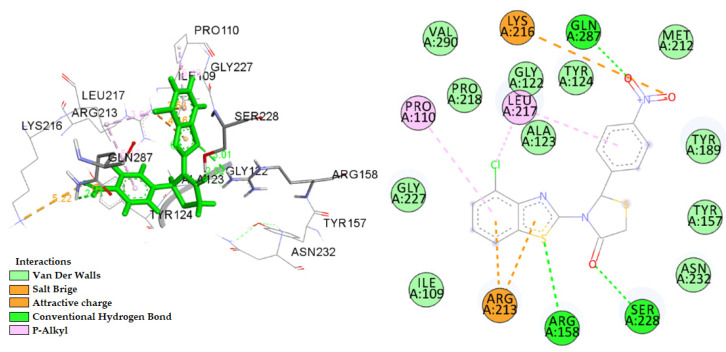
(Left) Docking pose of compounds f2 (green) and f3 (red) in the active site of the enzyme. (Right) 2D diagram of compounds 8 and 9. The hydrogen bond is represented by a dotted green line.
Figure 7
Figure 7
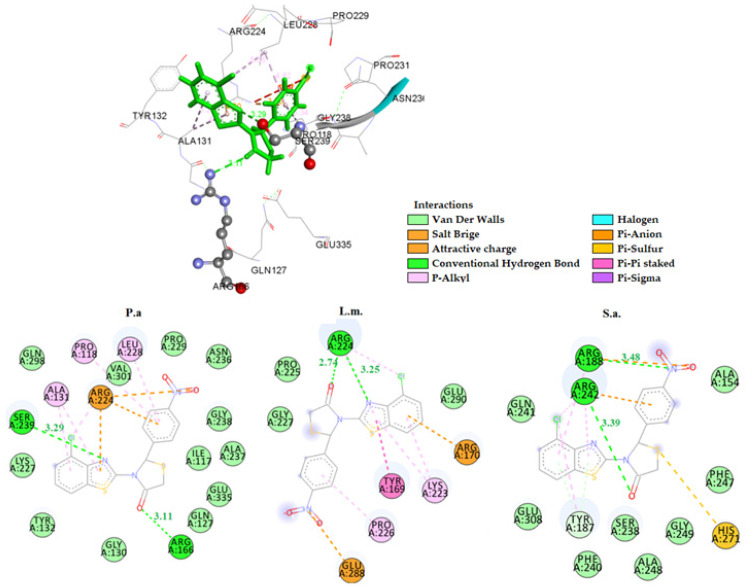
(Above) Binding pose of compound 5 (R-isomer) in the active MurB site of Pseudomonas aeruginosa (4JAY). (Bottom) 2D binding plots of compound 5 to MurB enzymes of Pseudomonas aeruginosa (4JAY), Listeria monocytogenes (3TX1), and Staphylococcus aureus (1HSK), (left to right).
Figure 8
Figure 8
(Above) Binding pose of compound 8 (R-isomer) in the active center of MurB Pseudomonas aeruginosa (4JAY) and 2D diagram. (Bottom) 2D binding plots of compound 8 to the MurB enzymes of Listeria monocytogenes (3TX1) and Staphylococcus aureus (1HSK), (left to right).
Figure 9
Figure 9
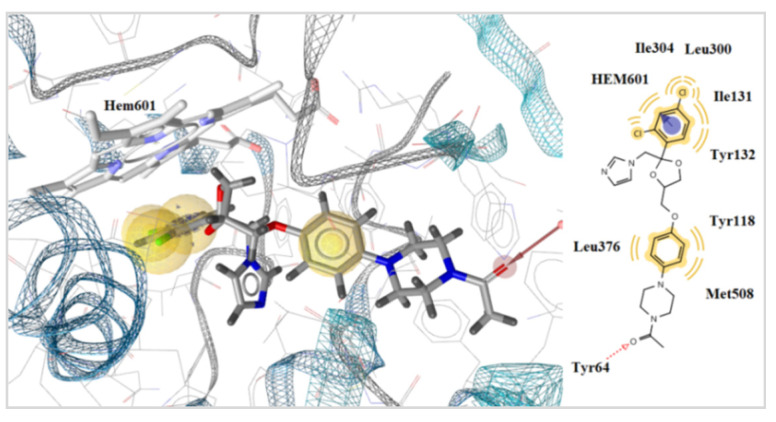
Docking pose of ketoconazole in the active site of C. albicans lanosterol 14alpha-demethylase (CYP51ca).
Figure 10
Figure 10
(Top) 2D diagrams of compounds 5 (left) and 16 (right) in the active site of C. albicans lanosterol 14alpha-demethylase (CYP51ca). (Bottom) Docking pose of compound 5 in the active site of the enzyme lanosterol 14alpha-demethylase of C. albicans (CYP51ca). Heme is represented in dark blue.
Figure 11
Figure 11
Bioavailability radar of compounds 5 and 8. The pink area represents the optimal range for each property for oral bioavailability (Lipophilicity (LIPO): XLOGP3 between −0.7 and +5.0, Molecular weight (SIZE): MW between 150 and 500 g/mol, Polarity (POLAR) TPSA between 20 and 130 Å2, Solubility (INSOLU): log S not higher than 6, Saturation (INSATU): fraction of carbons in the sp3 hybridization not less than 0.25, and Flexibility (FLEX): no more than 9 rotatable bonds).
Figure 12
Figure 12
Cell growth kinetics of HSC-3 cells exposed for 48 h at various concentrations in culture to compounds 1, 2, 5, 6, 12, 13, 15, and 10.
Figure 13
Figure 13
Cell growth kinetics of MRC-5 cells exposed for 48 h at various concentrations in culture to compounds 15, 18, and 6.

References

    1. Davies D. Understanding biofilm resistance to antibacterial agents. Nat. Rev. Drug. Discov. 2003;2:114–122. doi: 10.1038/nrd1008. - DOI - PubMed
    1. Jamal M., Ahmad W., Andleeb S., Jalil F., Imran M., Nawaz M.A., Hussain T., Ali M., Rafiq M., Kamil M.A. Bacterial biofilm and associated infections. J. Chin. Med. Assoc. 2018;81:7–11. doi: 10.1016/j.jcma.2017.07.012. - DOI - PubMed
    1. RömLing U., Balsalobre C. Biofilm infections, their resilience to therapy and innovative treatment strategies. J. Intern. Med. 2012;272:541–561. doi: 10.1111/joim.12004. - DOI - PubMed
    1. Roy R., Tiwari M., Donelli G., Tiwari V. Strategies for combating bacterial biofilms: A focus on anti-biofilm agents and their mechanisms of action. Virulence. 2018;9:522–555. doi: 10.1080/21505594.2017.1313372. - DOI - PMC - PubMed
    1. Shenkutie A.M., Yao M.Z., Siu G.K., Wong B.K., Leung P.H. Biofilm-Induced Antibiotic Resistance in Clinical Acinetobacter baumannii Isolates. Antibiotics. 2020;9:817. doi: 10.3390/antibiotics9110817. - DOI - PMC - PubMed

Substances

LinkOut - more resources