Review
. 2022 Mar 9;10(3):596.
doi: 10.3390/microorganisms10030596.

Biological Control of Plant Pathogens: A Global Perspective

Affiliations
Review

Biological Control of Plant Pathogens: A Global Perspective

Rachid Lahlali et al. Microorganisms. .

Abstract

The increase in the world population has generated an important need for both quality and quantity agricultural products, which has led to a significant surge in the use of chemical pesticides to fight crop diseases. Consumers, however, have become very concerned in recent years over the side effects of chemical fungicides on human health and the environment. As a result, research into alternative solutions to protect crops has been imposed and attracted wide attention from researchers worldwide. Among these alternatives, biological controls through beneficial microorganisms have gained considerable importance, whilst several biological control agents (BCAs) have been screened, among them Bacillus, Pantoea, Streptomyces, Trichoderma, Clonostachys, Pseudomonas, Burkholderia, and certain yeasts. At present, biopesticide products have been developed and marketed either to fight leaf diseases, root diseases, or fruit storage diseases. However, no positive correlation has been observed between the number of screened BCAs and available marketed products. Therefore, this review emphasizes the development of biofungicides products from screening to marketing and the problems that hinder their development. Finally, particular attention was given to the gaps observed in this sector and factors that hamper its development, particularly in terms of efficacy and legislation procedures.

Keywords: antagonist; biological control; biological control agents; crop diseases.


Conflict of interest statement

The authors declare no conflict of interest.

Figures
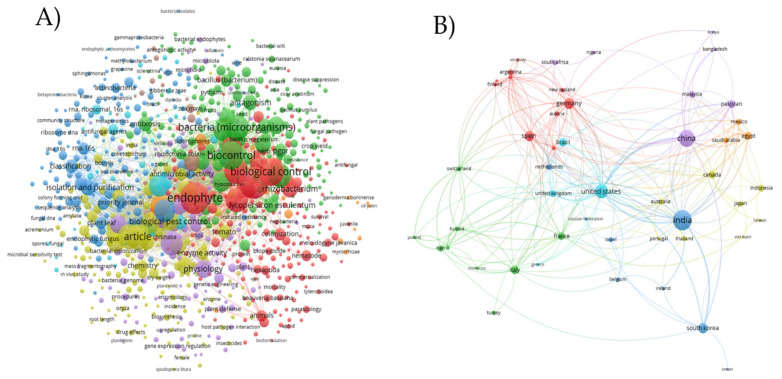
Figure 1
Figure 1
Bibliometric analysis of 1150 articles published on biological control according to the Scopus database using specific keywords such as “Rhizobacteria” OR “Endophytes” OR ”Biocontrol” (A) and the network analysis of their worldwide distribution (B); the larger the circle, the more intense the scientific activity.
Figure 2
Figure 2
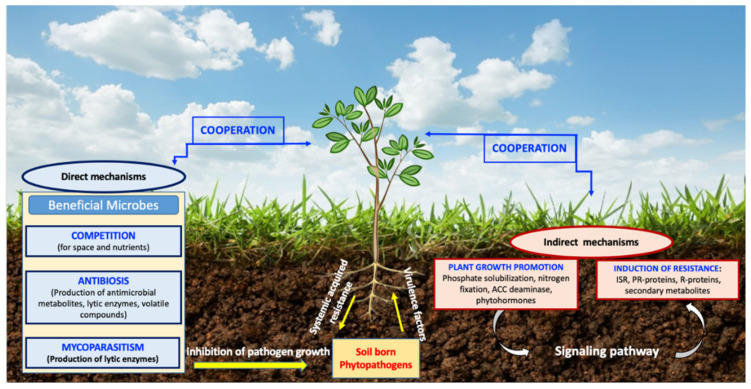
Possible modes of action of biological control agents.
Figure 3
Figure 3
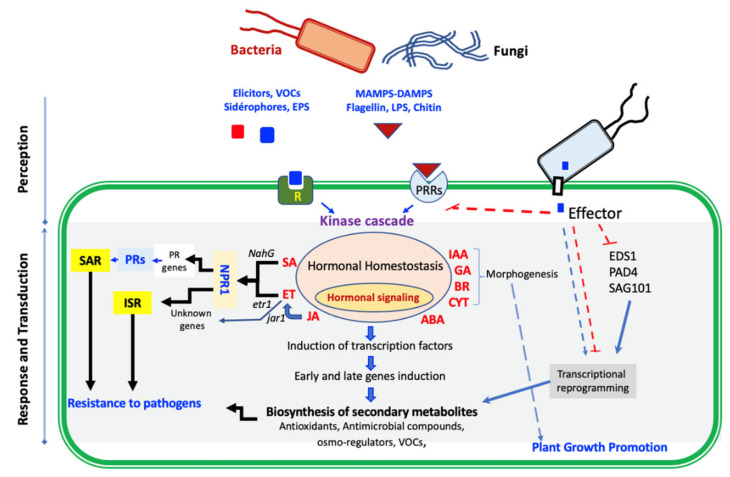
Schematic model of signal transduction events triggered by microbes. Microbes may produce microbe-associated molecular patterns (MAMPs) or damage-associated molecular patterns (DAMPs), such as flagellin or chitin, which are perceived by pattern-recognition receptors (PRRs), or other elicitors, such as volatile organic compounds (VOCs), or siderophores, which are perceived by receptors. The activated receptors may then trigger different signaling cascades, acting as a precursor for the biosynthesis of phytohormones that trigger defensive pathways. The kinase cascade may also phosphorylate transcription factors that modulate the expression of early and late response genes. Abbreviations: 3-indole acetic acid (IAA); abscisic acid (ABA); brassinosteroid (BR); cytokinin (CYT); enhanced disease susceptibility (EDS); ethylene (ET); exopolysaccharides (EPS); gibberellic acid (GA); induced systemic resistance (ISR), jasmonic acid (JA); lipopolysaccharides (LPS); nonexpressor of pathogenesis-related genes (NPR); pathogenesis-related protein (PR); peptidyl arginine deiminase (PAD), salicylic acid (SA); senescence-associated gene (SAG), systemic acquired resistance (SAR).
Figure 4
Figure 4
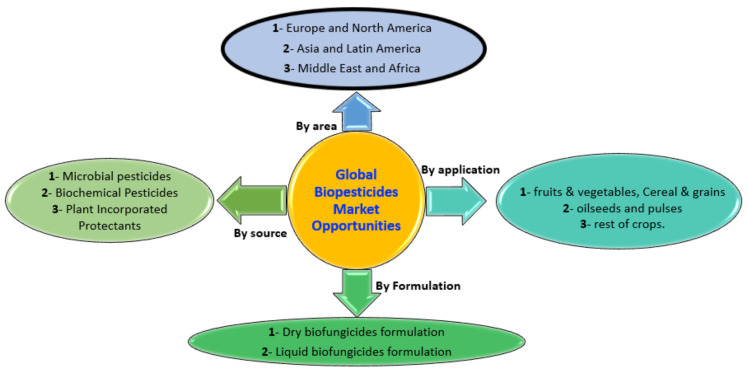
The potential market of biopesticide.

References

    1. Van Montagu M. The future of plant biotechnology in a globalized and environmentally endangered world. Genet. Mol. Biol. 2020;43:e20190040. doi: 10.1590/1678-4685-gmb-2019-0040. - DOI - PMC - PubMed
    1. Godfray H.C.J. The challenge of feeding 9–10 billion people equitably and sustainably. J. Agric. Sci. 2014;152:2–8. doi: 10.1017/S0021859613000774. - DOI
    1. Guillou M., Matheron G. The World’s Challenge. Springer; Dordrecht, The Netherlands: 2014.
    1. Dwivedi S.L., Lammerts van Bueren E.T., Ceccarelli S., Grando S., Upadhyaya H.D., Ortiz R. Diversifying Food Systems in the Pursuit of Sustainable Food Production and Healthy Diets. Trends Plant Sci. 2017;22:842–856. doi: 10.1016/j.tplants.2017.06.011. - DOI - PubMed
    1. Hobbs P.R., Sayre K., Gupta R. The role of conservation agriculture in sustainable agriculture. Philos. Trans. R. Soc. B Biol. Sci. 2007;363:543–555. doi: 10.1098/rstb.2007.2169. - DOI - PMC - PubMed