


Clinical Evaluation of a Fully-Automated High-Throughput Multiplex Screening-Assay to Detect and Differentiate the SARS-CoV-2 B.1.1.529 (Omicron) and B.1.617.2 (Delta) Lineage Variants
- PMID: 35337015
- PMCID: PMC8950896
- DOI: 10.3390/v14030608
Clinical Evaluation of a Fully-Automated High-Throughput Multiplex Screening-Assay to Detect and Differentiate the SARS-CoV-2 B.1.1.529 (Omicron) and B.1.617.2 (Delta) Lineage Variants
Abstract
Background: The recently emerged SARS-CoV-2 B.1.1.529 lineage and its sublineages (Omicron variant) pose a new challenge to healthcare systems worldwide due to its ability to efficiently spread in immunized populations and its resistance to currently available monoclonal antibody therapies. RT-PCR-based variant tests can be used to screen large sample-sets rapidly and accurately for relevant variants of concern (VOC). The aim of this study was to establish and validate a multiplex assay on the cobas 6800/8800 systems to allow discrimination between the two currently circulating VOCs, Omicron and Delta, in clinical samples.
Methods: Primers and probes were evaluated for multiplex compatibility. Analytic performance was assessed using cell culture supernatant of an Omicron variant isolate and a clinical Delta variant sample, normalized to WHO-Standard. Clinical performance of the multiplex assay was benchmarked against NGS results.
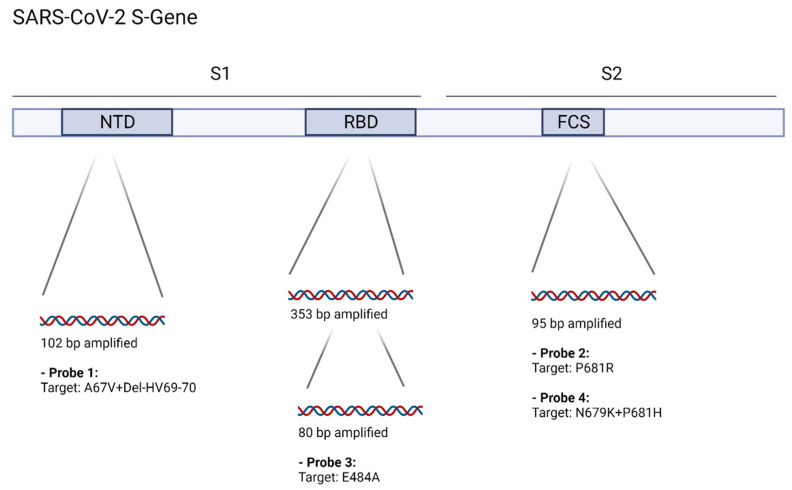
Results: In silico testing of all oligos showed no interactions with a high risk of primer-dimer formation or amplification of human DNA/RNA. Over 99.9% of all currently available Omicron variant sequences are a perfect match for at least one of the three Omicron targets included in the multiplex. Analytic sensitivity was determined as 19.0 IU/mL (CI95%: 12.9-132.2 IU/mL) for the A67V + del-HV69-70 target, 193.9 IU/mL (CI95%: 144.7-334.7 IU/mL) for the E484A target, 35.5 IU/mL (CI95%: 23.3-158.0 IU/mL) for the N679K + P681H target and 105.0 IU/mL (CI95%: 80.7-129.3 IU/mL) for the P681R target. All sequence variances were correctly detected in the clinical sample set (225/225 Targets).
Conclusion: RT-PCR-based variant screening compared to whole genome sequencing is both rapid and reliable in detecting relevant sequence variations in SARS-CoV-2 positive samples to exclude or verify relevant VOCs. This allows short-term decision-making, e.g., for patient treatment or public health measures.
Keywords: Omicron variant; RT-qPCR; SARS-CoV-2; variant screening.
Conflict of interest statement
M.L. received speaker honoraria and related travel expenses from Roche Diagnostics. All other authors declare no conflict of interest.
Figures
References
Publication types
MeSH terms
Substances
Supplementary concepts
LinkOut - more resources
Full Text Sources
Medical
Miscellaneous
