Review
. 2022 Mar 19;14(3):640.
doi: 10.3390/v14030640.

Mutations and Evolution of the SARS-CoV-2 Spike Protein

Affiliations
Review

Mutations and Evolution of the SARS-CoV-2 Spike Protein

Nicholas Magazine et al. Viruses. .

Erratum in

Abstract

The SARS-CoV-2 spike protein mediates target recognition, cellular entry, and ultimately the viral infection that leads to various levels of COVID-19 severities. Positive evolutionary selection of mutations within the spike protein has led to the genesis of new SARS-CoV-2 variants with greatly enhanced overall fitness. Given the trend of variants with increased fitness arising from spike protein alterations, it is critical that the scientific community understand the mechanisms by which these mutations alter viral functions. As of March 2022, five SARS-CoV-2 strains were labeled "variants of concern" by the World Health Organization: the Alpha, Beta, Gamma, Delta, and Omicron variants. This review summarizes the potential mechanisms by which the common mutations on the spike protein that occur within these strains enhance the overall fitness of their respective variants. In addressing these mutations within the context of the SARS-CoV-2 spike protein structure, spike/receptor binding interface, spike/antibody binding, and virus neutralization, we summarize the general paradigms that can be used to estimate the effects of future mutations along SARS-CoV-2 evolution.

Keywords: COVID-19; SARS-CoV-2; evolution; immune escape; infectivity; mutation; spike.


Conflict of interest statement

W.H. received financial support from MegaRobo Technologies Corporation, which was not used in this study. The other authors declare no conflict of interest.

Figures
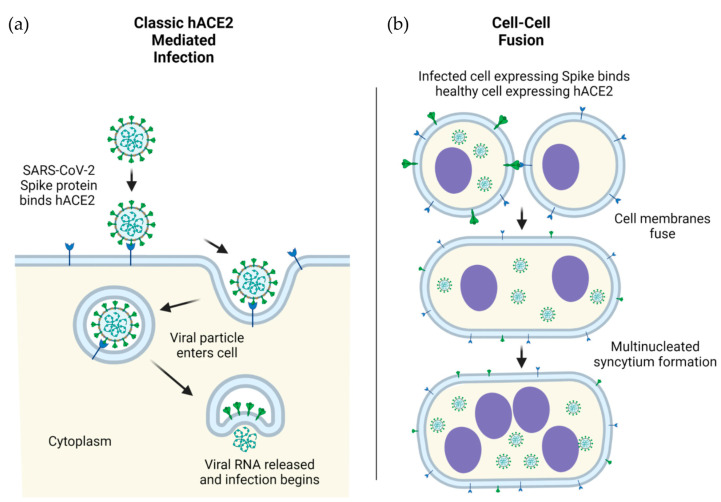
Figure 1
Figure 1
ACE2-mediated cellular infection by SARS-CoV-2. (a) Schematic of direct cellular entry of SARS-CoV-2 viral particles into human cells, mediated by ACE2. (b) Cellular infection by ACE2-spike mediated cell-cell fusion. Infection in human (h) cells is used as an example.
Figure 2
Figure 2
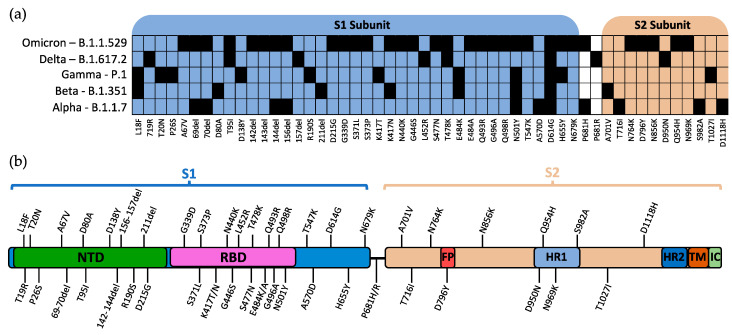
Mutations of spike protein within VOCs. (a) Defining mutations of WHO-labelled VOCs and their relative position in the S1/S2 subunits. (b) Visual representation of the relative position of mutations within the SARS-CoV-2 spike protein. Mutations are reported as listed in the CoV-Lineages database as of December 2021. NTD: N-terminal domain; RBD: receptor-binding domain; FP: fusion peptide; HR1: heptad repeat 1; HR2: heptad repeat 2; TM: transmembrane region; IC: intracellular domain.
Figure 3
Figure 3
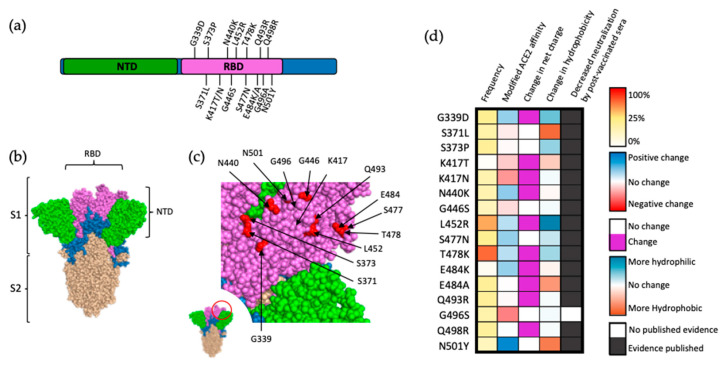
Mutations within the RBD of SARS-CoV-2 spike protein. (a) Visual representation of mutations within the RBD (magenta) of SARS-CoV-2 spike. Notably, 15 out of the 32 amino acid substitutions in the spike protein are localized in the RBD. (b) Structural location of SARS-CoV-2 S subunits. (c) Close-up view of RBD (magenta) and VOC-occurring mutations (red). (d) Frequency, effect on ACE2 affinity, modification of charge at physiological pH, alterations in hydrophobicity at pH 7, and direct evidence of decreased neutralization by postvaccinated sera for mutations within the RBD of S protein. Frequency is presented as a percentage of reported SARS-CoV-2 genomes logged within the GISAID database, as a notion of fitness advantage. Alteration in ACE2 affinity based on data by Starr et al. [21], with mutations that increase ACE2 affinity in blue and mutations negatively impacting ACE2 affinity in red. Frequency represented as a percentage of reported SARS-CoV-2 genomes logged within the GISAID database retrieved 10 March 2022. Alterations in hydrophobicity based on previously established values [23]. Alterations in residue charge based on standard calculations at physiological pH.
Figure 4
Figure 4
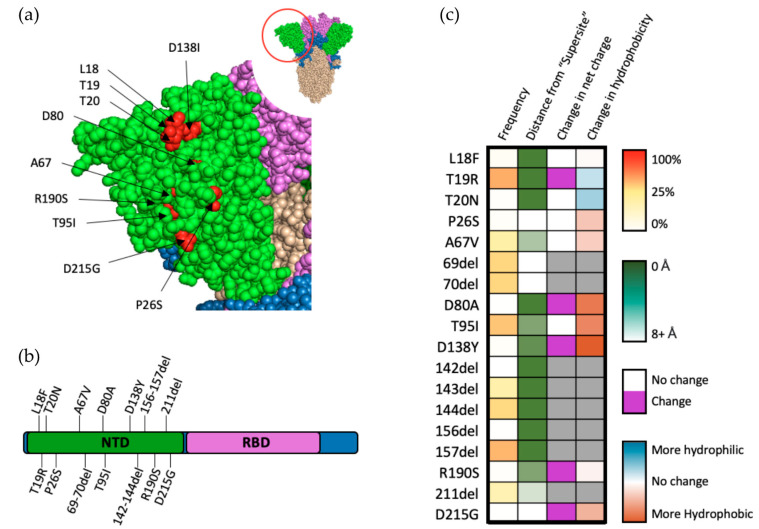
Mutations within the NTD of SARS-CoV-2 spike protein. (a) Structural representation of substitutions (red) within the NTD (green) of SARS-CoV-2 spike protein. (b) Visual representation of mutations within the NTD of spike protein. (c) Frequency, residue distance from NTD “supersite”, modification in charge at physiological pH, and change in hydrophobicity at pH 7. Residue distance was calculated in PyMOL on the protein three-dimension structure (PDB-6ZGG), by measuring the distance between the nearest atom of “supersite” amino acids identified by Mccalum et al., 2021 [32] and the nearest atom of amino acids of interest.
Figure 5
Figure 5
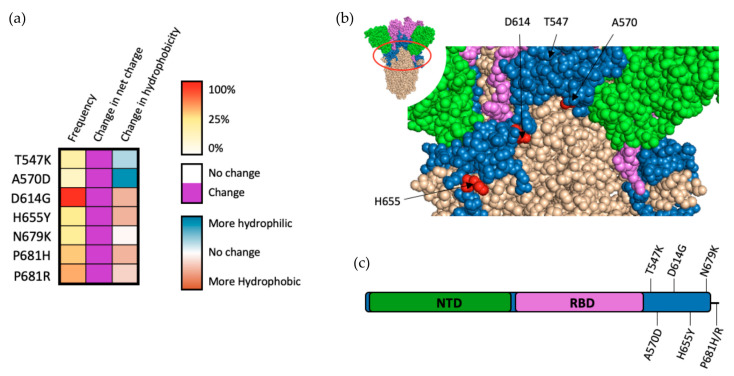
Mutations occurring outside of major SARS-CoV-2 spike subdomains. (a) Frequency, charge modifications, and alteration in hydrophobicity for mutations occurring outside of major spike subdomains. (b) Structural representation of mutations occurring within this region (P681 is not shown, as it is on the other surface of the current 3D view). (c) Schematic representation of mutations occurring outside of major spike subdomains.
Figure 6
Figure 6
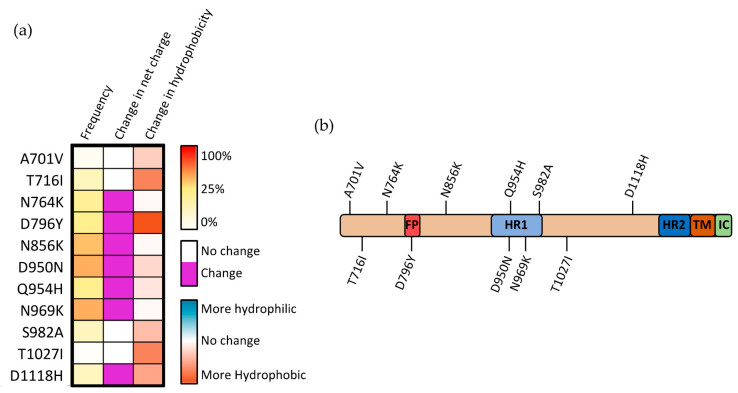
Mutations occurring within the S2 subunit of SARS-CoV-2 spike protein. (a) Frequency, modification in charge at physiological pH, and alteration in hydrophobicity for mutations occurring within the S2 subunit. (b) Visual representation of mutations occurring within the S2 subunit.

References

    1. Huang Y., Yang C., Xu X.F., Xu W., Liu S.W. Structural and functional properties of SARS-CoV-2 spike protein: Potential antivirus drug development for COVID-19. Acta Pharmacol. Sin. 2020;41:1141–1149. doi: 10.1038/s41401-020-0485-4. - DOI - PMC - PubMed
    1. Mengist H.M., Kombe Kombe A.J., Mekonnen D., Abebaw A., Getachew M., Jin T. Mutations of SARS-CoV-2 spike protein: Implications on immune evasion and vaccine-induced immunity. Semin. Immunol. 2021;55:101533. doi: 10.1016/j.smim.2021.101533. - DOI - PMC - PubMed
    1. Korber B., Fischer W.M., Gnanakaran S., Yoon H., Theiler J., Abfalterer W., Hengartner N., Giorgi E.E., Bhattacharya T., Foley B., et al. Tracking Changes in SARS-CoV-2 Spike: Evidence that D614G Increases Infectivity of the COVID-19 Virus. Cell. 2020;182:812–827.e19. doi: 10.1016/j.cell.2020.06.043. - DOI - PMC - PubMed
    1. He X., Hong W., Pan X., Lu G., Wei X. SARS-CoV-2 Omicron variant: Characteristics and prevention. MedComm. 2021;2:838–845. doi: 10.1002/mco2.110. - DOI - PMC - PubMed
    1. Xia X. Domains and Functions of Spike Protein in Sars-Cov-2 in the Context of Vaccine Design. Viruses. 2021;13:109. doi: 10.3390/v13010109. - DOI - PMC - PubMed

Publication types

Substances

Supplementary concepts