. 2022 Mar 2;15(3):305.
doi: 10.3390/ph15030305.

Vitamin D Status and Immune Response in Hospitalized Patients with Moderate and Severe COVID-19

Affiliations

Vitamin D Status and Immune Response in Hospitalized Patients with Moderate and Severe COVID-19

Tatiana L Karonova et al. Pharmaceuticals (Basel). .

Abstract

A low 25-hydroxyvitamin D (25(OH)D) level is considered as an independent risk factor for COVID-19 severity. However, the association between vitamin D status and outcomes in COVID-19 is controversial. In the present study we investigate the association between the serum 25(OH)D level, immune response, and clinical disease course in patients with COVID-19. A total of 311 patients hospitalized with COVID-19 were enrolled. For patients with a vitamin D deficiency/insufficiency, the prevalence of severe COVID-19 was higher than in those with a normal 25(OH)D level (p < 0.001). The threshold of 25(OH)D level associated with mortality was 11.4 ng/mL (p = 0.003, ROC analysis). The frequency of CD3+CD4+ T helper (Th) cells was decreased in patients with 25(OH)D level ≤ 11.4 ng/mL, compared to healthy controls (HCs). There were no differences in the frequency of naive, central memory (CM), effector memory (EM), and terminally differentiated effector memory Th cells in patients with COVID-19 compared to HCs. The frequency of T-follicular helpers was decreased both in patients with 25(OH)D level > 11.4 ng/mL (p < 0.001) and 25(OH)D level ≤ 11.4 ng/mL (p = 0.003) compared to HCs. Patients with 25(OH)D level > 11.4 ng/mL had an increased frequency of Th2 CM (p = 0.010) and decreased Th17 CM (p < 0.001). While the frequency of Th2 EM was significantly increased, the frequency of Th17 EM was significantly decreased in both groups compared to HCs. Thus, 25(OH)D level is an independent risk factor for the disease severity and mortality in patients with COVID-19. We demonstrate that the serum 25(OH)D level ≤ 11.4 ng/mL is associated with the stimulation of Th2 and the downregulation of Th17 cell polarization of the adaptive immunity in patients with COVID-19.

Keywords: 25(OH)D; COVID-19; SARS-CoV-2; T-follicular helpers; Th cell subsets; immune response; vitamin D.


Conflict of interest statement

The authors declare no conflict of interest.

Figures
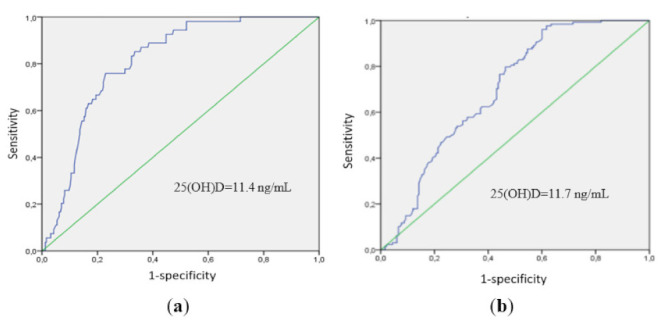
Figure 1
Figure 1
ROC analysis data: (a) the threshold for 25(OH)D levels associated with mortality was 11.4 ng/mL (AUC area = 0.811; sensitivity, 76%; and specificity, 77%; p = 0.003), and (b) the threshold for 25(OH)D levels associated with severe disease was 11.7 ng/mL (AUC area = 0.69; sensitivity, 76%; and specificity, 54%; p = 0.01).
Figure 2
Figure 2
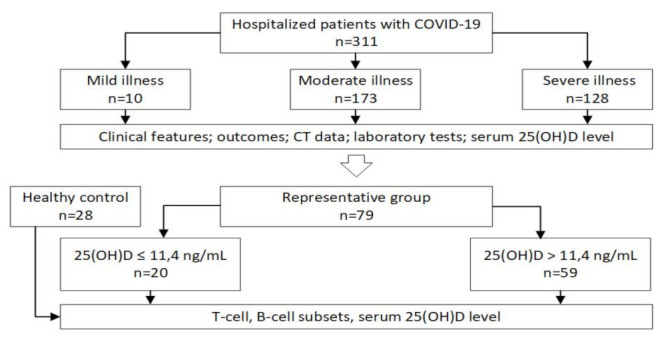
Study design: 25(OH)D—25-hydroxyvitamin D; CD—cluster of differentiation.
Figure 3
Figure 3
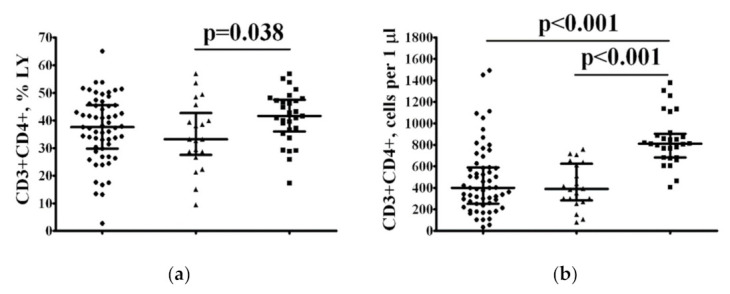
The frequency of peripheral blood CD3+CD4+ Th cells in patients with COVID-19 and 25(OH)D > 11.4 ng/mL or 25(OH)D ≤ 11.4 ng/mL. Scatter plots show the relative (a) and absolute (b) numbers of CD3+CD4+ T-lymphocytes in peripheral blood samples from patients with COVID-19 and 25(OH)D > 11.4 ng/mL (black circles, n = 59), patients with COVID-19 and 25(OH)D ≤ 11.4 ng/mL (black triangles, n = 20), and HC subjects (n = 28, black squares). Numbers represent the percentages of the indicated Th cell subset among the total lymphocyte population. Each dot represents an individual subject, and the horizontal bars represent the group medians and interquartile ranges (Me [IQR 25; 75]).
Figure 4
Figure 4
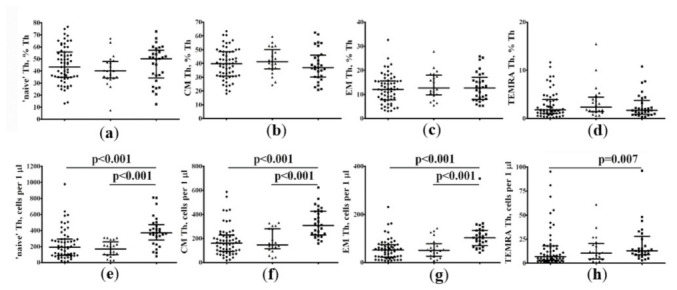
Distribution of differentiation Th subsets according to CD45RA and CD62L expression in patients with COVID-19 and in HCs. Scatter plots showing the relative (ad) and absolute (eh) counts of the main Th cell maturation stages in peripheral blood samples from patients with COVID-19 with 25(OH)D > 11.4 ng/mL (black circles), patients with COVID-19 with 25(OH)D≤ 11.4 ng/mL (black triangles) and HC subjects (black squares). Scatter plots (a,e)—”naïve” CD45RA+CD62L+ Th cells; (b,f)—central memory CD45RA−CD62L+ Th cells; (c,g)—effector memory CD45RA−CD62L– Th cells; and (d,h)—TEMRA CD45RA+CD62L– Th cells. Numbers represent the percentage of the indicated Th cell subset among the total lymphocyte population. Each dot represents the individual subjects, and the horizontal bars represent the group medians and quartile ranges (Me [IQR 25; 75]).
Figure 5
Figure 5
Imbalance of central memory CD3+CD4+ Th cell subsets in patients with COVID-19. Scatter plots show the relative count of the main “polarizes” Th cell subsets within the total central memory CD45RA−CD62L+ Th cells, including Th1 (CXCR5-CXCR3+CCR6-CCR4-) (a), Th2 (CXCR5-CXCR3-CCR6-CCR4+) (b), total Th17 (CXCR5-CCR6+) (c), and CXCR5-positive Tfh cells (d), respectively, in peripheral blood samples from patients with 25(OH)D > 11.4 ng/mL (black circles), patients with 25(OH)D ≤ 11.4 ng/mL (black triangles), and HC subjects (black squares). Numbers represent the percentage of the indicated Th cell subset among the total lymphocyte population. Each dot represents the individual subjects, and the horizontal bars represent the group medians and quartile ranges (Me [IQR 25; 75]).
Figure 6
Figure 6
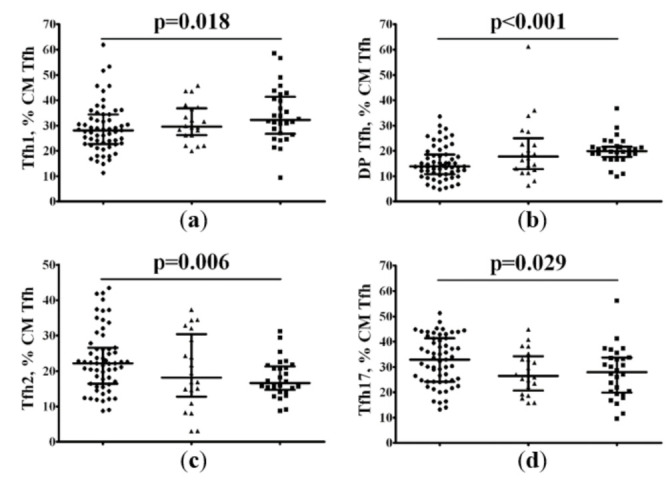
Imbalance of central memory Tfh cell subsets in patients with COVID-19. Scatter plots show the percentages of CXCR3+CCR6− Tfh1 (a), double-positive CXCR3+CCR6+ Tfh (b), CXCR3−CCR6− Tfh2 (c), and CXCR3−CCR6+ Tfh17 (d) cells among the total CD45RA−CD62L+ Tfh population, respectively, in peripheral blood samples in patients with 25(OH)D > 11.4 ng/mL (black circles), patients with 25(OH)D ≤ 11.4 ng/mL (black triangles), and HC subjects (black squares). Numbers represent the percentage of the indicated Th cell subset among the total lymphocyte population.
Figure 7
Figure 7
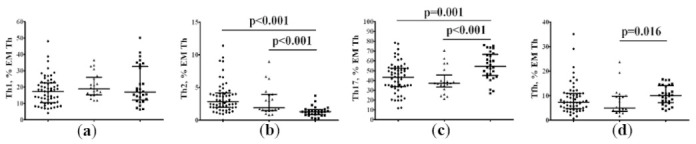
Imbalance of effector memory CD3+CD4+ Th cell subsets in patients with COVID-19. Scatter plots showing the relative count of the main “polarizes” Th cell subsets within the total central memory CD45RA−CD62L– Th cells, including Th1 (CXCR5-CXCR3+CCR6-CCR4-) (a), Th2 (CXCR5-CXCR3-CCR6-CCR4+) (b), total Th17 (CXCR5-CCR6+) (c), and CXCR5-positive Tfh cells (d), respectively, in peripheral blood samples from patients with 25(OH)D > 11.4 ng/mL (black circles), patients with 25(OH)D ≤ 11.4 ng/mL (black triangles), and HC subjects (black squares). Numbers represent the percentage of the indicated Th cell subset among the total lymphocyte population.

References

    1. Khalifa S.A.M., Swilam M.M., El-Wahed A.A.A., Du M., El-Seedi H.H.R., Kai G., Masry S.H.D., Abdel-Daim M.M., Zou X., Halabi M.F., et al. Beyond the Pandemic: COVID-19 Pandemic Changed the Face of Life. Int. J. Environ. Res. Public Health. 2021;18:5645. doi: 10.3390/ijerph18115645. - DOI - PMC - PubMed
    1. Cascella M., Rajnik M., Aleem A., Dulebohn S.C., Di Napoli R. StatPearls [Internet] StatPearls Publishing; Treasure Island, FL, USA: 2022. Features, Evaluation, and Treatment of Coronavirus (COVID-19) - PubMed
    1. Selvaraj P., Harishankar M., Afsal K. Vitamin D: Immuno-modulation and tuberculosis treatment. Can. J. Physiol. Pharmacol. 2015;93:377–384. doi: 10.1139/cjpp-2014-0386. - DOI - PubMed
    1. Meinken C., Kamen D.L., Wagner M., Bals R., Steinmeyer A., Zügel U., Gallo R.L., Eisenberg D., Hewison M., Hollis B.W., et al. Toll-like receptor triggering of a vitamin D-mediated human antimicrobial response. Science. 2006;311:1770–1773. doi: 10.1126/science.1123933. - DOI - PubMed
    1. Wang T.T., Nestel F.P., Bourdeau V., Nagai Y., Wang Q., Liao J., Tavera-Mendoza L., Lin R., Hanrahan J.W., Mader S., et al. Cutting edge: 1,25-dihydroxyvitamin D3 is a direct inducer of antimicrobial peptide gene expression. J. Immunol. 2004;173:2909–2912. doi: 10.4049/jimmunol.173.5.2909. - DOI - PubMed