


Local infiltration analgesia versus peripheral nerve block anaesthesia in total knee arthroplasty: a pharmaco-economic comparison
- PMID: 35337268
- PMCID: PMC8953132
- DOI: 10.1186/s12871-022-01620-w
Local infiltration analgesia versus peripheral nerve block anaesthesia in total knee arthroplasty: a pharmaco-economic comparison
Abstract
Background: A superior analgesic method in perioperative pain-management of patients receiving total knee arthroplasty is the subject of controversial debate. Although higher cost-efficiency is claimed for the local infiltration analgesia (LIA), there is a lack of data on its costs compared to peripheral nerve block anaesthesia (PNBA). The goal of this study was to investigate the differences in immediate perioperative costs between the LIA and PNBA in treatment of patients receiving total knee arthroplasty.
Methods: The comparison was conducted based on a randomized controlled clinical trial examining 40 patients with elective, primary total knee arthroplasty (TKA, 20 patients with LIA and 20 patients with PNBA). The analysis included surgical case costs, anaesthesiological case costs, material, costs of postoperative opioid requirements and catheter review visits for patients receiving PNBA.
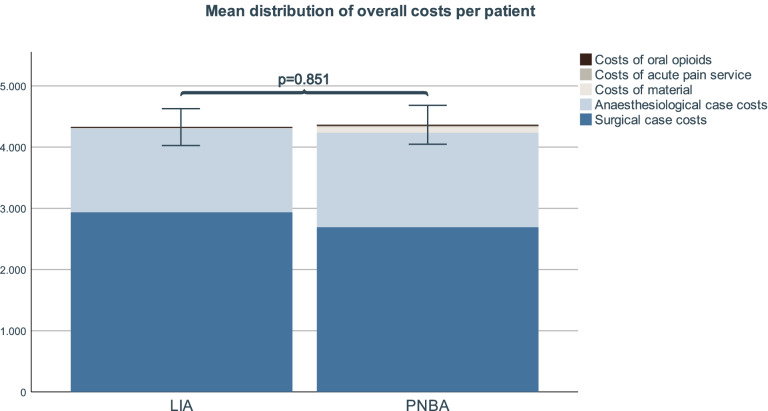
Results: The overall mean costs for the LIA-group were 4328.72€ and 4368.12€ for the PNBA (p = 0.851). While there was no statistically significant difference in surgical case costs, the anaesthesiological costs were lower with the LIA procedure (1370.26€ vs. 1542.45€, p = 0.048). Material costs in the LIA group were 4.18€/patient and 94.64€/patient with the PNBA. Costs for postoperative opioid requirements showed no statistically significant difference between the two procedures.
Conclusions: There is no relevant difference in immediate perioperative costs between LIA and PNBA. Shorter induction times lead to lower anaesthesiological case costs with the LIA. Overall economic aspects seem to play a less important role for determining an adequate procedure for perioperative pain management.
Trial registration: The study was approved by the ethics-review-board of Charité Hospital Berlin (Ethikausschuss 4, Charité - Universitätsmedizin Berlin, on 16th February 2017) and registered with data safety authorities. Study patients provided written informed consent to participate in the trial. Study registry: ClinicalTrials.gov, NCT03114306 .
Keywords: Cost comparison; Local infiltration analgesia; Pain management; Peripheral nerve block.
© 2022. The Author(s).
Conflict of interest statement
MB declares no conflicts of interest. JW declares no conflicts of interest. MH declares no conflicts of interest. CP declares no conflicts of interest. JK declares no conflicts of interest. S. Tafelski received funding from two charitable foundations (AMS Stiftung, Paul-Martini Stiftung) unrelated to this study. S. Treskatsch received honoraria for lectures from Edwards, Carinopharm, OrionPharma and Smith & Nephews outside this work.
Figures
References
-
- Kerr DR. Local infiltration analgesia a technique to improve outcomes after hip, knee or lumbar spine surgery. London: Informa Healthcare; 2012.
-
- Mayr HO, Prall WC, Haasters F, Baumbach SF, Hube R, Stoehr A. Pain relieve without impairing muscle function after local infiltration anaesthesia in primary knee arthroplasty: a prospective randomized study. Arch Orthop Trauma Surg. 2019;139(7):1007–1013. doi: 10.1007/s00402-019-03194-8. - DOI - PubMed
-
- Derogatis MJ, Sodhi N, Anis HK, Ehiorobo JO, Bhave A, Mont MA. Pain Management Strategies To Reduce Opioid Use Following Total Knee Arthroplasty. Surg Technol Int. 2019;35:301–310. - PubMed
-
- Greimel F, Maderbacher G, Baier C, Schwarz T, Zeman F, Meissner W, Grifka J, Benditz A. Matched-Pair Analysis of Local Infiltration Analgesia in Total Knee Arthroplasty: Patient Satisfaction and Perioperative Pain Management in 846 Cases. J Knee Surg. 2019;32(10):953–9. 10.1055/s-0038-1672156. Epub 2018 Oct 6. - PubMed
Publication types
MeSH terms
Substances
Associated data
LinkOut - more resources
Full Text Sources
Medical
