Metabolic dysfunction-related liver disease as a risk factor for cancer
- PMID: 35338048
- PMCID: PMC8961105
- DOI: 10.1136/bmjgast-2021-000817
Metabolic dysfunction-related liver disease as a risk factor for cancer
Abstract
Objective: The aim of this study was to investigate the association between obesity, diabetes and metabolic related liver dysfunction and the incidence of cancer.
Design: This study was conducted with health record data available from the National Health Service in Tayside and Fife. Genetics of Diabetes Audit and Research Tayside, Scotland (GoDARTS), Scottish Health Research Register (SHARE) and Tayside and Fife diabetics, three Scottish cohorts of 13 695, 62 438 and 16 312 patients, respectively, were analysed in this study. Participants in GoDARTS were a volunteer sample, with half having type 2 diabetes mellitus(T2DM). SHARE was a volunteer sample. Tayside and Fife diabetics was a population-level cohort. Metabolic dysfunction-related liver disease (MDLD) was defined using alanine transaminase measurements, and individuals with alternative causes of liver disease (alcohol abuse, viruses, etc) were excluded from the analysis.
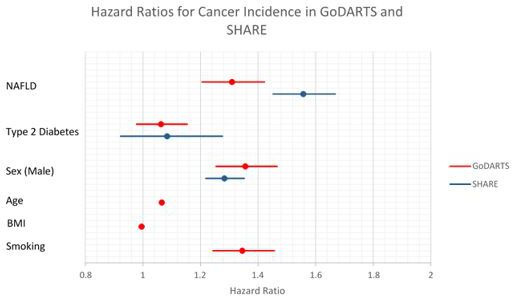
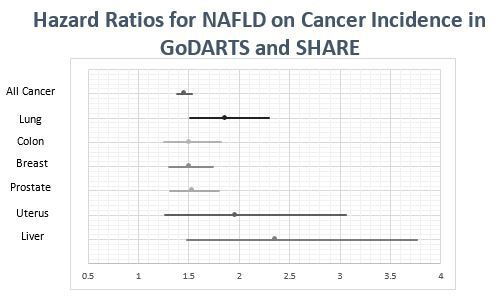
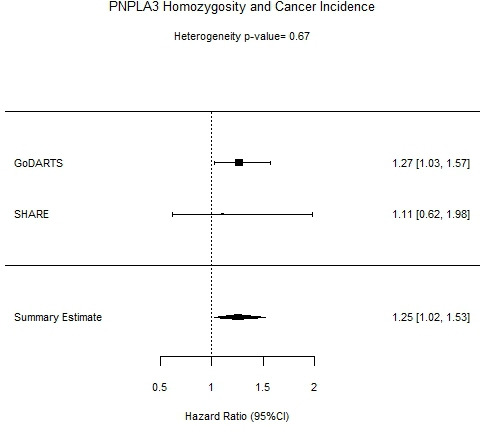
Results: MDLD associated with increased cancer incidence with a HR of 1.31 in a Cox proportional hazards model adjusted for sex, type 2 diabetes, body mass index(BMI), and smoking status (95% CI 1.27 to 1.35, p<0.0001). This was replicated in two further cohorts, and similar associations with cancer incidence were found for Fatty Liver Index (FLI), Fibrosis-4 Index (FIB-4) and non-alcoholic steatohepatitis (NASH). Homozygous carriers of the common non-alcoholic fatty liver disease (NAFLD) risk-variant PNPLA3 rs738409 had increased risk of cancer. (HR=1.27 (1.02 to 1.58), p=3.1×10 -2). BMI was not independently associated with cancer incidence when MDLD was included as a covariate.
Conclusion: MDLD, FLI, FIB-4 and NASH associated with increased risk of cancer incidence and death. NAFLD may be a major component of the relationship between obesity and cancer incidence.
Keywords: cancer; epidemiology; fatty liver; genetics; obesity.
© Author(s) (or their employer(s)) 2022. Re-use permitted under CC BY-NC. No commercial re-use. See rights and permissions. Published by BMJ.
Conflict of interest statement
Competing interests: Philip Ambery, Javier Armisen, Benjamin Challis and Carolina Haefliger are employees of AstraZeneca and are shareholders of AstraZeneca.
Figures
References
-
- Younossi Z, Loomba R, Rinella M. Current and future therapeutic regimens for non-alcoholic fatty liver disease (NAFLD) and non-alcoholic steatohepatitis (NASH). Hepatology 2017;5:1–36.
Publication types
MeSH terms
Grants and funding
LinkOut - more resources
Full Text Sources
Medical