Clinical Trial
. 2022 Jun 9;139(23):3376-3386.
doi: 10.1182/blood.2021013733.

Efficacy and safety of CD19-specific CAR T cell-based therapy in B-cell acute lymphoblastic leukemia patients with CNSL

Affiliations
Clinical Trial

Efficacy and safety of CD19-specific CAR T cell-based therapy in B-cell acute lymphoblastic leukemia patients with CNSL

Yuekun Qi et al. Blood. .

Abstract

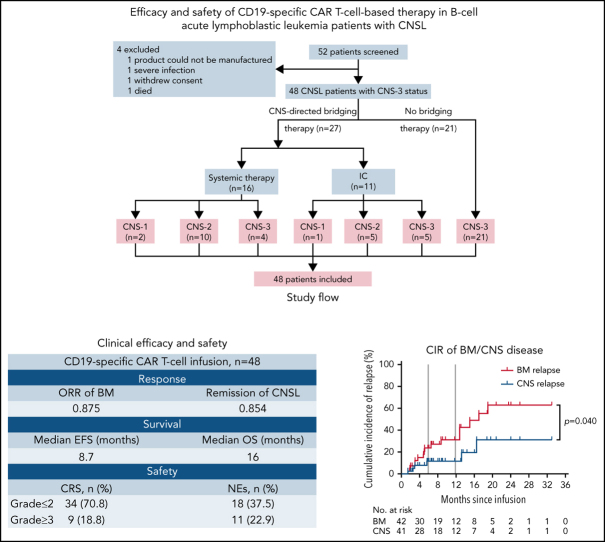
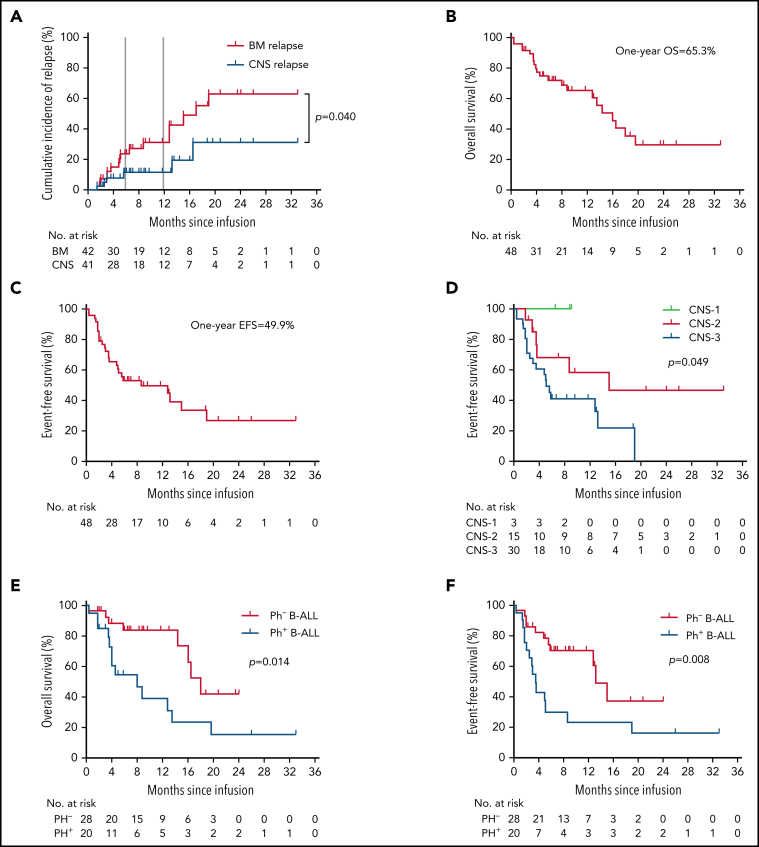
Few studies have described chimeric antigen receptor (CAR) T-cell therapy for patients with B-cell acute lymphoblastic leukemia (B-ALL) with central nervous system leukemia (CNSL) because of concerns regarding poor response and treatment-related neurotoxicity. Our study included 48 patients with relapsed/refractory B-ALL with CNSL to evaluate the efficacy and safety of CD19-specific CAR T cell-based therapy. The infusion resulted in an overall response rate of 87.5% (95% confidence interval [CI], 75.3-94.1) in bone marrow (BM) disease and remission rate of 85.4% (95% CI, 72.8-92.8) in CNSL. With a median follow-up of 11.5 months (range, 1.3-33.3), the median event-free survival was 8.7 months (95% CI, 3.7-18.8), and the median overall survival was 16.0 months (95% CI, 13.5-20.1). The cumulative incidences of relapse in BM and CNS diseases were 31.1% and 11.3%, respectively, at 12 months (P = .040). The treatment was generally well tolerated, with 9 patients (18.8%) experiencing grade ≥3 cytokine release syndrome. Grade 3 to 4 neurotoxic events, which developed in 11 patients (22.9%), were associated with a higher preinfusion disease burden in CNS and were effectively controlled under intensive management. Our results suggest that CD19-specific CAR T cell-based therapy can induce similar high response rates in both BM and CNS diseases. The duration of remission in CNSL was longer than that in BM disease. CD19 CAR T-cell therapy may provide a potential treatment option for previously excluded patients with CNSL, with manageable neurotoxicity. The clinical trials were registered at www.clinicaltrials.gov as #NCT02782351 and www.chictr.org.cn as #ChiCTR-OPN-16008526.


Figures

None
Graphical abstract
Figure 1
Figure 1
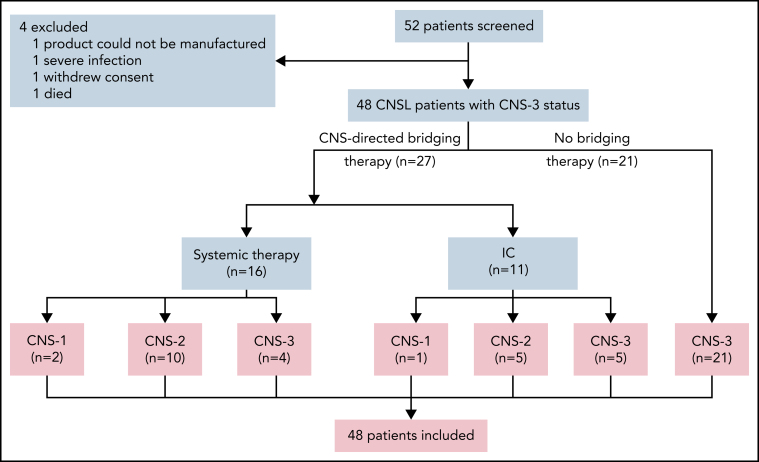
Screening and enrollment of patients. Fifty-two patients with R/R B-ALL with CNSL were screened for eligibility between November 2016 and April 2021 in the study. CNS-directed bridging therapy included systemic chemotherapy (high-dose methotrexate; range, 3-5 g/m2) and triple intrathecal chemotherapy (IC; 10 mg of methotrexate, 50 mg of cytarabine, and 5 mg of dexamethasone each time). Patients were categorized as CNS-1 (n = 3), CNS-2 (n = 15), and CNS-3 status (n = 30) by the last assessment before CAR T-cell infusion. A total of 48 patients received CAR T-cell infusion and were included in the analysis for response evaluation, survival, and toxicity assessment.
Figure 2
Figure 2
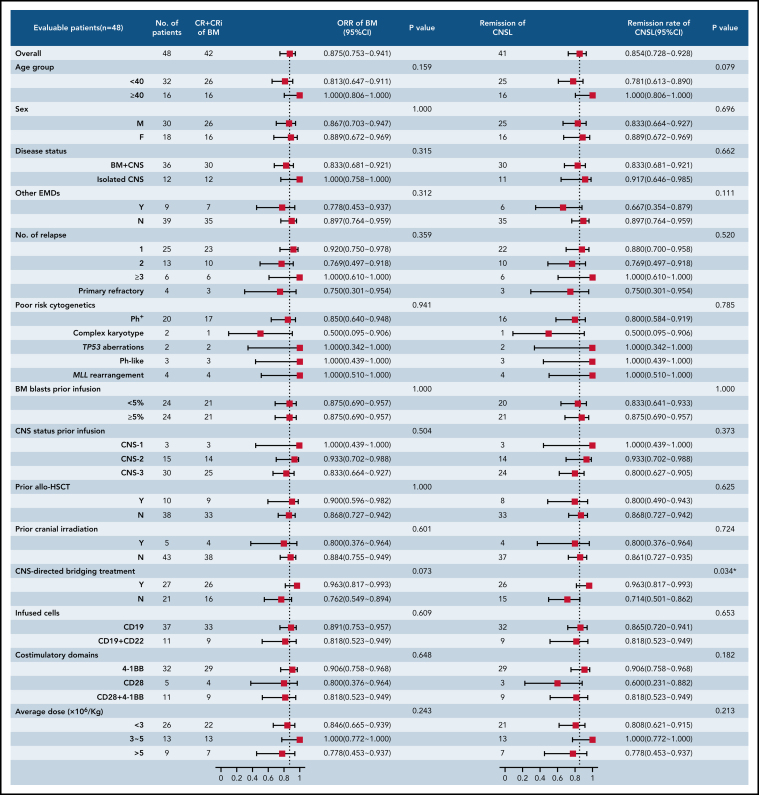
Subgroup analysis of response rates in patients with R/R B-ALL with CNSL. The forest plots showed the subgroup analysis of the rate of ongoing responses according to demographic and clinical characteristics at baseline. The analysis of response rate across subgroups was performed using the Clopper-Pearson 95% CI and Fisher's exact test. CRi, CR with incomplete blood count recovery; EMD, extramedullary disease; MLL, mixed-lineage leukemia; ORR, overall response rate.
Figure 3
Figure 3
Long-term survival in patients with R/R B-ALL with CNSL after CAR T-cell therapy. (A) The cumulative incidence of BM relapse and CNS relapse in patients achieving remission in terms of BM (n = 42) or CNS (n = 41) disease. Event of interest was defined as any pattern of relapse occurring by the cutoff day, and nonrelapse mortality and subsequent allo-HSCT were considered competing risks. Patients who did not experience relapse at last follow-up were censored. (B-F) OS analysis (B) and EFS analysis (C); EFS analysis according to CNS status before CAR T-cell infusion (D); and OS analysis (E) and EFS analysis (F) according to Ph status. The probabilities of OS and EFS were estimated by means of the Kaplan-Meier method and were compared using the log-rank test.
Figure 4
Figure 4
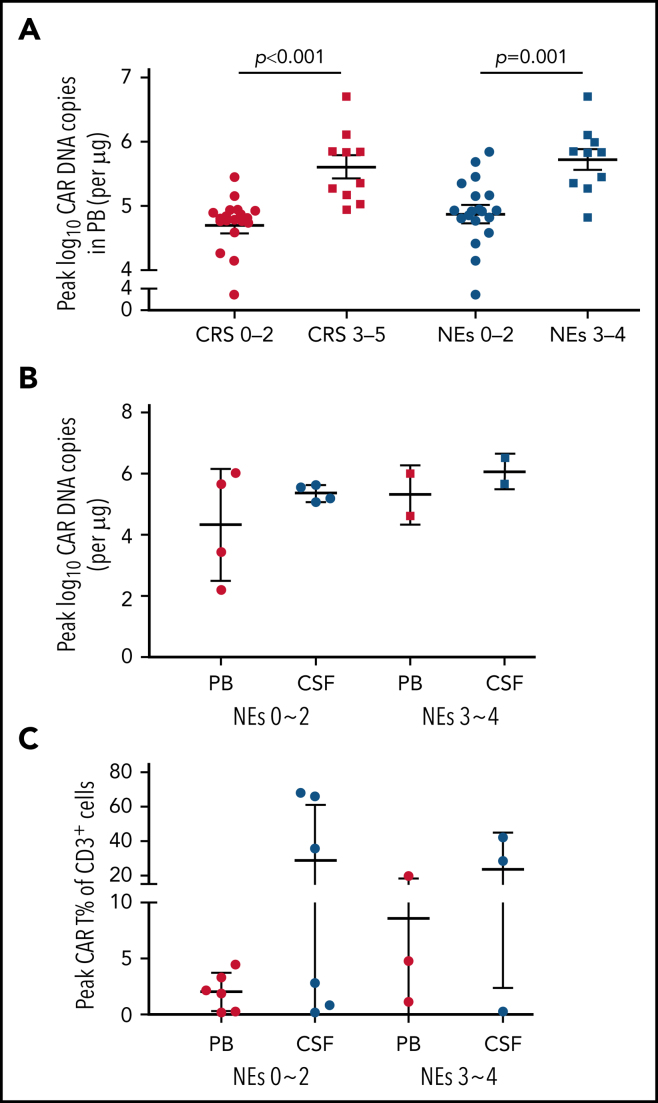
Expansion of CAR T cells in both PB and CSF. (A) The peak CAR T-cell expansion in PB after CAR T-cell infusion assessed by real-time quantitative polymerase chain reaction (qPCR) categorized by severity of CRS and NEs. (B) The comparison of peak CAR T-cell expansion in PB and CSF assessed by qPCR categorized by NE grade. (C) The comparison of peak CAR T-cell expansion in PB and CSF assessed by flow cytometry categorized by NE grade. Patients were not completely overlapped as presented in panels B and C. Data represent median ± standard deviation. The Mann-Whitney U test was used for statistical analysis. Grade given on x-axis labels.

References

    1. Richard-Carpentier G, Kantarjian H, Jabbour E. Recent advances in adult acute lymphoblastic leukemia. Curr Hematol Malig Rep. 2019;14(2):106–118. - PubMed
    1. Bassan R, Pavoni C, Intermesoli T, et al. Updated risk-oriented strategy for acute lymphoblastic leukemia in adult patients 18-65 years: NILG ALL 10/07. Blood Cancer J. 2020;10(11):119. - PMC - PubMed
    1. Inaba H, Pui CH. Advances in the diagnosis and treatment of pediatric acute lymphoblastic leukemia. J Clin Med. 2021;10(9):1926. - PMC - PubMed
    1. Park JH, Rivière I, Gonen M, et al. Long-term follow-up of CD19 CAR therapy in acute lymphoblastic leukemia. N Engl J Med. 2018;378(5):449–459. - PMC - PubMed
    1. Maude SL, Laetsch TW, Buechner J, et al. Tisagenlecleucel in children and young adults with B-cell lymphoblastic leukemia. N Engl J Med. 2018;378(5):439–448. - PMC - PubMed

Publication types

MeSH terms

Associated data