


Brain health correlates of mobility-related confidence
- PMID: 35339632
- PMCID: PMC9109136
- DOI: 10.1016/j.exger.2022.111776
Brain health correlates of mobility-related confidence
Abstract
Background: Mobility is important for independence in older age. While brain health correlates of objectively measured mobility-related features like gait and balance have been reported, we aimed to test neuroimaging and cognitive correlates of subjective measures of mobility-related confidence.
Methods: We carried out a cross-sectional observational study comprised of N = 29 cognitively unimpaired older adult participants, mean age 75.8 ± 5.8, 52% female, 24% non-white. We measured cognition, hippocampal volume, white matter hyperintensities, cerebral amyloid-β (Aβ), and gait and balance confidence. We tested associations using unadjusted Spearman correlations and correlations partialling out covariates of interest one at a time.
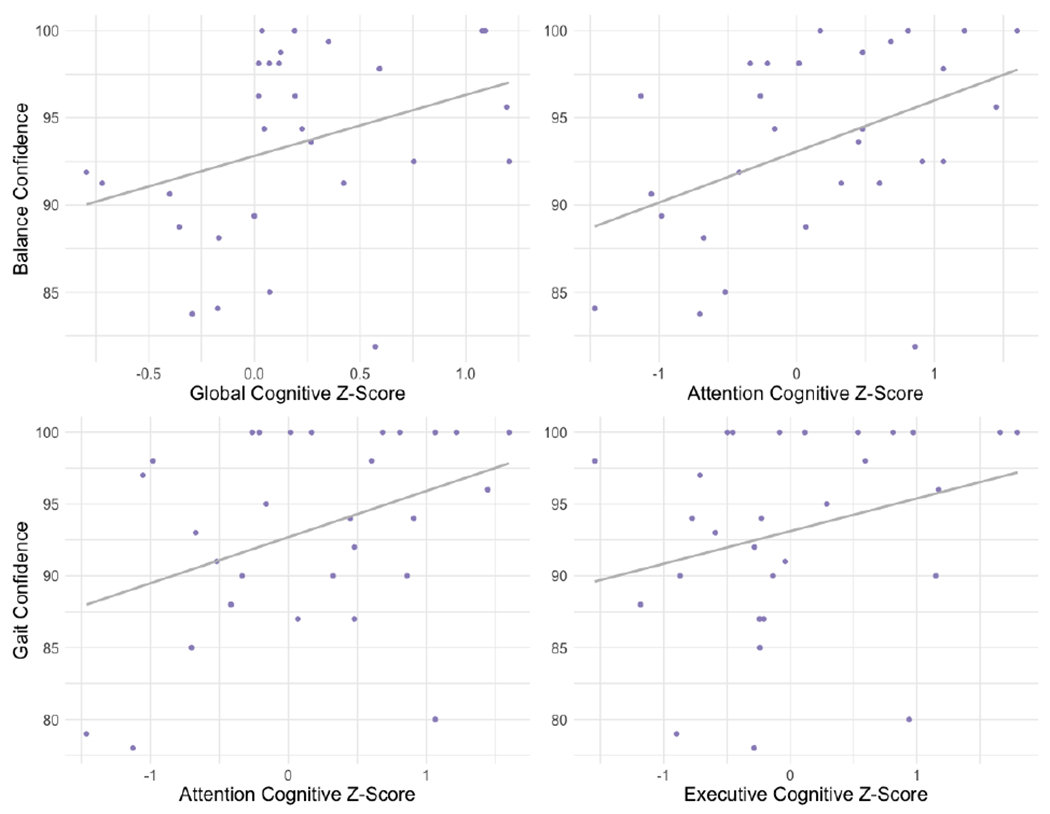
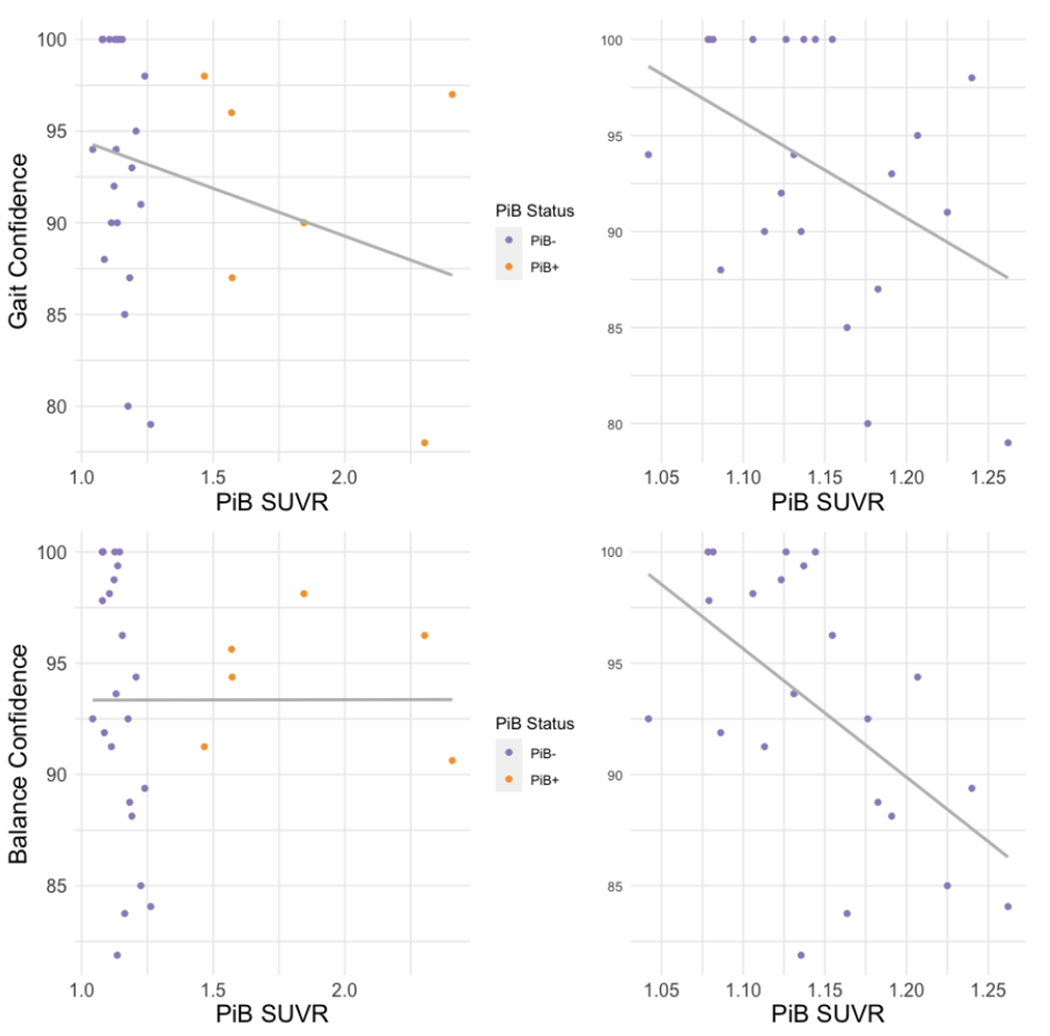
Results: Greater gait confidence was associated with better attention (unadjusted ρ = 0.37, p = 0.05; partially attenuated by adjustment for age, APOE4, anxiety, motivation, gait speed, or Aβ); executive performance (unadjusted ρ = 0.35, p = 0.06; partially attenuated by adjustment for age, APOE4, gait speed, or Aβ); and lower Aβ levels (unadjusted ρ = -0.40, p = 0.04; partially attenuated by adjustment for age, depressive symptoms, motivation, or gait speed). Greater balance confidence was associated with better global cognition (unadjusted ρ = 0.41, p = 0.03; partially attenuated by adjustment for APOE4, gait speed, or Aβ); attention (unadjusted ρ = 0.46, p = 0.01; robust to adjustment); and lower Aβ levels (unadjusted ρ = -0.35, p = 0.07; partially attenuated by adjustment for age, education, APOE4, depressive symptoms, anxiety, motivation, or gait speed).
Conclusions: Self-reported mobility-related confidence is associated with neuroimaging and cognitive measures and would be easy for providers to use in clinical evaluations. These associations should be further evaluated in larger samples, and longitudinal studies can help determine temporality of declines.
Keywords: Amyloid-β; Cognition; Hippocampal volume; Mobility; White matter hyperintensities.
Copyright © 2022 Elsevier Inc. All rights reserved.
Figures
References
-
- Rosso AL, Studenski SA, Longstreth WT Jr., Brach JS, Boudreau RM, Rosano C. Contributors to Poor Mobility in Older Adults: Integrating White Matter Hyperintensities and Conditions Affecting Other Systems. The journals of gerontology Series A, Biological sciences and medical sciences. 2017;72(9):1246–1251. - PMC - PubMed
-
- Bandura A Human agency in social cognitive theory. Am Psychol. 1989;44(9):1175–1184. - PubMed
Publication types
MeSH terms
Substances
Grants and funding
LinkOut - more resources
Full Text Sources
