Observational Study
. 2022 Aug;292(2):350-364.
doi: 10.1111/joim.13488. Epub 2022 Apr 3.

Bacterial meningitis: Aetiology, risk factors, disease trends and severe sequelae during 50 years in Sweden

Affiliations
Observational Study

Bacterial meningitis: Aetiology, risk factors, disease trends and severe sequelae during 50 years in Sweden

Nils Block et al. J Intern Med. 2022 Aug.

Abstract

Background: Bacterial meningitis (BM) is a rare but severe infection. Few population-based studies have characterised BM episodes and sequelae over long periods.

Methods: This was a population-based observational cohort study with national coverage, using data on aetiological pathogens, sex, premorbid conditions, steroid pretreatment, severe sequelae and birth, death and diagnosis dates collected from 10,339 patients with BM reported to the National Board of Health and Welfare in Sweden between 1964 and 2014.

Results: During the 50-year study period, the incidence of BM decreased in young children, but not in the elderly. The most common cause of BM was pneumococci (34%), followed by Haemophilus influenzae (26%), and meningococci (18%), mainly community acquired. Premorbid conditions were found in 20%. After the H. influenzae type b vaccine was introduced in 1993, the BM incidence decreased by 36%. Following pneumococcal conjugated vaccine introduction in 2009, the incidence and 30-day mortality from pneumococcal meningitis decreased by 64% and 100%, respectively, in previously healthy children, and the 30-day mortality decreased by 64% among comorbid adults. The BM incidence in immunosuppressed patients increased by 3% annually post vaccine introduction. The 30-day mortality was 3% in children and 14% in adults, and the rate of severe sequelae was 44%. On average, patients lost 11 years of healthy life due to BM.

Conclusion: The introduction of conjugated vaccines into the childhood vaccination program has reduced the incidence of BM in young children, but not in adults. Post vaccine introduction, patients present with more premorbid conditions and other bacterial causes of BM, emphasising the need for a correct diagnosis when treating these infections.

Keywords: Haemophilus influenzae; Streptococcus pneumoniae; bacterial meningitis; conjugate vaccines; severe sequelae.


Conflict of interest statement

The authors declare that no competing interests exist.

Figures
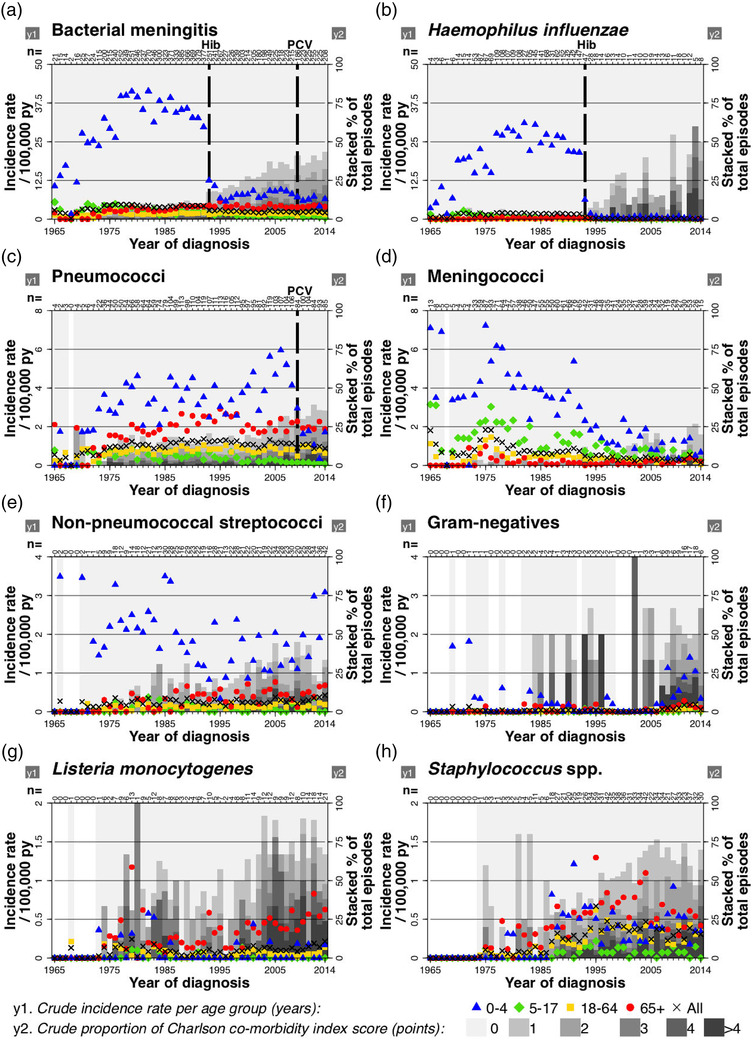
Fig. 1
Fig. 1
Incidence rate (IR) of and comorbidity with bacterial meningitis (BM). The annual IRs of BM in Sweden between 1965 and 2014 by single pathogen and age group are shown in relation to the introduction of H. influenzae B (Hib) and pneumococcal conjugate vaccines (PCVs) on the left y‐axis (y1) and annual stacked proportions of patient Charlson comorbidity index scores on the right y‐axis (y2) in grayscale. The total annual number of episodes is shown for each year. The annual incidence of (a) all BM, followed by that of BM due to single pathogens, namely (b) Haemophilus influenzae, (c) Streptococcus pneumoniae, (d) Neisseria meningitidis, (e) non‐pneumococcal streptococci, (f) gram‐negative bacteria, (g) Listeria monocytogenes and (h) Staphylococcal spp.
Fig. 2
Fig. 2
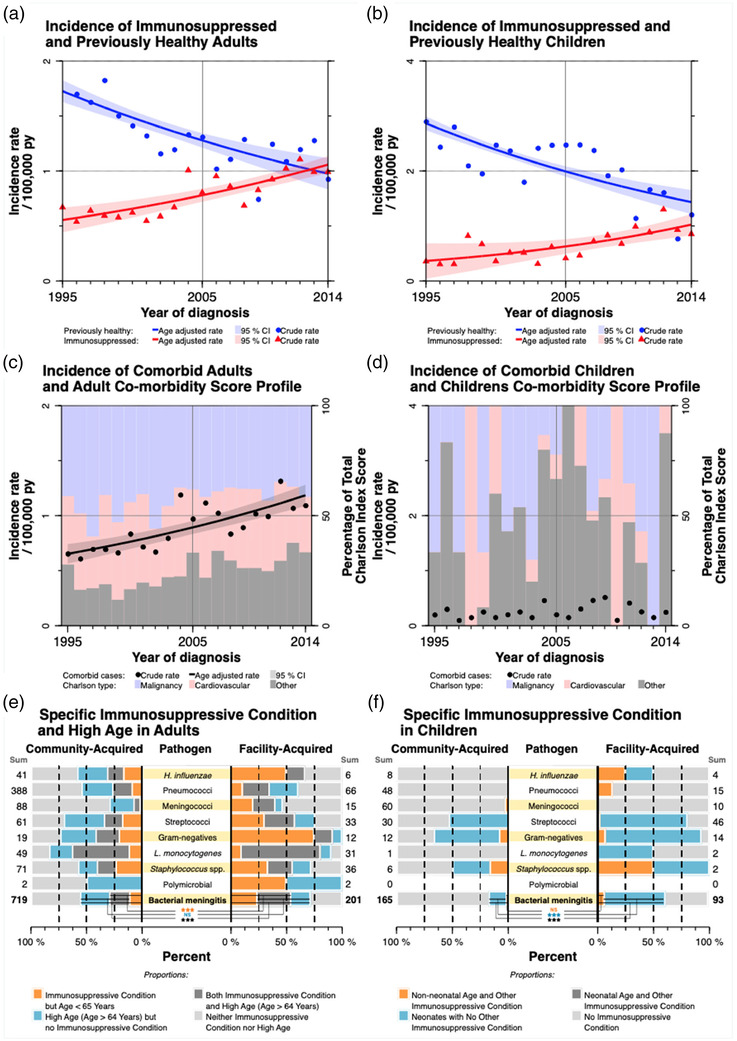
Incidence rate (IR) and immunosuppression of bacterial meningitis (BM). (a) The crude and predicted IRs for BM in adult patients with specific immunosuppression and without premorbid conditions at admission during the conjugate vaccine era, 1995–2014, are shown. Detailed definitions of premorbid conditions are available in the Supplementary Information (Materials and Methods, Tables S1 and S2). (b) The corresponding estimates are shown for children. (c) The crude and predicted IRs for BM in adult patients with Charlson comorbidities present at admission during the conjugate vaccine era on the left y‐axis (y1) and annual stacked proportions by patient Charlson comorbidity score during the conjugate vaccine era on the right y‐axis (y2). (d) The corresponding values for children. (e) The pathogen‐specific profiles of specific predisposing conditions and older age among adult community‐acquired episodes compared to adult (non‐neurosurgical) facility‐acquired episodes, post pneumococcal conjugate vaccine (PCV). (f) The pathogen‐specific profiles of individual predisposing conditions among children with community‐acquired episodes compared to those in children with (non‐neurosurgical) facility‐acquired episodes, post‐PCV. Post‐neurosurgical episodes are excluded from (e) and (f) as they are, by definition, preceded by a lesion resulting in dysfunction of the blood–brain barrier, a specific form of immunosuppression. CI95%, 95% percent confidence interval; H. influenzae, Haemophilus influenzae; L. monocytogenes, Listeria monocytogenes; Py, person‐years; Streptococci, non‐pneumococcal streptococci. Significance levels are shown as: *p < 0.05; **p < 0.01; ***p < 0.001; or nonsignificant. Predictions are depicted as median splines. The crude IR for adult patients without premorbid conditions in 1995 (IR = 2.07) is not shown in the graph.
Fig. 3
Fig. 3
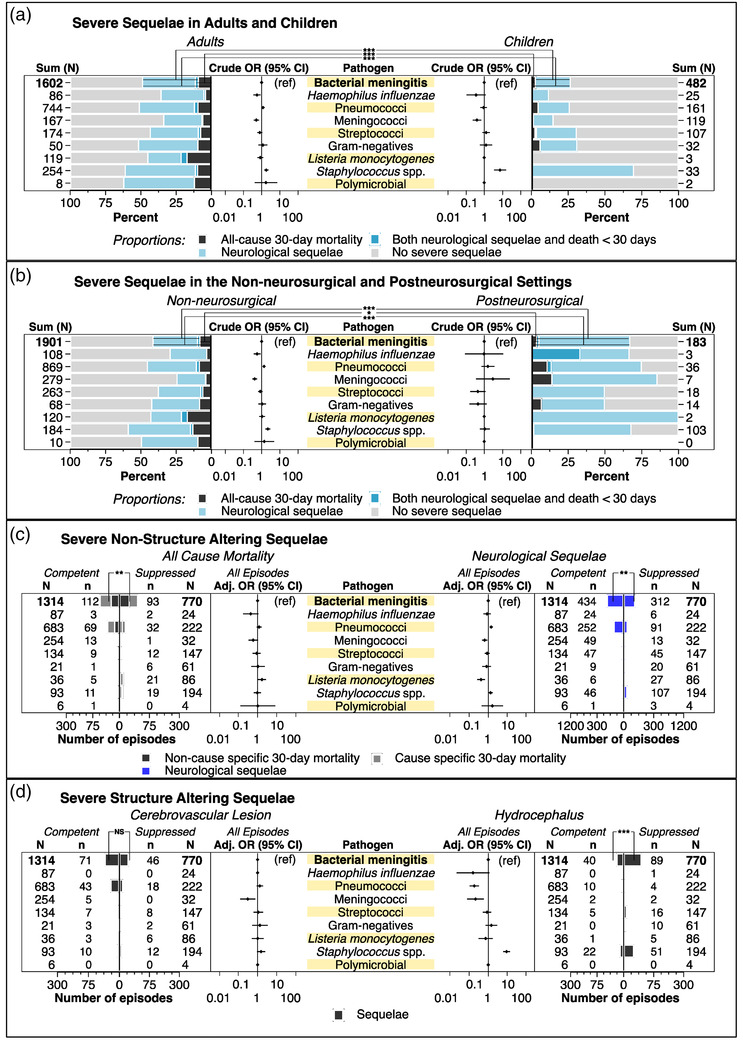
Severe sequelae (SS) of bacterial meningitis. (a) The unadjusted odds ratios (ORs) with 95% confidence intervals (CI95%) of meningitis‐causing pathogens and the univariate analysis of age and SS, consisting of all‐cause 30‐day mortality and severe neurological sequelae (including structural and nonstructural forms). The OR for age and SS was 2.6 (CI95% 2.1–3.3, p < 0.001), for age and all‐cause 30‐day mortality was 3.9 (CI95% 2.3–6.6, p < 0.001) and for age and severe neurological sequelae was 2.1 (CI95% 1.7–2.7, p < 0.001). (b) The corresponding distributions and analysis of SS stratified by clinical setting. The OR for clinical setting and SS was 2.9 (CI95% 2.1–3.9, p < 0.001), for clinical setting and all‐cause 30‐day mortality was 0.5 (CI95% 0.3–1.0, p = 0.04) and for clinical setting and severe neurological sequelae was 3.5 (CI95% 2.5–4.8, p < 0.001). (c) The univariate analysis of immunocompetence and all‐cause 30‐day mortality was 1.5 (CI95% 1.1–2.0, p = 0.009), and the adjusted ORs for pathogen‐specific and all‐cause 30‐day mortality are shown on the left. The proportion of the all‐cause mortality that was cause specific is also shown. On the right, the corresponding analyses of immunocompetence, pathogens and nonstructural neurological sequelae are shown. (d) The corresponding stratified distributions and analysis for structural neurological sequelae. The OR for immunosuppression and hydrocephalus was 4.2 (CI95% 2.8–6.1, p < 0.001). Logistic regression was used for univariate and multivariate analysis; the multivariate analysis included adjustment for sex, age and clinical setting. Significance levels are shown as: *p < 0.05; **p < 0.01; ***p < 0.001; or nonsignificant. Pharmacological data were available from 2005 onwards; data on SS were therefore restricted to episodes reported thereafter. Adj., adjusted; Ref, reference category; Streptococci, non‐pneumococcal streptococci.

References

    1. Lucas MJ, Brouwer MC, van de Beek D. Neurological sequelae of bacterial meningitis. J Infect. 2016;73(1):18–27. - PubMed
    1. Durand ML, Calderwood SB, Weber DJ, Miller SI, Southwick FS, Caviness VS Jr, et al. Acute bacterial meningitis in adults. A review of 493 episodes. N Engl J Med. 1993;328(1):21–8. - PubMed
    1. Tebruegge M, Curtis N. Epidemiology, etiology, pathogenesis, and diagnosis of recurrent bacterial meningitis. Clin Microbiol Rev. 2008;21(3):519–37. - PMC - PubMed
    1. Laxmi S, Tunkel AR. Healthcare‐associated bacterial meningitis. Curr Infect Dis Rep. 2011;13(4):367–73. - PubMed
    1. Wright J. Nosocomial infections in children's wards. J Hyg (Lond). 1940;40(6):647–72. - PMC - PubMed

Publication types