


The economics of vision impairment and its leading causes: A systematic review
- PMID: 35340626
- PMCID: PMC8943414
- DOI: 10.1016/j.eclinm.2022.101354
The economics of vision impairment and its leading causes: A systematic review
Abstract
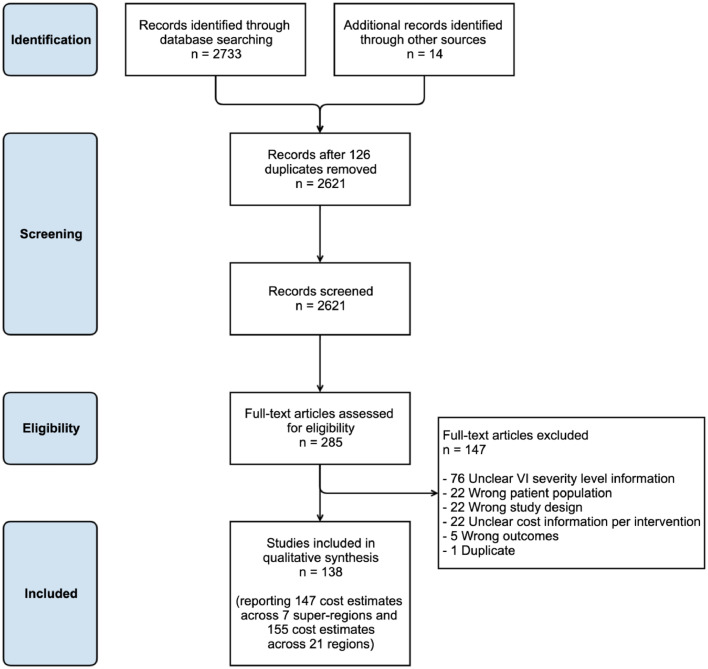
Vision impairment (VI) can have wide ranging economic impact on individuals, households, and health systems. The aim of this systematic review was to describe and summarise the costs associated with VI and its major causes. We searched MEDLINE (16 November 2019), National Health Service Economic Evaluation Database, the Database of Abstracts of Reviews of Effects and the Health Technology Assessment database (12 December 2019) for partial or full economic evaluation studies, published between 1 January 2000 and the search dates, reporting cost data for participants with VI due to an unspecified cause or one of the seven leading causes globally: cataract, uncorrected refractive error, diabetic retinopathy, glaucoma, age-related macular degeneration, corneal opacity, trachoma. The search was repeated on 20 January 2022 to identify studies published since our initial search. Included studies were quality appraised using the British Medical Journal Checklist for economic submissions adapted for cost of illness studies. Results were synthesized in a structured narrative. Of the 138 included studies, 38 reported cost estimates for VI due to an unspecified cause and 100 reported costs for one of the leading causes. These 138 studies provided 155 regional cost estimates. Fourteen studies reported global data; 103/155 (66%) regional estimates were from high-income countries. Costs were most commonly reported using a societal (n = 48) or healthcare system perspective (n = 25). Most studies included only a limited number of cost components. Large variations in methodology and reporting across studies meant cost estimates varied considerably. The average quality assessment score was 78% (range 35-100%); the most common weaknesses were the lack of sensitivity analysis and insufficient disaggregation of costs. There was substantial variation across studies in average treatment costs per patient for most conditions, including refractive error correction (range $12-$201 ppp), cataract surgery (range $54-$3654 ppp), glaucoma (range $351-$1354 ppp) and AMD (range $2209-$7524 ppp). Future cost estimates of the economic burden of VI and its major causes will be improved by the development and adoption of a reference case for eye health. This could then be used in regular studies, particularly in countries with data gaps, including low- and middle-income countries in Asia, Eastern Europe, Oceania, Latin America and sub-Saharan Africa.
Keywords: AMD, Age- related macular degeneration; DALYs, Disability Adjusted Life Years; DR, Diabetic Retinopathy; EU, European; GBD, Global Burden of Disease; Health economics; ICD 11, International Statistical Classification of Diseases, Injuries and Causes of Death 11th revision; LMICs, Low Middle Income Countries; MSVI, Moderate and Severe Vision Impairment; NR, Not reported; Ophthalmology; PPP, Purchasing power parity; Public health; QALYs, Quality Adjusted Life Years; RE, Refractive Error; Systematic review; USD, United States Dollars ($); VI, Vision Impairment; WHO, World Health Organization; anti-VEGF, antivascular endothelial growth factor.
© 2022 The Authors.
Conflict of interest statement
MJB reports grants, in support of the work for The Lancet Global Health Commission on Global Eye Health, from The Queen Elizabeth Diamond Jubilee Trust, The Wellcome Trust, Moorfields Eye Charity (GR001061), Sightsavers, The Fred Hollows Foundation, The SEVA Foundation, The British Council for the Prevention of Blindness, and Christian Blind Mission. MJB is supported by the Wellcome Trust (207472/Z/17/Z). PK reports grants from Wellcome Trust, The Helen Hamlyn Trust, UCL Technology Fund, Moorfields Eye Charity, The Jules Thorn Charitable Trust, Fight for Sight, National Institute for Health Research, Apollo Therapeutics Fund, Medical Research Council, personal fees from Aerie, Alcon, CMER Hospital Group, Genetech, Glaukos, ISA RNA Therapeutics GmBH, Novartis, Santen, and Thea outside of the submitted work; having a patent pending for Biochannel Device, PK Eye Model, Moorfields UCL MIO Muller stem cells; participation on advisory boards for (Novartis, DrugTech, Santen, CRICK Institute, Decisions in health Care to Introduce or Diffuse innovations using Evidence); being a board member of Moorfields Eye Hospital, Ophthalmology Foundation Board, UCL Partners Academic Health Science Centre, UCLP Informatics Board; being a member of Clinical Research Coalition Group, AHSC Planning & Performance Executive, UCL IOO & Moorfields Joint Campaign and Steering Group, Faculty of Brain Sciences Heads of Research Departments Board, Joint Research Governance Committee, AHSC and AHSN Programme Directors Forum, Moorfields Eye Hospital and UCL Institute of Ophthalmology, R&D Advisory Group of Central & East London Local Clinical Research Network, Joint Research Strategy Committee, Moorfields Eye Hospital Institute of Ophthalmology, Research Management Committee, Moorfields Eye Hospital; being a director of NIHR Biomedical Research Centre for Ophthalmology; being on the grant panel of Moorfields Eye Charity, ICO-Allergan Research Fellowship Program, Alcon Research Institute Scientific Select Committee, Ruskell Medal Reviewer Committee, Worshipful Company of Spectacle; being a founder of and stockholding for Radiance Therapeutics and Optceutics; being a co-founder of Lumemed Let and being a private clinician at Moorfields Private.
References
-
- GBD 2019 Blindness and Vision Impairment Collaborators; Vision Loss Expert Group of the Global Burden of Disease Study Trends in prevalence of blindness and distance and near vision impairment over 30 years: an analysis for the Global Burden of Disease Study. Lancet Glob Health. 2021;9(2):e130–ee43. - PMC - PubMed
-
- Langelaan M., de Boer M.R., van Nispen R.M., Wouters B., Moll A.C., van Rens G.H. Impact of visual impairment on quality of life: a comparison with quality of life in the general population and with other chronic conditions. Ophthalmic Epidemiol. 2007;14(3):119–126. - PubMed
-
- Mojon-Azzi S.M., Sousa-Poza A., Mojon D.S. Impact of low vision on employment. Ophthalmologica. 2010;224(6):381–388. Journal international d'ophtalmologie International journal of ophthalmology Zeitschrift fur Augenheilkunde. - PubMed
Publication types
Grants and funding
LinkOut - more resources
Full Text Sources
