


Utilizing Artificial Intelligence to Enhance Health Equity Among Patients with Heart Failure
- PMID: 35341539
- PMCID: PMC8988237
- DOI: 10.1016/j.hfc.2021.11.001
Utilizing Artificial Intelligence to Enhance Health Equity Among Patients with Heart Failure
Abstract
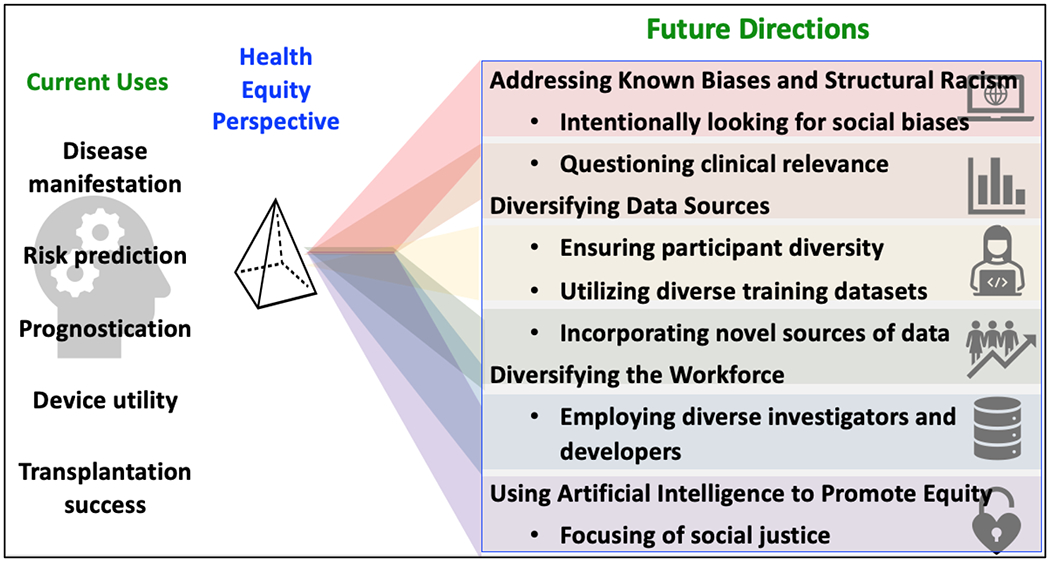
Patients with heart failure (HF) are heterogeneous with various intrapersonal and interpersonal characteristics contributing to clinical outcomes. Bias, structural racism, and social determinants of health have been implicated in unequal treatment of patients with HF. Through several methodologies, artificial intelligence (AI) can provide models in HF prediction, prognostication, and provision of care, which may help prevent unequal outcomes. This review highlights AI as a strategy to address racial inequalities in HF; discusses key AI definitions within a health equity context; describes the current uses of AI in HF, strengths and harms in using AI; and offers recommendations for future directions.
Keywords: Artificial intelligence; Guideline-directed therapy; Health equity; Health services research; Machine learning; Racial disparities; Risk prediction.
Copyright © 2021 Elsevier Inc. All rights reserved.
Conflict of interest statement
Figures
References
-
- Virani SS, Alonso A, Aparicio HJ, et al. Heart Disease and Stroke Statistics-2021 Update: A Report From the American Heart Association. Circulation. 2021;143(8):e254–e743. - PubMed
-
- Glynn P, Lloyd-Jones DM, Feinstein MJ, Carnethon M, Khan SS. Disparities in Cardiovascular Mortality Related to Heart Failure in the United States. Journal of the American College of Cardiology. 2019;73(18):2354–2355. - PubMed
-
- Chan PS, Oetgen WJ, Buchanan D, et al. Cardiac performance measure compliance in outpatients: the American College of Cardiology and National Cardiovascular Data Registry’s PINNACLE (Practice Innovation And Clinical Excellence) program. Journal of the American College of Cardiology. 2010;56(1):8–14. - PMC - PubMed
-
- Farmer SA, Kirkpatrick JN, Heidenreich PA, Curtis JP, Wang Y, Groeneveld PW. Ethnic and racial disparities in cardiac resynchronization therapy. Heart rhythm. 2009;6(3):325–331. - PubMed
Publication types
MeSH terms
Grants and funding
LinkOut - more resources
Full Text Sources
Medical
Research Materials
Miscellaneous
