


Epigenetics underpins phenotypic plasticity of protandrous sex change in fish
- PMID: 35342607
- PMCID: PMC8931711
- DOI: 10.1002/ece3.8730
Epigenetics underpins phenotypic plasticity of protandrous sex change in fish
Abstract
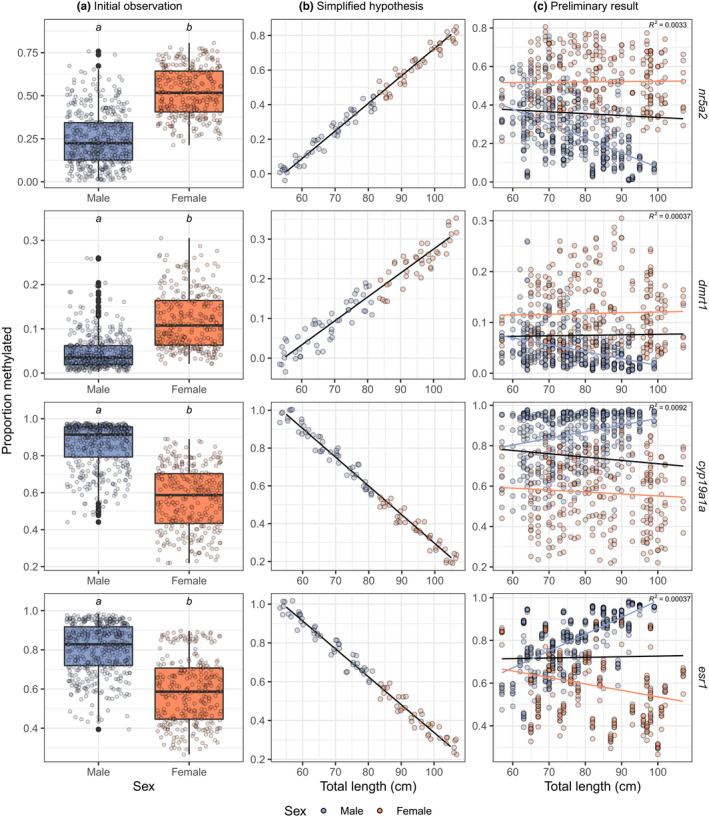
Phenotypic plasticity is an important driver of species resilience. Often mediated by epigenetic changes, phenotypic plasticity enables individual genotypes to express variable phenotypes in response to environmental change. Barramundi (Lates calcarifer) are a protandrous (male-first) sequential hermaphrodite that exhibits plasticity in length-at-sex change between geographic regions. This plasticity is likely to be mediated by changes in DNA methylation (DNAm), a well-studied epigenetic modification. To investigate the relationships between length, sex, and DNAm in a sequential hermaphrodite, here, we compare DNAm in four conserved vertebrate sex-determining genes in male and female barramundi of differing lengths from three geographic regions of northern Australia. Barramundi first mature as male and later sex change to female upon the attainment of a larger body size; however, a general pattern of increasing female-specific DNAm markers with increasing length was not observed. Significant differences in DNAm between males and females of similar lengths suggest that female-specific DNAm arises rapidly during sex change, rather than gradually with fish growth. The findings also reveal that region-specific differences in length-at-sex change are accompanied by differences in DNAm and are consistent with variability in remotely sensed sea temperature and salinity. Together, these findings provide the first in situ evidence for epigenetically and environmentally mediated sex change in a protandrous hermaphrodite and offer significant insight into the molecular and ecological processes governing the marked and unique plasticity of sex in fish.
Keywords: DNA methylation; ecological adaptation; phenotypic plasticity; sex change; teleost; temperature.
© 2022 The Authors. Ecology and Evolution published by John Wiley & Sons Ltd.
Conflict of interest statement
The authors declare that they are not aware of any competing interests.
Figures



References
-
- Athauda, S. , & Anderson, T. (2014). Effect of temperature and salinity on sex inversion in Asian Seabass (Lates calcarifer): Relationship with plasma sex steroids concentration and aromatase activity of gonad and brain. Aquaculture Research.
-
- Australian Institute of Marine Science (AIMS) (2017). AIMS Sea Water Temperature Observing System (AIMS Temperature Logger Program). 10.25845/5b4eb0f9bb848accessed. 21‐May‐2021. - DOI
-
- Banh, Q. Q. , Guppy, J. L. , Domingos, J. A. , Budd, A. M. , Pinto, R. C. , Marc, A. F. , & Jerry, D. R. (2021). Induction of precocious females in the protandrous barramundi (Lates calcarifer) through implants containing 17β‐estradiol‐effects on gonadal morphology, gene expression and DNA methylation of key sex genes. Aquaculture, 539, 736601. 10.1016/j.aquaculture.2021.736601 - DOI
Associated data
LinkOut - more resources
Full Text Sources
