


Human-health impacts of controlling secondary air pollution precursors
- PMID: 35342772
- PMCID: PMC8942014
- DOI: 10.1021/acs.estlett.1c00798
Human-health impacts of controlling secondary air pollution precursors
Abstract
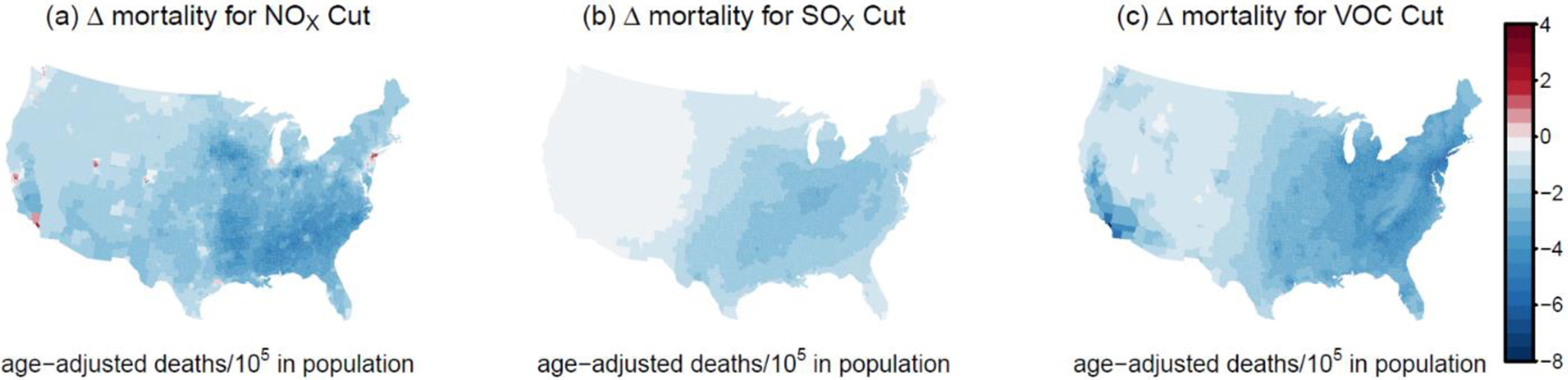
Exposure to ozone and fine particle (PM2.5) air pollution results in premature death. These pollutants are predominantly secondary in nature and can form from nitrogen oxides (NOX), sulfur oxides (SOX), and volatile organic compounds (VOCs). Predicted health benefits for emission reduction scenarios often incompletely account for VOCs as precursors as well as the secondary organic aerosol (SOA) component of PM2.5. Here, we show that anthropogenic VOC emission reductions are more than twice as effective as equivalent fractional reductions of SOX or NOX at reducing air pollution-associated cardiorespiratory mortality in the United States. A 25% reduction in anthropogenic VOC emissions from 2016 levels is predicted to avoid 13,000 premature deaths per year, and most (85%) of the VOC-reduction benefits result from reduced SOA with the remainder from ozone. While NOX (-5.7 ± 0.2 % yr-1) and SOX (-12 ± 1 % yr-1) emissions have declined precipitously across the U.S. since 2002, anthropogenic VOC emissions (-1.8 ± 0.3 % yr-1) and concentrations of non-methane organic carbon (-2.4 ± 1.0 % yr-1) have changed less. This work indicates preferentially controlling VOCs could yield significant benefits to human health.
Figures


References
-
- U.S. Global Change Research Program Impacts, Risks, and Adaptation in the United States: Fourth National Climate Assessment , Volume II; Washington, D.C., USA, 2018.
-
- Fann N; Baker KR; Fulcher CM, Characterizing the PM2.5-related health benefits of emission reductions for 17 industrial, area and mobile emission sectors across the U.S. Environ. Int 2012, 49, 141–151. - PubMed
-
- U.S. Environmental Protection Agency Estimating the Benefit per Ton of Reducing PM2.5 Precursors from 17 Sectors. https://www.epa.gov/sites/production/files/2018-02/documents/sourceappor... (accessed 20 August 2021).
-
- Cohen AJ; Brauer M; Burnett R; Anderson HR; Frostad J; Estep K; Balakrishnan K; Brunekreef B; Dandona L; Dandona R; Feigin V; Freedman G; Hubbell B; Jobling A; Kan H; Knibbs L; Liu Y; Martin R; Morawska L; Pope CA III; Shin H; Straif K; Shaddick G; Thomas M; van Dingenen R; van Donkelaar A; Vos T; Murray CJL; Forouzanfar MH, Estimates and 25-year trends of the global burden of disease attributable to ambient air pollution: an analysis of data from the Global Burden of Diseases Study 2015. Lancet 2017, 389 (10082), 1907–1918. - PMC - PubMed
-
- Robinson AL; Donahue NM; Shrivastava MK; Weitkamp EA; Sage AM; Grieshop AP; Lane TE; Pierce JR; Pandis SN, Rethinking organic aerosols: Semivolatile emissions and photochemical aging. Science 2007, 315 (5816), 1259. - PubMed
Grants and funding
LinkOut - more resources
Full Text Sources
Miscellaneous