


Risk factors for self-reported insufficient milk during the first 6 months of life: A systematic review
- PMID: 35343065
- PMCID: PMC9113468
- DOI: 10.1111/mcn.13353
Risk factors for self-reported insufficient milk during the first 6 months of life: A systematic review
Abstract
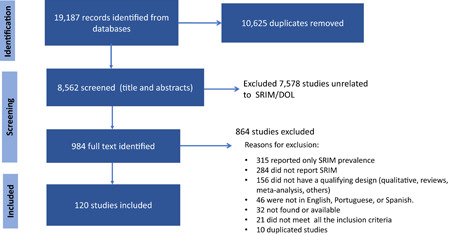
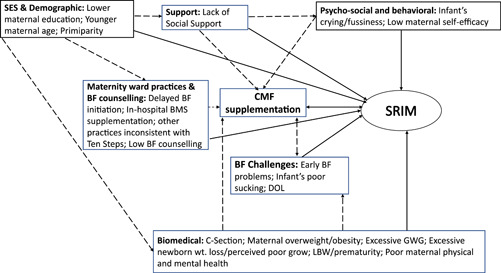
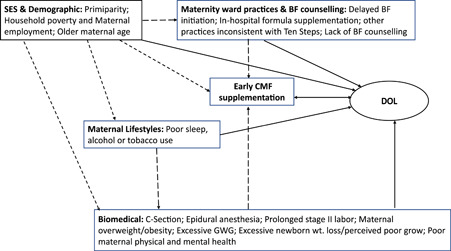
The objective of this systematic review was to identify multifactorial risk factors for self-reported insufficient milk (SRIM) and delayed onset of lactation (DOL). The review protocol was registered a priori in PROSPERO (ID# CDR42021240413). Of the 120 studies included (98 on SRIM, 18 on DOL, and 4 both), 37 (31%) studies were conducted in North America, followed by 26 (21.6%) in Europe, 25 (21%) in East Asia, and Pacific, 15 (12.5%) in Latin America and the Caribbean, 7 (6%) in the Middle East and North Africa, 5 (4%) in South Asia, 3 (2.5%) in Sub-Saharan Africa, and 2 (1.7%) included multiple countries. A total of 79 studies were from high-income countries, 30 from upper-middle-income, 10 from low-middle-income countries, and one study was conducted in a high-income and an upper-middle-income country. Findings indicated that DOL increased the risk of SRIM. Protective factors identified for DOL and SRIM were hospital practices, such as timely breastfeeding (BF) initiation, avoiding in-hospital commercial milk formula supplementation, and BF counselling/support. By contrast, maternal overweight/obesity, caesarean section, and poor maternal physical and mental health were risk factors for DOL and SRIM. SRIM was associated with primiparity, the mother's interpretation of the baby's fussiness or crying, and low maternal BF self-efficacy. Biomedical factors including epidural anaesthesia and prolonged stage II labour were associated with DOL. Thus, to protect against SRIM and DOL it is key to prevent unnecessary caesarean sections, implement the Baby-Friendly Ten Steps at maternity facilities, and provide BF counselling that includes baby behaviours.
Keywords: breastfeeding; cesarean section; delayed onset of lactation; health care system; insufficient milk; maternal obesity; risk factors; systematic review.
© 2022 The Authors. Maternal & Child Nutrition published by John Wiley & Sons Ltd.
Conflict of interest statement
The authors declare no conflicts of interest.
Figures
References
-
- Amine, E. K. , Al‐Awadi, F. , & Rabie, M. (1989). Infant feeding pattern and weaning practices in Kuwait. Journal of the Royal Society of Health, 109(5), 178–180. - PubMed
-
- Amir, L. H. , & Cwikel, J. (2005). Why do women stop breastfeeding? A closer look at ‘not enough milk’ among Israeli women in the Negev Region. Breastfeeding Review: Professional Publication of the Nursing Mothers' Association of Australia, 13(3), 7–13. - PubMed
-
- Andrade Barcia, A. , & Valle Carrera, E. (1981). Breast feeding: Causes for its discontinuation in 2 cities in Ecuador. Boletin de la Oficina Sanitaria Panamericana. Pan American Sanitary Bureau, 91(5), 408–417. - PubMed
-
- Bartick, M. C. , Schwarz, E. B. , Green, B. D. , Jegier, B. J. , Reinhold, A. G. , Colaizy, T. T. , & Stuebe, A. M. (2017). Suboptimal breastfeeding in the United States: Maternal and pediatric health outcomes and costs. Maternal & Child Nutrition, 13(1), e12366. 10.1111/mcn.12366 - DOI - PMC - PubMed
Publication types
MeSH terms
LinkOut - more resources
Full Text Sources
Medical
Miscellaneous
