


Central executive training for ADHD: Effects on academic achievement, productivity, and success in the classroom
- PMID: 35343732
- PMCID: PMC9035079
- DOI: 10.1037/neu0000798
Central executive training for ADHD: Effects on academic achievement, productivity, and success in the classroom
Abstract
Objective: Central executive training (CET) is a "Level 2" evidence-based treatment for improving ADHD-related executive dysfunction and behavioral symptoms, but the extent to which these gains extend to the disorder's well-documented academic difficulties is unknown.
Method: Across two clinical trials, 108 children with attention-deficit/hyperactivity disorder (ADHD) 8-13 years old (M = 10.29, SD = 1.50; 32 girls; 75% White/Non-Hispanic) were treated with CET (n = 52), inhibitory control training (ICT; n = 29), or gold-standard behavioral parent training (BPT; n = 27).
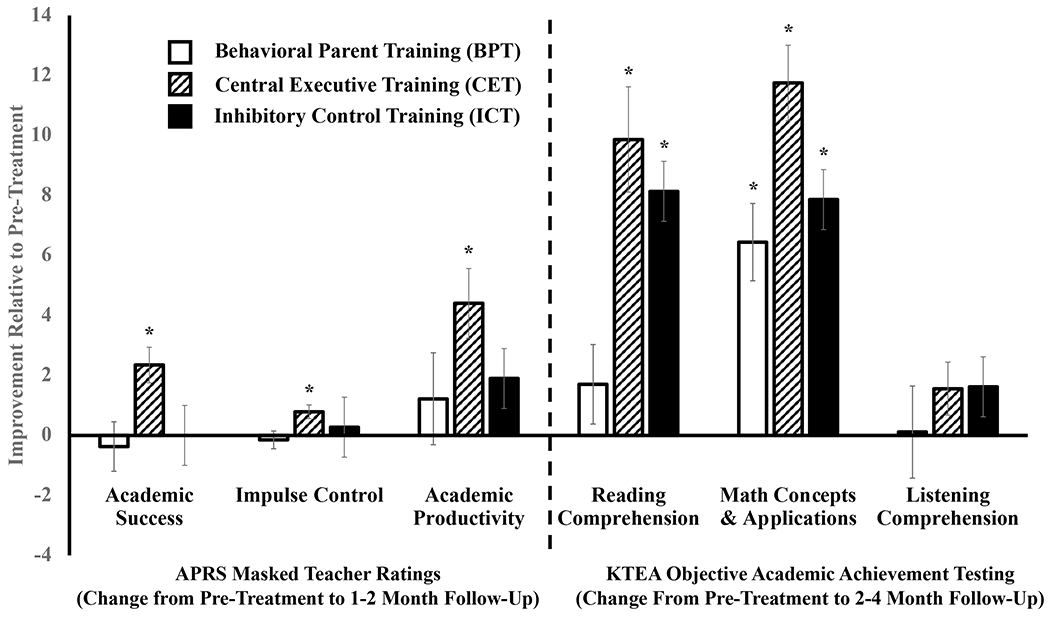
Results: CET was superior to BPT and ICT (d = 0.62-0.88) for improving masked teacher perceptions of academic success, impulse control, and academic productivity at 1-2 months posttreatment. At 2-4-month follow-up, CET (d = 0.76) and ICT (d = 0.54) were superior to BPT for improving objectively-tested academic achievement overall (reading comprehension, math problem-solving, language comprehension), and CET was superior to ICT (d = 0.56) for improving math problem-solving. The significant benefits of CET on academic success, academic productivity, reading comprehension, and math problem-solving replicated across both trials and were clinically significant as evidenced by low number needed to treat estimates (Needed to Treat; NNT = 3-7) and significantly higher proportions of individual cases demonstrating reliable improvements in academic success/productivity (33%-36% vs. 0%-18%) and achievement (38%-72% vs. 18%-54%) across outcomes (all p ≤ .01).
Conclusions: Results across the two trials provide strong support for the efficacy of CET for ADHD, and are consistent with model-driven hypotheses that academic difficulties in ADHD are due, in part, to these children's underdeveloped executive functioning abilities. (PsycInfo Database Record (c) 2022 APA, all rights reserved).
Conflict of interest statement
Conflict of Interest:
Michael J. Kofler/Florida State University was recently awarded U.S. Patent 11,210,967 for the neurocognitive interventions described in the present study. There are no current licensing, financial, or other conflicts to report.
Figures
References
-
- Achenbach TM (1991). Manual for the Teacher’s Report Form and 1991 profile. U. Vermont.
-
- Alderson RM, Rapport MD, & Kofler MJ (2007). ADHD and behavioral inhibition: a meta-analytic review of the stop-signal paradigm. Journal of Abnormal Child Psychology,35, 745–758. - PubMed
-
- Allan NP, Hume LE, Allan DM, Farrington AL, & Lonigan CJ (2014). Relations between inhibitory control and the development of academic skills in preschool and kindergarten: A meta-analysis. Developmental Psychology,50, 2368. - PubMed
