


Fatigability and the Role of Neuromuscular Impairments in Chronic Kidney Disease
- PMID: 35344954
- PMCID: PMC9871956
- DOI: 10.1159/000523714
Fatigability and the Role of Neuromuscular Impairments in Chronic Kidney Disease
Abstract
Background: The combination of neuromuscular impairments plus psychosocial aspects of chronic kidney disease (CKD) may predispose these patients to greater risk for experiencing increased levels of fatigability. There has been extensive clinical and scientific interest in the problem of fatigue in CKD and end-stage kidney disease (ESKD) patients, whereas less attention has been directed to understanding fatigability. Accordingly, the primary purposes of this review are to (1) discuss fatigue and fatigability and their potential interactions in patients with CKD and ESKD, (2) provide evidence for increased fatigability in CKD and ESKD patients, (3) examine how commonly experienced neuromuscular impairments in CKD and ESKD patients may contribute to the severity of performance fatigability, and (4) highlight preliminary evidence on the effects of exercise as a potential clinical treatment for targeting fatigability in this population.
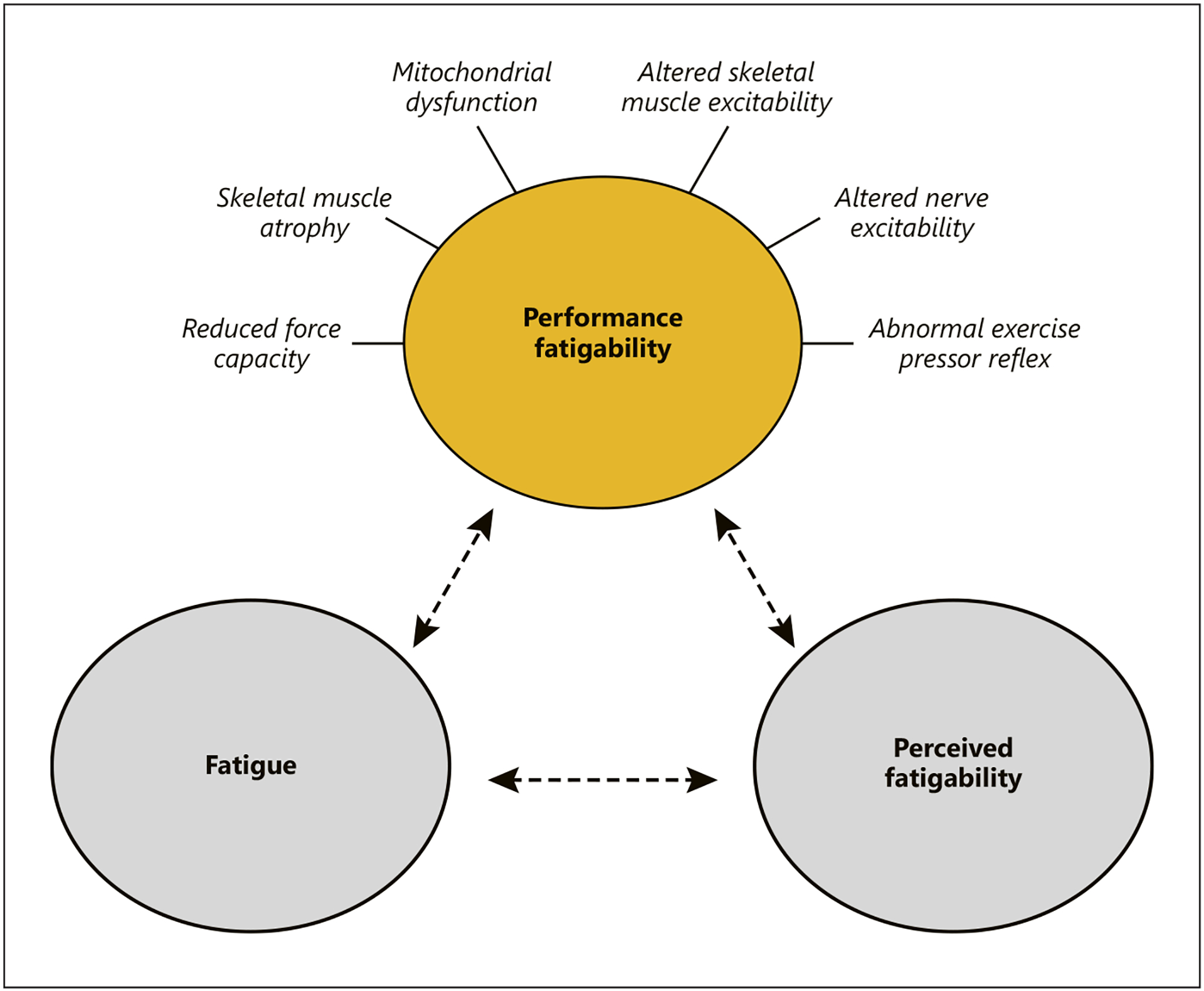
Summary: Fatigue is broadly defined as a multidimensional construct encompassing a subjective lack of physical and/or mental energy that is perceived by the individual to interfere with usual or desired activities. In contrast, fatigability is conceptualized within the context of physical activity and is quantified as the interactions between reductions in objective measures of performance (i.e., performance fatigability) and perceptual adjustments regulating activity performance (i.e., perceived fatigability). We propose herein a conceptual model to extend current understandings of fatigability by considering the interactions among fatigue, perceived fatigability, and performance fatigability. Neuromuscular impairments reported in patients with CKD and ESKD, including reductions in force capacity, skeletal muscle atrophy, mitochondrial dysfunction, abnormal skeletal muscle excitability, and neurological complications, may each contribute to the greater performance fatigability observed in these patients.
Key messages: Considering the interactions among fatigue, perceived fatigability, and performance fatigability provides a novel conceptual framework to advance the understanding of fatigability in CKD and ESKD patients. Measures of fatigability may provide valuable clinical insights into the overall health status of CKD and ESKD patients. Existing data suggest that CKD and ESKD patients are at greater risk of experiencing increased fatigability, partly due to neuromuscular impairments associated with reduced kidney function. Further investigations are warranted to determine the potential clinical role fatigability measures can play in monitoring the health of CKD and ESKD patients, and in identifying potential treatments targeting fatigability in this patient population.
Keywords: Depression; Fatigability weakness; Fatigue; Functional impairment; Renal failure.
© 2022 S. Karger AG, Basel.
Conflict of interest statement
Conflict of Interest Statement
The authors have no conflicts of interest to declare.
Figures
References
-
- Webster AC, Nagler EV, Morton RL, Masson P. Chronic kidney disease. Lancet. 2017. Mar; 389(10075):1238–52. - PubMed
-
- Bossola M, Tazza L. Postdialysis fatigue: a frequent and debilitating symptom. Semin Dial. 2016. May;29(3):222–7. - PubMed
-
- Almutary H, Bonner A, Douglas C. Symptom burden in chronic kidney disease: a review of recent literature. J Ren Care. 2013. Sep;39(3): 140–50. - PubMed
-
- Murtagh FEM, Addington-Hall J, Higginson IJ. The prevalence of symptoms in end-stage renal disease: a systematic review. Adv Chronic Kidney Dis. 2007. Jan;14(1):82–99. - PubMed
Publication types
MeSH terms
Grants and funding
LinkOut - more resources
Full Text Sources
Medical
