


Integrated phylogenomics and fossil data illuminate the evolution of beetles
- PMID: 35345430
- PMCID: PMC8941382
- DOI: 10.1098/rsos.211771
Integrated phylogenomics and fossil data illuminate the evolution of beetles
Abstract
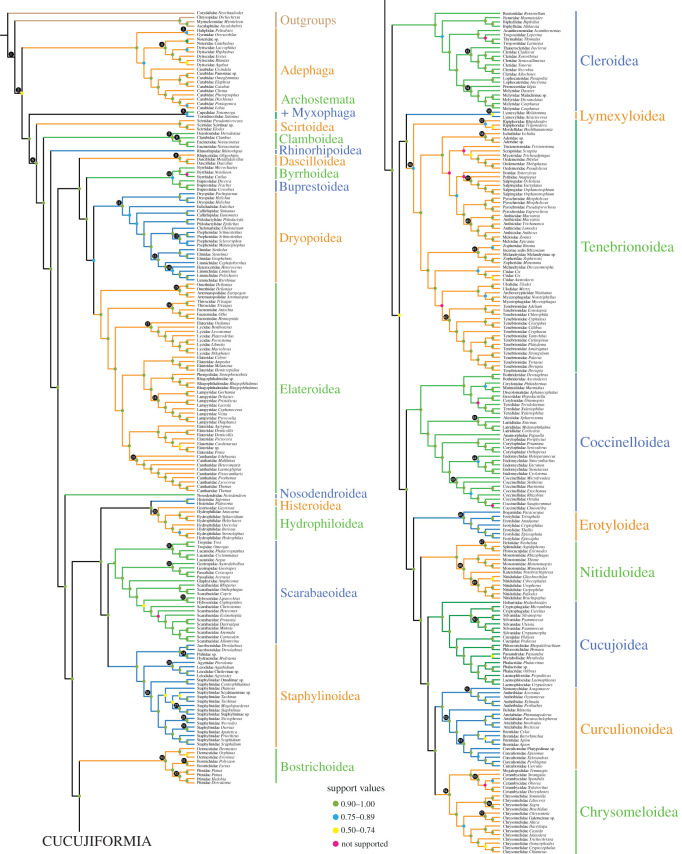
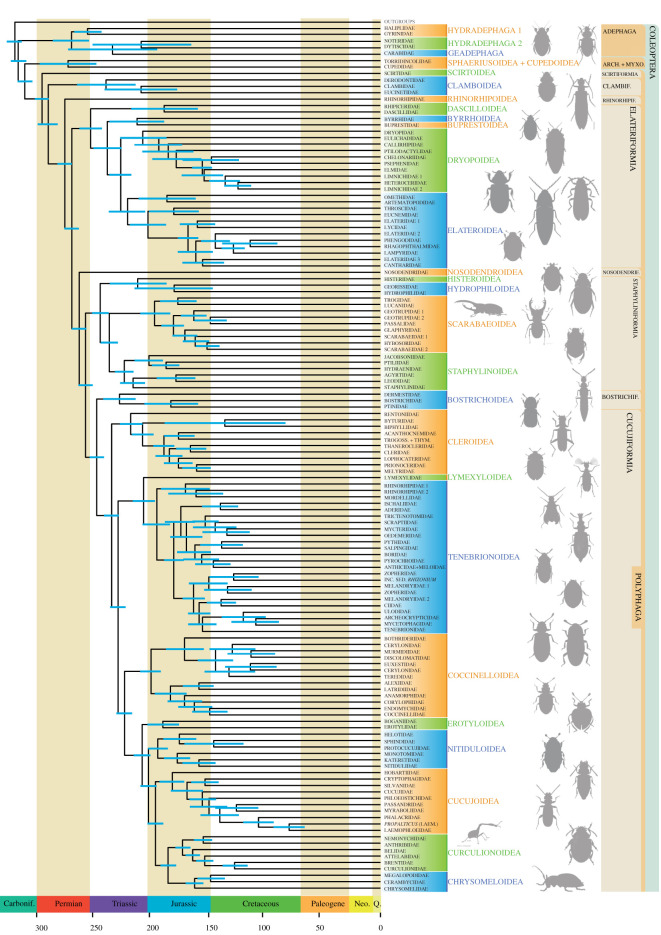
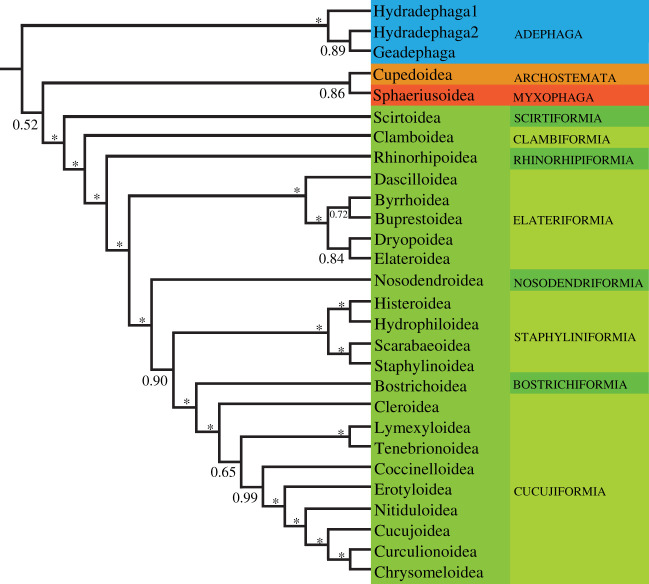
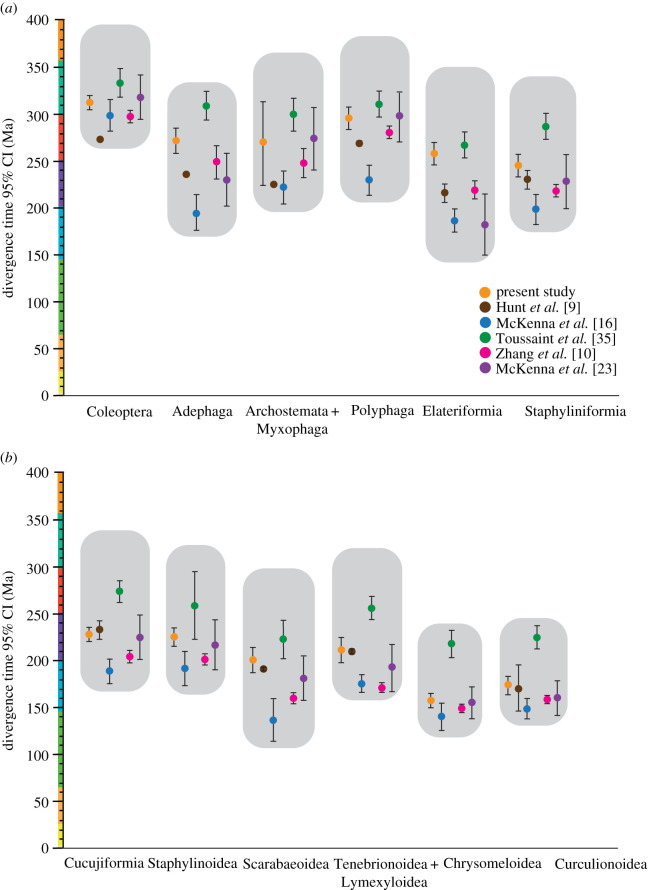
Beetles constitute the most biodiverse animal order with over 380 000 described species and possibly several million more yet unnamed. Recent phylogenomic studies have arrived at considerably incongruent topologies and widely varying estimates of divergence dates for major beetle clades. Here, we use a dataset of 68 single-copy nuclear protein-coding (NPC) genes sampling 129 out of the 193 recognized extant families as well as the first comprehensive set of fully justified fossil calibrations to recover a refined timescale of beetle evolution. Using phylogenetic methods that counter the effects of compositional and rate heterogeneity, we recover a topology congruent with morphological studies, which we use, combined with other recent phylogenomic studies, to propose several formal changes in the classification of Coleoptera: Scirtiformia and Scirtoidea sensu nov., Clambiformia ser. nov. and Clamboidea sensu nov., Rhinorhipiformia ser. nov., Byrrhoidea sensu nov., Dryopoidea stat. res., Nosodendriformia ser. nov. and Staphyliniformia sensu nov., and Erotyloidea stat. nov., Nitiduloidea stat. nov. and Cucujoidea sensu nov., alongside changes below the superfamily level. Our divergence time analyses recovered a late Carboniferous origin of Coleoptera, a late Palaeozoic origin of all modern beetle suborders and a Triassic-Jurassic origin of most extant families, while fundamental divergences within beetle phylogeny did not coincide with the hypothesis of a Cretaceous Terrestrial Revolution.
Keywords: CAT-GTR; Coleoptera; classification; diversification; phylogenomics; substitution modelling.
© 2022 The Authors.
Conflict of interest statement
We declare we have no competing interests.
Figures
References
-
- Erwin TL. 1982. Tropical forests: their richness in Coleoptera and other arthropod species. Coleopt. Bull. 36, 74-75.
-
- Beutel RG, Yan EV, Kukalová-Peck J. 2019. Is †Skleroptera (†Stephanastus) an order in the stemgroup of Coleopterida (Insecta)? Insect Syst. Evol. 50, 670-678. (10.1163/1876312X-00002187) - DOI
-
- Kirejtshuk AG, Poschmann M, Prokop J, Garrouste R, Nel A. 2014. Evolution of the elytral venation and structural adaptations in the oldest Palaeozoic beetles (Insecta: Coleoptera: Tshekardocoleidae). J. Syst. Palaeontol. 12, 575-600. (10.1080/14772019.2013.821530) - DOI
Associated data
Grants and funding
LinkOut - more resources
Full Text Sources
Miscellaneous