


Patient-Reported Quality of Life Before and After Total Knee Arthroplasty: A Multicenter Observational Study
- PMID: 35345540
- PMCID: PMC8957337
- DOI: 10.2147/PPA.S357632
Patient-Reported Quality of Life Before and After Total Knee Arthroplasty: A Multicenter Observational Study
Abstract
Purpose: To compare patients' self-reported health-related quality of life (HRQoL) before and after total knee arthroplasty (TKA) and determine factors contributing to any heterogeneity in HRQoL.
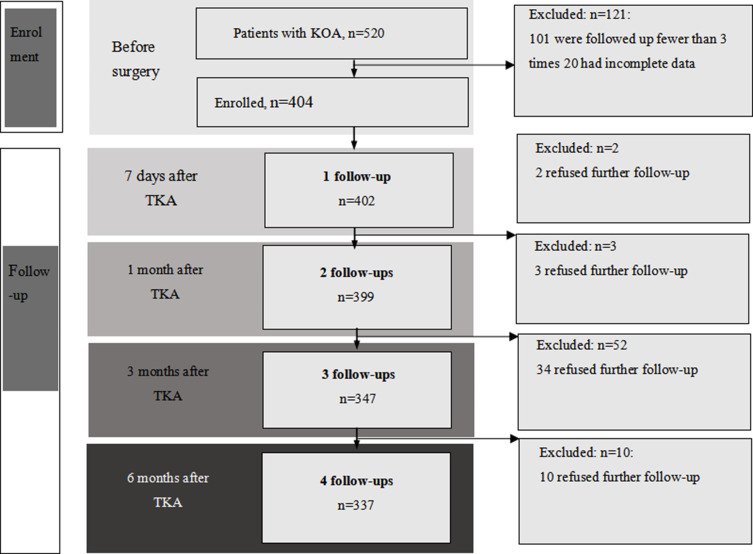
Patients and methods: This prospective multicenter observational study included 404 patients with knee osteoarthritis who underwent TKA between April 1, 2019 and December 30, 2019 and whose HRQoL was assessed preoperatively and 7 days and 1, 3, and 6 months postoperatively. Sociodemographic characteristics were assessed using a General Information Questionnaire, disability using the Knee Injury and Osteoarthritis Outcome Score (KOOS-PS), resting pain using the visual analogue scale (Pain-VAS), and HRQoL using the European Quality of Life Five Dimension Five Level (EQ-5D-5L) scale. The growth mixture model was used to identify group heterogeneity in the developmental trajectories of KOOS-PS, Pain-VAS, and EQ5D5L. Logistic regression was used to explore the factors influencing the developmental trajectories of factors affecting the developmental trajectory of HRQoL.
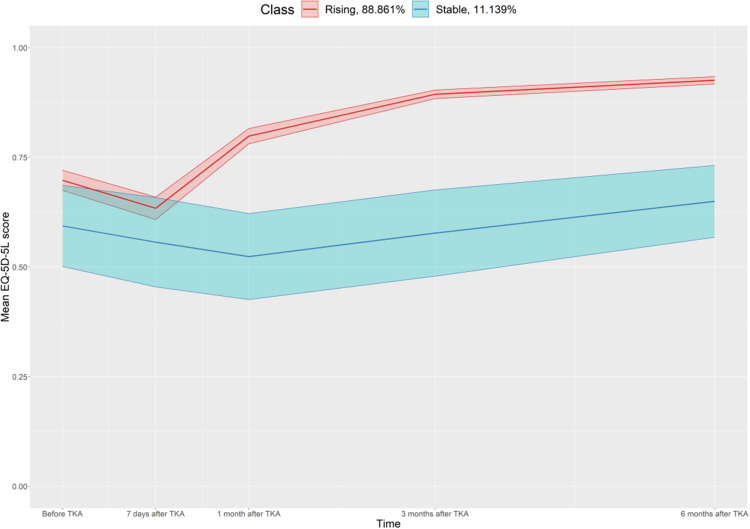
Results: The mean EQ-5D-5L score improved from 0.69 preoperatively to 0.90 at 6 months postoperatively. Longitudinal heterogeneity in HRQoL was observed in patients during recovery: 1) patients with a small and slow improvement in HRQoL and 2) patients who showed marked and rapid improvement in HRQoL. The main characteristics of the latter group were decreasing VAS pain scores, a monthly family income >2000 CNY (100 CNY equals approximately 14.9 USD), exercising for <30 min daily, and better knee function at baseline. Baseline knee function and change in knee function were significantly associated with the percentage change in HRQoL.
Conclusion: HRQoL improved considerably after TKA. However, there was heterogeneity in the changes in HRQoL depending on patients' socioeconomic status, exercise, and baseline knee function. Dynamic tracking of the HRQoL of TKA patients and timely provision of rehabilitation guidance will promote continuous improvement of the HRQoL of TKA patients.
Keywords: knee function; knee osteoarthritis; knee replacement.
© 2022 Chang et al.
Conflict of interest statement
The authors declare that they have no competing interests in this work.
Figures
References
-
- Prieto-Alhambra D, Judge A, Javaid MK, Cooper C, Diez-Perez A, Arden NK. Incidence and risk factors for clinically diagnosed knee, hip and hand osteoarthritis: influences of age, gender and osteoarthritis affecting other joints. Ann Rheum Dis. 2014;73(9):1659–1664. doi: 10.1136/annrheumdis-2013-203355 - DOI - PMC - PubMed
-
- Roberts NL, Mountjoy-Venning WC, Anjomshoa M, Banoub JA, Yasin YJ. GBD 2017 disease and injury incidence and prevalence collaborators. global, regional, and national incidence, prevalence, and years lived with disability for 354 diseases and injuries for 195 countries and territories, 1990-2017: a systematic analysis for the Global Burden of Disease Study 2017. Lancet. 2018;392:1789–1858. doi: 10.1016/S0140-6736(18)32279-7 - DOI - PMC - PubMed
-
- Xiao-jia T, Ru-geng Z, Meng Z, et al. [Prevalence of knee osteoarthritis in the middle-aged and elderly in China: a meta-analysis]. Zhongguo Zuzhi Gongcheng Yanjiu. 2018;22:650. Chinese.
LinkOut - more resources
Full Text Sources
Miscellaneous
