


Trust in Healthcare during COVID-19 in Europe: vulnerable groups trust the least
- PMID: 35345647
- PMCID: PMC8944407
- DOI: 10.1007/s10389-022-01705-3
Trust in Healthcare during COVID-19 in Europe: vulnerable groups trust the least
Abstract
Aim: We examined predictors of trust in the healthcare system during the COVID-19 pandemic in 27 European countries.
Subjects and methods: We used population-based data drawn from the Living, working and COVID-19 survey (N = 21,884, 52% female, ages 18 to 92 years) covering 27 European countries dated June and July 2020. Multilevel linear regression, linear regression, and regression-tree analyses were conducted.
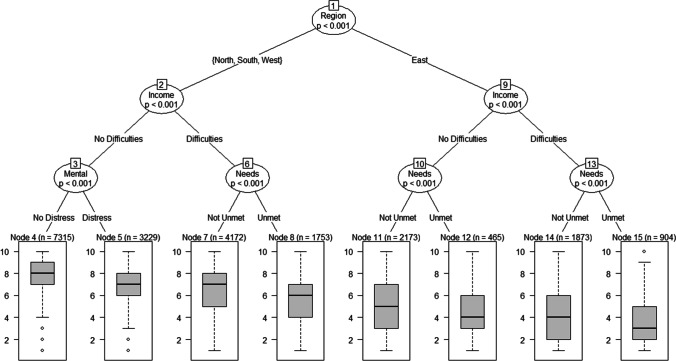
Results: We found that most participants tended to trust the healthcare system, although a substantial part could still be classified as distrusting (approx. 21%). Multiple variables, including being middle-aged or of older age, being female, lower levels of education, unemployment, worse general health status, having income difficulties, having unmet needs for healthcare, no healthcare contact during the COVID-19 pandemic, higher mental distress, and loneliness, were significantly associated with lower levels of trust. Among these variables mental distress, income difficulties, and unmet needs for healthcare emerged as especially important and, across European regions and countries, consistent predictors for lower trust in the healthcare system during the COVID-19 pandemic.
Conclusions: Medically vulnerable subgroups, such as individuals with unmet healthcare needs, higher levels of mental distress, and older age, as well as people living in socially and economically vulnerable situations, such as higher levels of loneliness and financial difficulties, were the least trusting of the healthcare system during the COVID-19 pandemic. As these vulnerable subgroups are also at highest risk for contracting COVID-19 and experiencing negative COVID-19-related outcomes, more targeted prevention and intervention efforts should be implemented in these groups.
Supplementary information: The online version contains supplementary material available at 10.1007/s10389-022-01705-3.
Keywords: COVID-19; Healthcare; Pandemic; Trust; Unmet needs; Vulnerable groups.
© The Author(s) 2022.
Conflict of interest statement
Conflicts of interestThe authors declare that they have no conflict of interest.
Figures
References
-
- Balog-Way DHP, McComas KA. COVID-19: reflections on trust, tradeoffs, and preparedness. J Risk Research. 2020;23:838–848. doi: 10.1080/13669877.2020.1758192. - DOI
-
- Beller J, Wagner A (2020) Loneliness and health: the moderating effect of cross-cultural individualism/collectivism. J Aging Health 089826432094333. 10.1177/0898264320943336 - PubMed
LinkOut - more resources
Full Text Sources